
Space Exploration – Predicting Launch Environment Acoustics for Next-Generation Rockets
The new heavy-lift Space Launch System (SLS) that NASA is developing for deep space exploration will produce unprecedented thrust levels and pressures as the plumes from its powerful boosters and engines blast into the launch pad's flame trench. To ensure that the acoustic pressure waves generated during liftoff will not compromise the rocket, NASA engineers are running tests and analyses to predict the acoustic launch environment and assess the effectiveness of the launch platform's water sound suppression system for the new configuration. Advanced computational fluid dynamics (CFD) simulations of the Scale Model Acoustic Test (SMAT)—a 5 percent scale experimental model of the SLS and launch platform—are greatly improving these critical launch acoustic predictions. CFD simulations performed on NASA's Pleiades supercomputer model the complex, 3D plume flow physics within the SMAT, enabling more accurate interpretation of the test data and greater insight into key factors affecting acoustic pressures.
Our high-fidelity simulations of plume flow physics within the SMAT have both enabled better understanding of the test data and helped to validate modeling approaches for future analysis of full-scale SLS launch environments.
Tanner Nielsen, computational fluid dynamicist at NASA Marshall Space Flight Center's Fluid Dynamics Branch
Quick Facts
- Accurate analysis of the complex SMAT geometry and intense rocket plume flows required high-resolution computational models with approximately 250 million grid cells, and used 2,000 parallel processors on NASA's Pleiades supercomputer.
- NASA's Pleiades supercomputer enabled these intensive, large-scale simulations to be turned around rapidly enough to provide valuable feedback to SMAT engineers during the testing period.
- Use of a segregated computational domain allowed ignition overpressure and duct overpressure waves to be isolated, resulting in a more accurate interpretation of the SMAT test data.
- CFD studies provided key data on ignition timing effects—revealing how small offsets between the ignition times of the two boosters can affect overpressure conditions in the launch environment—without requiring additional costly tests.
- The SLS will be the most powerful rocket ever built, providing 10 – 20 percent more thrust at launch than the Saturn V rocket and carrying more than three times the payload of the space shuttle.
Key Image
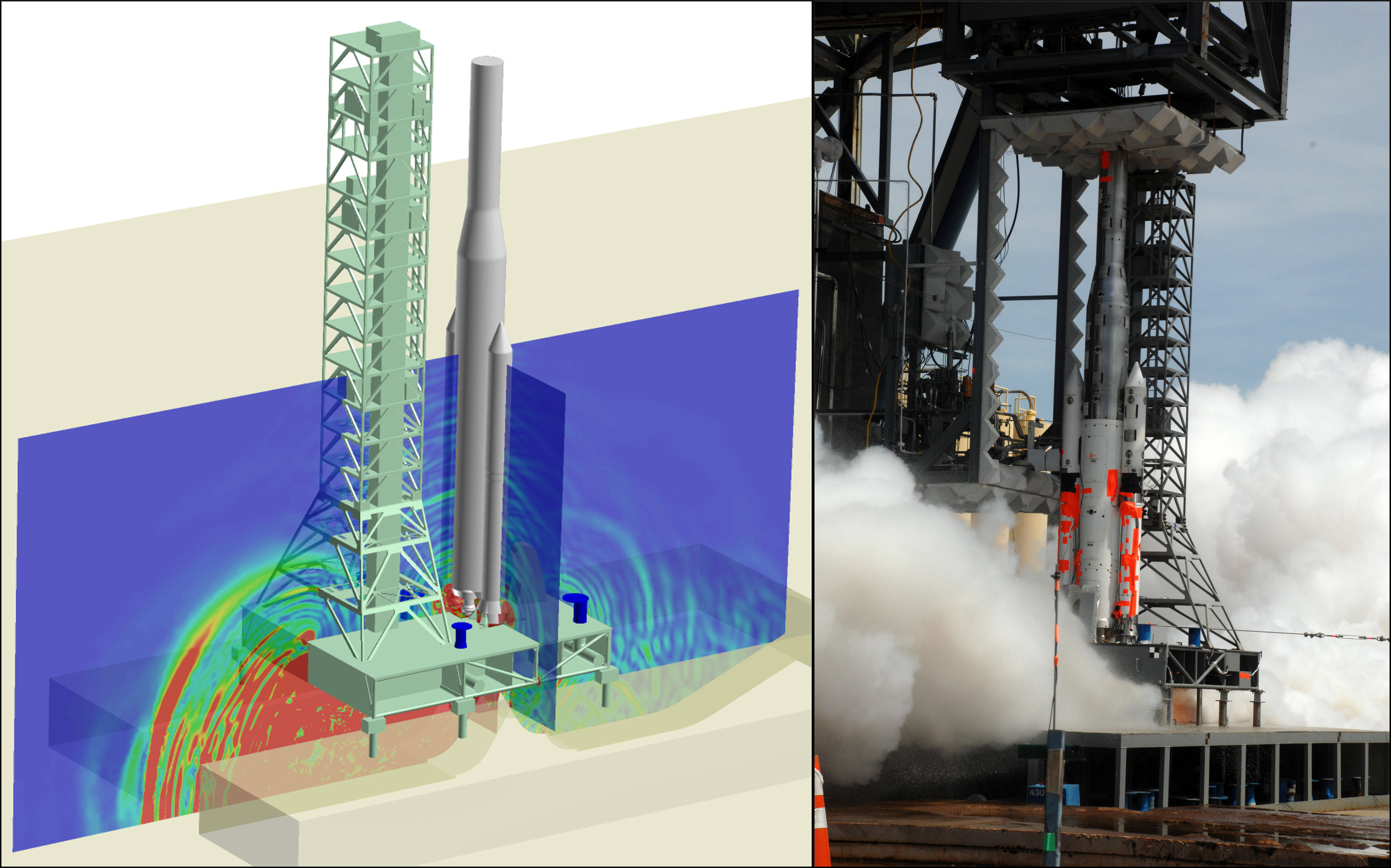
Image Caption
The Space Launch System (SLS) Scale Model Acoustic Test (SMAT) is shown (right) next to a computational fluid dynamics (CFD) simulation of the model (left). The CFD image shows contours of the pressure gradient magnitudes, which accent the overpressure waves surrounding the vehicle during the early stages of a launch simulation. Tanner Nielsen, NASA/MarshallDownload High-Res Image (9.6 MB)
More Media
See additional videos related to this demo in our media gallery.
Contacts
Tanner Nielsen, NASA Marshall Space Flight Centertanner.b.nielsen-1@nasa.gov