Press Room
Wherever you are around the world, people are inspired by NASA! Launch your news items, blog posts, interviews, and features using facts from our HPC announcements, data sheets, and the research projects featured in the NASA@SC20 virtual exhibit. Get in touch with our press contacts during the conference to schedule interviews and request high-resolution videos.
Press Releases and Announcements
- November 19, 2020
-
Simulating NASA's Rocket Launch for Artemis Moon Missions
The Launch Ascent and Vehicle Aerodynamics (LAVA) team at NASA’s Ames Research Center runs high-fidelity, multiphase launch environment simulations to better understand the ignition overpressure and acoustic pressure waves that occur during launch and how they affect the Space Launch System rocket and Orion spacecraft, to help ensure when launch day arrives, everything goes smoothly.
Read more… - November 19, 2020
-
Tree Census from Space: Quantifying Woody Biomass Using Machine Learning
Combining 50-centimeter scale satellite data with computing resources from the NASA Center for Climate Simulation and National Center for Supercomputing Applications, NASA Goddard Space Flight Center’s Compton Tucker and collaborators mapped a surprising 1.8 billion trees across West Africa and determined the area of leaves within the tree crowns, which the researchers will combine with tree height calculations to accurately predict carbon in the wood of trees over vast semi-arid regions.
Read more… - November 18, 2020
-
NASA Simulations Validate Orion Safety Models for Artemis Astronauts
As part of the Artemis program, NASA’s Orion spacecraft will carry the first woman and next man to lunar orbit before they land on the Moon in 2024. An integral part of ensuring safe spaceflight is Orion’s Launch Abort System (LAS). To better understand the effects of strong vibrations generated by the abort motor’s high-speed exhaust plumes, a team at Ames produced high-fidelity simulations using NASA’s Electra supercomputer.
Read more… - November 17, 2020
-
NASA Model Reveals How Much COVID-related Pollution Levels Deviated from the Norm
Using computer models to generate a COVID-free 2020 for comparison, NASA researchers found that since February, pandemic restrictions have reduced global nitrogen dioxide concentrations by nearly 20%. The model simulation and machine learning analysis took place at the NASA Center for Climate Simulation. Read more…
- November 17, 2020
-
NASA Supercomputers Visualize Quieter Supersonic Flight
NASA’s X-59 Quiet SuperSonic Technology X-plane is designed to fly faster than the speed of sound without producing sonic booms. Researchers at the NASA Advanced Supercomputing (NAS) facility, in collaboration with Lockheed Martin, created a database of computational fluid dynamics simulations to verify the aircraft’s supersonic performance. The X-59 simulations are performed on the NAS facility’s Pleiades supercomputer.
Read more… - November 17, 2020
-
NASA Triples the Power of its Aitken Modular Supercomputer
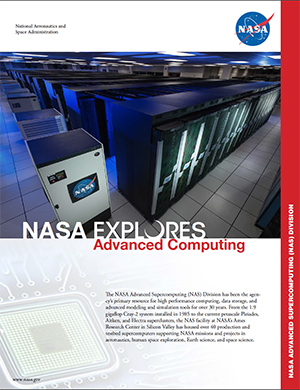
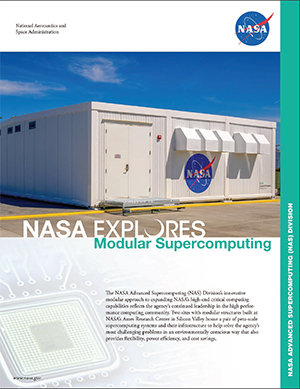
The NASA Advanced Supercomputing (NAS) facility recently expanded its petascale Aitken supercomputer— more than tripling the system’s production capability to help solve NASA’s most challenging science and engineering problems. Read more…
- November 17, 2020
-
UK Researchers Dial in to the Sound of Mars
Researchers from the UK have used NASA data to create new mobile phone ringtones that are quite literally out of this world. Dr. Domenico Vicinanza, of Anglia Ruskin University, and Dr. Genevieve Williams, of the University of Exeter, carried out the project to celebrate NASA’s Pleiades supercomputer and its role in the successful Mars InSight mission. Read more…
- November 16, 2020
-
NASA Research Exhibit to Highlight Science and Engineering Advances at the Virtual SC20 Supercomputing Conference
From assessing COVID-19’s global impacts to helping NASA return humans to the Moon to searching the cosmos for new exoplanets, researchers from across NASA, with university and industry partners, will highlight their latest advances, enabled by the agency’s supercomputers, in the NASA research exhibit at SC20—the International Conference for High Performance Computing, Networking, Storage and Analysis. Read more…
- November 4, 2020
-
Captivating Images from a Year of NCCS Science Success Stories!
NASA scientists and engineers are benefitting from the high-performance computing, artificial intelligence/machine learning, and big data resources at the NASA Center for Climate Simulation (NCCS). Read more…
- October 15, 2020
-
Exploration and Scientific Discovery at NASA
William Thigpen, assistant division chief of HPC operations for the NASA Advanced Supercomputing (NAS) Division at NASA’s Ames Research Center in Silicon Valley, CA, discusses the NAS facility’s role in providing HPC, storage, and associated services to meet the changing needs of scientists and engineers supporting agency missions to employ large-scale modelling, simulation, and analysis—all while reducing power consumption and cooling costs. Read more…