Press Room
Wherever you are around the world, people are inspired by NASA! Launch your news items, blog posts, interviews, and features using facts from our HPC announcements, data sheets, and the research projects featured in the NASA@SC21 virtual exhibit. Get in touch with our press contacts during the conference to schedule interviews and request high-resolution videos.
Press Releases and Announcements
- November 22, 2021
-
New Deep Learning Method Adds 301 Planets to Kepler’s Total Count
As part of the Artemis missions, NASA’s Orion spacecraft will carry the first woman and first person of color to the Moon and return them safely back to Earth. NAS Division researchers are using their LAVA software to simulate Orion’s launch abort system, to predict how different abort scenarios will affect vibrations generated by exhaust plume pressure waves. Read more about the ExoMiner deep neural network run on the Pleiades supercomputer.
- November 22, 2021
-
NASA Supercomputers Predict How Vibrations Vary With Altitude for Orion Abort Scenarios
As part of the Artemis missions, NASA’s Orion spacecraft will carry the first woman and first person of color to the Moon and return them safely back to Earth. NAS Division researchers are using their LAVA software to simulate Orion’s launch abort system, to predict how different abort scenarios will affect vibrations generated by exhaust plume pressure waves. Read more about LAVA simulations to keep astronauts safe.
- November 18, 2021
-
NASA’s Newest Supercomputer Gets a Power Boost
NASA’s Aitken supercomputer is being expanded with 512 new nodes that will be available to scientists and engineers across the country on Nov. 19. The boost brings the system’s theoretical peak performance to 10.76 petaflops—a 28% increase in performance, which translates to solving larger problems with faster results for important NASA research projects in aeronautics, human and robotic space missions, Earth science, and astrophysics. Get more details on the Aitken supercomputer power boost.
- November 17, 2021
-
Supercomputing Reveals "Fossil Record" of Galaxy Collisions and Mergers
Using the Pleiades supercomputer at the NASA Advanced Supercomputing (NAS) facility and data from the Hubble Space Telescope, researchers simulated a Milky Way-like galaxy in the early stages of a collision with another smaller galaxy—revealing a detailed “fossil record” of information about the simulated galaxy’s history. Find out more about this galaxy simulation run on NASA's Pleiades supercomputer.
- November 12, 2021
-
6 Things to Know About Supercomputing at NASA
From exploring the solar system and outer space to improving life here on Earth, supercomputing is vital to NASA missions. The agency is showcasing how these powerful machines are enabling science and engineering advances during SC21.
- November 10, 2021
-
TESS Detects Planet in Orbit Around Two Stars
Researchers at the SETI Institute, NASA, and a variety of other institutions detected a planet in a 200-day orbit around two stars – known as a circumbinary planet—from observations of just one NASA Transiting Exoplanet Survey Satellite (TESS) sector over an observation period of 27 days. TESS data analysis took place at the NASA Center for Climate Simulation (NCCS). Find out More about TESS data analysis at NCCS.
- November 8, 2021
-
NASA, Supercomputing, and the Artemis Moon Mission
NASA supercomputers are helping the agency prepare for Artemis, the program that will return humans to the Moon. Learn more in this SC21 TV interview with Jordan Angel, Derek Dalle and Francois Cadieux, research scientists in the NASA Advanced Supercomputing Division at Ames Research Center in California. Watch or listen to the SC21 video interview on Artemis
- November 6, 2021
-
AI, Data are Key to Future of High-Performance Computing
Teams across NASA and the Department of Labor are accelerating artificial intelligence and data capabilities to prepare for high-performance computing and supercharge existing tools and technologies, agency leaders said during GovernmentCIO Media & Research’s AI Gov: National Security virtual event last week. Watch or listen to the SC21 video interview on Artemis
- November 6, 2021
-
NASA Researchers Participate in SC21 Technical Program
If you're attending SC21 at the Technical Program or Workshop level, you can find NASA high-performance computing experts presenting their work throughout the week.
- Workshop: Feasibility of Running Singularity Containers with Hybrid MPI on NASA High-End Computing Resources
- Workshop: HybridQ: A Hybrid Simulator for Quantum Circuits
- Tutorial: Introduction to Quantum Computing
- Workshop: Accelerating Unstructured-Grid CFD Algorithms on NVIDIA and AMD GPUs
- Birds of a Feather: Modular, Flexible and Composable HPC Module, HPCM, from the Open Compute Project
- Workshop: Memory Optimizations for Sparse Linear Algebra on GPU Hardware
Data Sheets
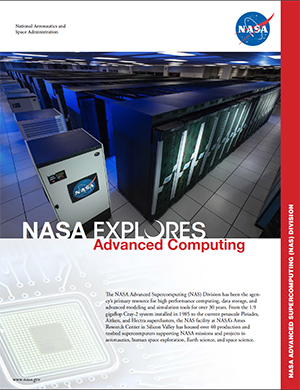
Advanced Computing
NASA Advanced Supercomputing (NAS) Division Overview.
Download Advanced Computing PDF
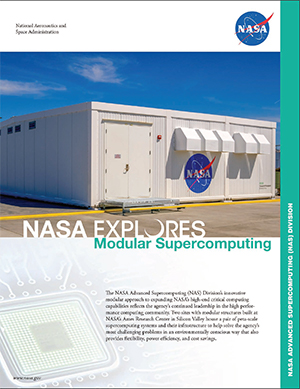
Modular Computing
NASA Advanced Supercomputing (NAS) Division Innovative Modular Supercomputing.
Download Modular Supercomputing PDF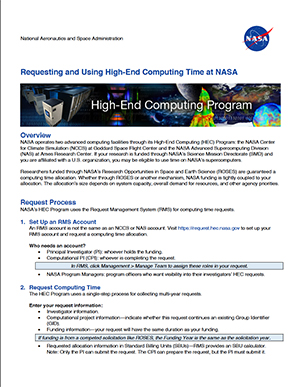
RMS Quick Start Guide
Requesting and Using High-End Computing Time at NASA.
Download RMS Quick Start Guide PDF
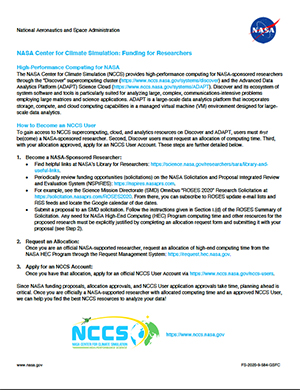
Funding For Researchers
Requesting Funding for NASA Center for Climate Simulation (NCCS) Users
Download Funding For Researchers PDF