Searching for Sister Planets
The discovery that planets orbit the Sun in ellipses, rather than circles, was made by 16th century mathematician and astronomer Johannes Kepler using only the observations of his predecessors and his own unique calculations—without the aid of the yet-to-be invented telescope and long before modern computers were dreamed of.
Today, with the help of one of NASA's largest space telescopes and its most powerful supercomputer, scientists are analyzing observational data gathered from that pioneering astronomer's modern-day namesake—the Kepler Mission spacecraft—to search the skies for Earth's sister planets and make new astronomical discoveries.

Launched in March 2009 with the goal to explore the structure and diversity of planetary systems and search for other life-supporting planets, the Kepler spacecraft continuously monitors over 150,000 stars in the Milky Way constellations of Cygnus and Lyra. Kepler's custom-designed photometer, a highly precise light sensor, will continue recording data from this single group of stars over the entire three-plus years of the mission.
"The Kepler Mission has already transformed our understanding of how planetary systems work," said Todd Klaus, lead software engineer in the Kepler Science Operations Center (SOC) at NASA's Ames Research Center, Mountain View, Calif. NASA's Pleiades supercomputer, operated by the NASA Advanced Supercomputing (NAS) Division at Ames, is an "essential component to make these planet searches possible," Klaus said.
The Kepler team has already found more than 1,235 candidate planets—so called because they have not yet been confirmed as true planets—orbiting 997 stars. Of these, the team has identified 68 candidates that are about the size of Earth, and 54 candidates that are in the habitable zone. Of these 54 potential "sister" planets, five are thought to be near Earth-size. In September of this year, the team discovered the extraordinary existence of a planet orbiting two stars, called a circumbinary planet.
Groundbreaking findings such as these are made possible by a 95-megapixel digital camera residing in the Kepler photometer—the largest digital camera to ever fly in space. Pixels are downloaded once a month and transferred to the SOC, where they are calibrated, combined to form light curves, corrected for systematic errors introduced in the photometer, and then searched for the signatures of transiting planets. When a planet passes (or transits) in front of its host star, it blocks a small fraction of the light from that star that appears as tiny, repeating pulse or beat. "By measuring the frequency of these beats and the amount of light blocked, we can detect the planets and calculate their size and orbital distance," Klaus explained.
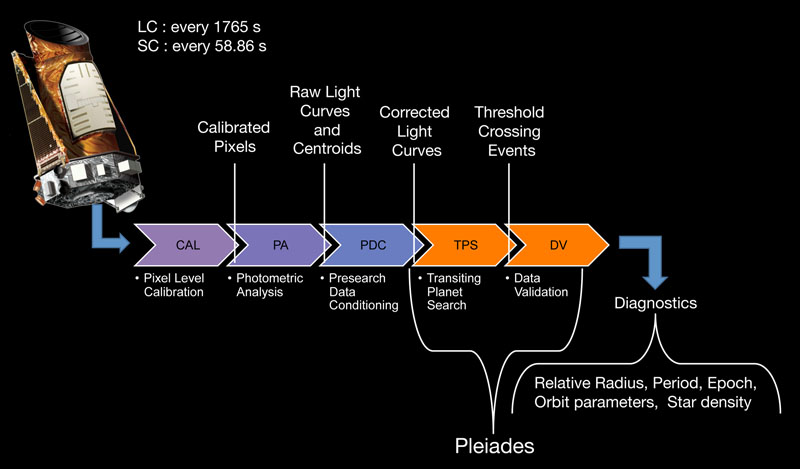
This is where the computational power of the 112,896-core Pleiades supercomputer comes in. After the light curves are corrected, automated copies of the data are transmitted between the Kepler science processing and data analysis pipeline and Pleiades to run the transiting planet search and data validation, which are the most computationally intensive portions of the analyses.
"Pleiades has enabled us to do the computationally intensive planetary transit search on Kepler light curves for more than 200,000 observed stars, in less than a day," said Klaus, noting that the same search would take more than a month to complete on Kepler computers. "Two years into the mission, each of these light curves already contains over 30,000 individual data points, which represent a significant computational challenge for the transit search. Pleiades makes this search possible," added Klaus.
As the mission continues, additional planetary candidates with longer orbital periods will be found. "The availability of Pleiades will become even more important going forward, since the time needed to process the data will increase significantly with the amount of data collected," Klaus said.
Looking ahead, the next challenge for the Kepler team is to find terrestrial planets—those that are one-half to twice the size of Earth and composed mainly of rock. A particularly focus will be on those planets in the habitable zones of their stars, where liquid water and some form of life might possibly exist.
Related SC11 Demo
Contact Information:
Todd C. Klaus
Kepler Science Operations Center, NASA Ames Research Center
todd.klaus@nasa.gov
(650) 604-2576
Joseph D. Twicken
Kepler Science Operations Center, NASA Ames Research Center
joseph.twicken@nasa.gov
(650) 604-0972
More Information:
Amateur Astronomers:
"Kepler's growing list of discoveries is also a boon for amateur astronomers," said Todd Klaus, lead software engineer in the Kepler Science Operations Center at NASA Ames Research Center. "Well-equipped amateurs can now observe transits of Kepler's larger planet and eclipsing binary discoveries from their own backyard." Klaus, who is also an amateur astronomer, has seen exoplanet transits with depths as small as 3% from his own backyard observatory."
