Kepler: NASA's Search for Habitable Earth-Size Planets
Overview
Kepler is NASA's first mission capable of finding Earth-size and smaller planets around other stars. Launched in March 2009, the Kepler spacecraft has been continuously monitoring over 150,000 stars in the constellations of Cygnus and Lyra, watching for the periodic dimming that may indicate the presence of an exoplanet passing in front of a star.

Project Details
Kepler's sole instrument is a specially designed photometer with a 0.95-meter aperture telescope. It has a very large field of view for an astronomical telescope—105 square degrees, which is comparable to the area of your hand held at arm's length. Such a large a field is needed in order to observe the enormous number of stars being monitored.
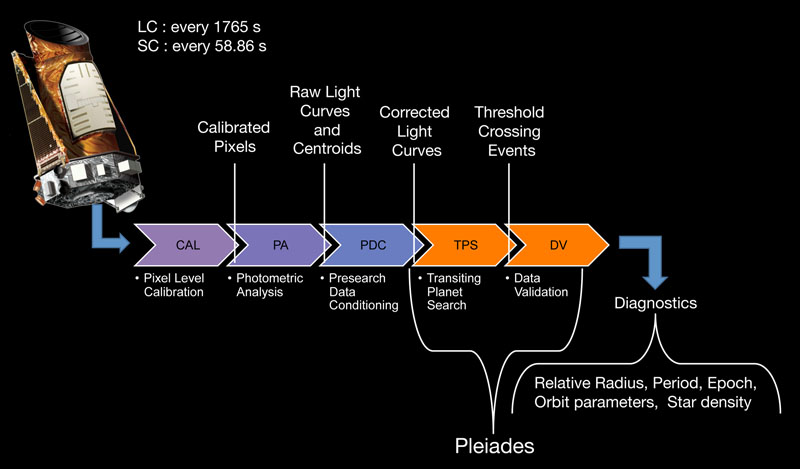
Kepler's photometer contains the largest digital camera to ever fly in space, consisting of 42 charge-coupled devices, with a total of nearly 95 megapixels. Pixels of interest are downlinked once a month and transferred to the Kepler Science Operations Center (SOC) at NASA Ames Research Center. The pixels are then calibrated, combined to form light curves, corrected for systematic errors introduced by the instrument, and then searched for the signatures of transiting planets.
Results and Impact
As of February 2011, the Kepler team has found 1,235 planetary candidates circling 997 host stars—more than twice the number of currently known exoplanets. These results imply that some stars have more than one candidate planet. The Kepler results also included 68 planetary candidates of Earth-like size and 54 candidates in the habitable zone of their stars, leading the science team to estimate that 5.4% of stars host Earth-size planet candidates. As the mission continues, additional candidates with longer orbital periods will be found.
Role of High-End Computing Resources
We have successfully ported the most computationally expensive portions of the Kepler "pipeline" (the transiting planet search and data validation modules) to the Pleiades supercomputer, and have demonstrated near-linear scaling up to 75,000 processors. We have also developed software that automatically copies data between the Kepler SOC and Pleiades so that we can run the less expensive computations at the SOC, while running the most expensive parts on Pleiades, in a manner that is transparent to the operators.
Todd C. Klaus, NASA Ames Research Centertodd.klaus@nasa.gov Joseph D. Twicken, NASA Ames Research Center
joseph.twicken@nasa.gov