The Search Continues: Kepler's Quest for Habitable Earth-Sized Planets
More than three years into its journey to discover Earth-sized planets in the Milky Way galaxy, the Kepler mission continues to captivate both amateur and professional astronomers from around the world.
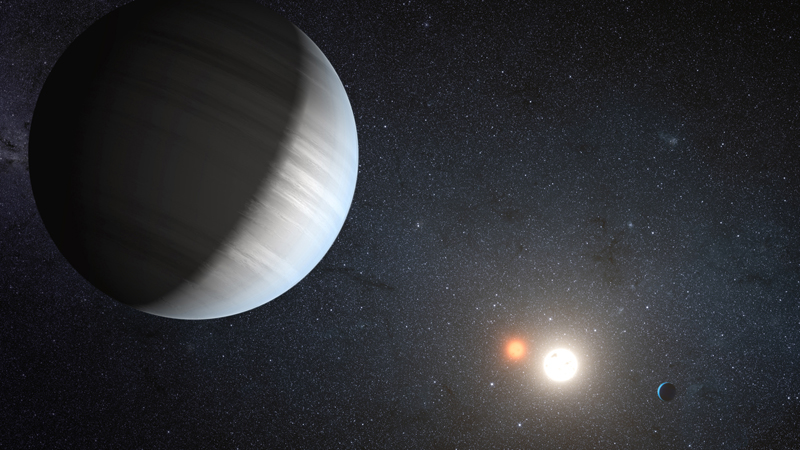
Just last month, on October 16, two volunteer citizen scientists from the Planet Hunters project made an astronomical discovery—a planet, orbiting a double star, that is orbited by a second distant pair of stars. Dubbed PH1, this first confirmed circumbinary planet in a four-star system was found using data gathered by the large, precision telescope aboard NASA's Kepler spacecraft.
More than 100 gigabytes of data are relayed each month from the spacecraft to the Kepler Science Operations Center (SOC) at NASA Ames Research Center in California's Silicon Valley. Some of that data is processed in the SOC, then copied to the space agency's Pleiades supercomputer, located at Ames' NASA Advanced Supercomputing (NAS) facility. Scientists then use Pleiades to crunch the most data-intensive portions of the SOC data processing pipeline—the pre-search data conditioning, transiting planet search, and data validation modules.
"Taking advantage of Pleiades' powerful compute capability allows us to analyze Kepler data in hours or days rather than weeks or months," said Shawn Seader, a scientific programmer who develops software code for the SOC pipeline. "This speed-up enables us to realize the benefits of algorithm improvements much more quickly, and lets us dig out more of the transit signals buried in the data."
In addition to PH1 (also known as Kepler 64-b), the past year has witnessed several other significant discoveries enabled by Kepler and Pleiades:
- Kepler-22b — The first planet confirmed to orbit within a star's habitable zone—the region around a star where liquid water could persist
- Kepler-30 — The central star of a three-star exoplanet system with regularly aligned orbits similar to those in our own solar system. Moreover, Kepler-30 is as bright and massive as our Sun
- Kepler-38b — The fourth confirmed circumbinary planet, roughly the size of Neptune, with a radius 4.35 times that of Earth
- Kepler-47b and -47c — The first circumbinary system with multiple planets orbiting two suns, one of which is in the habitable zone of its parent binary star
"Taking advantage of Pleiades' powerful compute capability allows us to analyze Kepler data in hours or days rather than weeks or months." — Shawn Seader, NASA Ames Research Center
These revolutionary findings led NASA to extend the Kepler mission's initial three-and-a-half-year operation through 2016. And, to the delight of amateur and professional astronomers alike, as of October 28th, both the Kepler SOC pipeline results and data are being publicly released for analysis with no proprietary period.
With immediate and full access to the star data gathered from Kepler and processed by Pleiades, one of these astronomers may soon discover the first habitable Earth-sized planet and perhaps transform our understanding of the universe.
Related SC12 Demo
Contact Information:
Shawn E. Seader
Kepler Science Operations Center, NASA Ames Research Center
shawn.seader@nasa.gov
(650) 604-4241
Contact Information:
Todd C. Klaus
Kepler Science Operations Center, NASA Ames Research Center
todd.klaus@nasa.gov
(650) 604-2576
More Information:
Planetary Transit
When a planet passes in front of a star as viewed from Earth, the event is called a "transit." On Earth, we can observe occasional Venus or Mercury transit, which appears as a small black dot creeping across the Sun as the planet moves between the Sun and us. Kepler finds planets by looking for tiny dips in the brightness of a star when a planet crosses in front of it as the planet transits the star.
Where to Get Kepler Data
On Oct. 28, 2012, the Kepler Science Operation Center team released 12 additional months of time series data collected between June 2011 and June 2012 to the public archive at the Barbara A. Mikulski Archive for Space Telescopes (MAST) at the Space Telescope Science Institute in Baltimore, Md. This data release marks a milestone for Kepler. As of October 28, all previously collected and processed data for the exoplanet survey will be in the public domain and all future data will be published to the public archive without delay.
