The Search Continues: Kepler's Quest for Habitable Earth-Sized Planets
Overview
NASA's Kepler mission has captivated science enthusiasts and astronomers from around the world in its quest to find Earth-sized and smaller planets around other stars. In the three-and-a-half years since its launch in March 2009, the Kepler spacecraft has been continuously measuring dips in the brightness of more than 150,000 stars to search for transiting planets.
Project Details
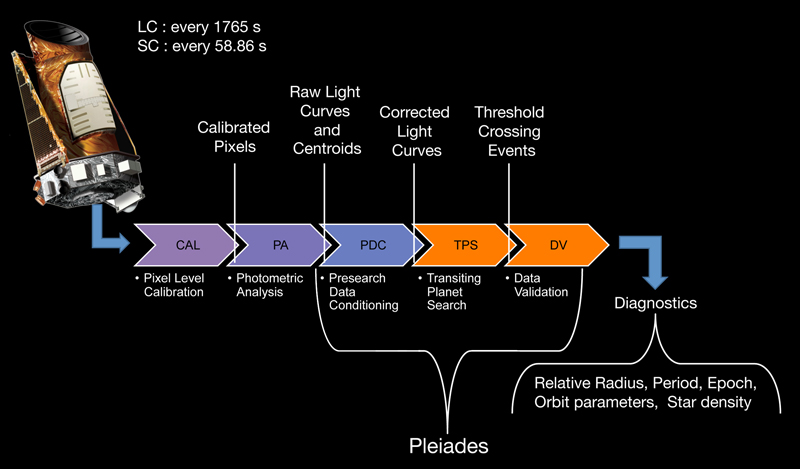
Ever since Kepler's 95-megapixel photometer began collecting science data, the Kepler team has been performing semi-weekly health checks of the spacecraft and downloading science data once per month. Pixels of interest are transferred to the Kepler Science Operations Center (SOC) at NASA Ames Research Center, where the pixels are calibrated, combined to form light curves, corrected for systematic errors introduced by the instrument, then searched for the signatures of transiting planets.
Data is automatically copied between the Kepler SOC and the Pleiades supercomputer at Ames' NASA Advanced Supercomputing (NAS) facility, with the most computationally intensive portions of the SOC data processing pipeline (the pre-search data conditioning, transiting planet search, and data validation modules) running on Pleiades, and the less-intensive parts on SOC computers. Recently added features and improvements to the SOC pipeline software that correct systematic errors and improve search sensitivities have been mirrored on Pleiades.
Results and Impact
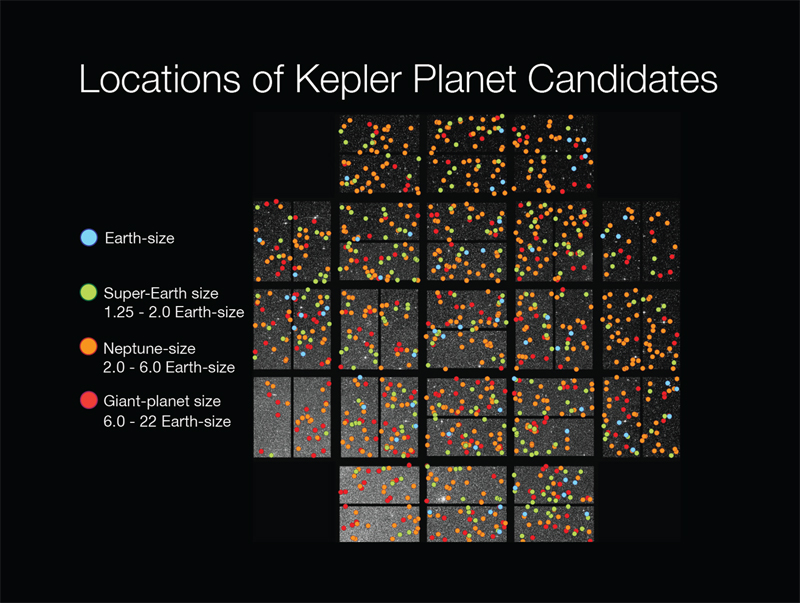
As of February 2012, the Kepler team has found 2,321 planet candidates circling 1,790 host stars, with 77 confirmed planets—an 88 percent increase over the previous year. Some of these systems also involve planetary candidates orbiting binary star systems (circumbinary planets). Among the important discoveries enabled by Kepler over the last year: a planet orbiting a double star that, in turn, is orbited by a second distant pair of stars; a circumbinary system with more than one transiting planet, one of which is in the habitable zone of its parent binary star system; and the first exoplanet system with regularly aligned orbits similar to those in our own solar system.
Role of High-End Computing Resources
The Pleiades supercomputer enables the enormous planetary transit searches to be completed in less than a day, as opposed to more than a month on the Kepler SOC systems. This year, computer scientists at the NAS facility significantly improved the accuracy and effectiveness of the pipeline software, and completed all the computational runs on Pleiades. The combination of supercomputing power and coding expertise enables the rapid turnaround of analyses of planet candidates. This will benefit the general public, as well—beginning in December, both the pipeline results and all data will be available for analysis with no proprietary period—allowing much greater community participation as we continue into Kepler's extended mission through 2016.
Shawn E. Seader, NASA Ames Research Centershawn.seader@nasa.gov