
Exploring the Sun's Magnetic Field Through High-Res 3D Modeling
You'd think that in today's world of scientific discovery and technology breakthroughs, modern explorers of the universe would have learned everything there is to know under the sun. Not so. But physicists at the New Jersey Institute of Technology (NJIT), working with visualization experts at NASA's Ames Research Center, are gaining new insight into solar phenomena that have eluded scientific understanding. The NJIT team uses cutting-edge, global 3D models to solve computations for the mass flows of plasma in and around the sun's convection zone, where most of the turbulent motion and flow occurs. The simulations also show how the plasma flows form and sustain a global magnetic field and how this field produces the solar cycle. The Data Analysis and Visualization team at the NASA Advanced Supercomputing (NAS) facility then uses simulation results to create incredible, high-resolution videos and images that provide a more detailed look at how turbulence inside the sun can create magnetic structures at the bottom of the convection zone. The space agency's most powerful supercomputer, Pleiades, allows the NJIT researchers to run their complex algorithms-which would take years on regular computers.
We still have a long way to go before we can accurately and effectively predict solar activity, but these models—along with new visualization techniques and powerful supercomputers—are an important step forward.
Andrey Stejko, Doctoral Student in Physics, Center for Computational Heliophysics, New Jersey Institute of Technology
Quick Facts
- The NJIT models employ an ideal magnetohydrodynamic theory algorithm with dynamo action to create a naturally developing magnetic field that interacts with charged plasma.
- The team is tracking the evolution of their models and comparing the cyclical patterns of solar activity with data collected from NASA's Solar Dynamics Observatory.
- Current models are able to accurately simulate the natural development of a solar cycle that corresponds to real-time periods of solar activity, as well as patterns of magnetic field distribution.
- To simulate the motion of plasma on the sun, the team ran a complex advection algorithm on 128 – 512 processor-cores of the Pleiades supercomputer at the NASA Advanced Supercomputing (NAS) facility.
- Researchers will use the simulation data to further improve their methods in order to generate realistic models that can be used to predict the effects of space weather on Earth, similar to weather models that we use today.
Key Image
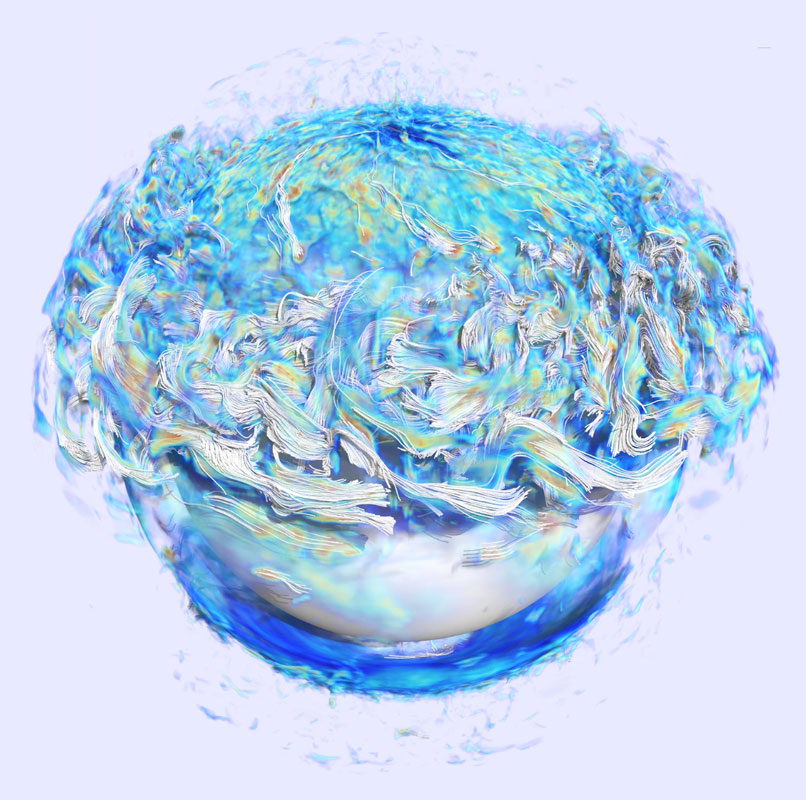
Image Caption
Frame from a video of the magnitude of the magnetic field on the sun, with magnetic field lines drawn in based on continuous magnetic field strength. A large portion of the magnetic field is stored at the transition layer between zones on the sun at about 70% of the solar radius, and emerges in twisted wreath structures onto the surface. Timothy Sandstrom, NASA/AmesDownload High-Res Image
Contacts
Andrey Stejko, NASA Ames Research Centerastejko1@ithaca.edu