
Building an Earth-Sized Chemistry Laboratory
Mixing chemicals in beakers is an early taste of doing science for many children, but few could imagine making the entire globe their chemistry laboratory, as scientists at NASA's Goddard Space Flight Center and Harvard University are doing. Their experiments require two mathematical models of Earth's atmosphere, millions of observations, and a supercomputer. The Goddard Earth Observing System (GEOS) general circulation model simulates the physics and movements of wind, precipitation, and other weather. The GEOS-Chem chemistry transport model represents the physical and chemical interactions of chemical compounds. Each model ingests observational data, with GEOS focusing on meteorological values and GEOS-Chem on natural and human emissions. Combining all these ingredients is the Discover supercomputer at the NASA Center for Climate Simulation. Discover recently hosted the biggest GEOS-Chem experiment ever run—a year-long simulation using the highest resolution, the most realistic meteorology, and the greatest chemical complexity to date. In painting an accurate global picture of atmospheric chemistry, the massive simulation captures the shifting patterns of ozone and other chemical compounds affecting human health.
Advances in supercomputing have given us the ability to run increasingly high-resolution simulations of atmospheric chemistry. With models like GEOS-Chem, we can realistically simulate on a global scale the small-scale concentration patterns of chemical species that are critical for human health.
Benjamin Auer, Senior Software Engineer, Global Modeling and Assimilation Office, NASA Goddard Space Flight Center
Quick Facts
- The simulation covers the period June 2013 to July 2014 to coincide with the Studies of Emissions and Atmospheric Composition, Clouds and Climate Coupling by Regional Surveys (SEAC4RS) field campaign that is being used to validate the results.
- The 12-kilometer-wide grid boxes produce the highest resolution for a GEOS-Chem simulation to date.
- Using the NASA Center for Climate Simulation's Discover supercomputer, the simulation ran on approximately 5,000 cores for a total of 36 days and produced just over 200 terabytes of data.
- The simulation results will become input for observation system simulation experiments for planning NASA's GEOstationary Coastal and Air Pollution Events (GEO-CAPE) mission.
Key Image
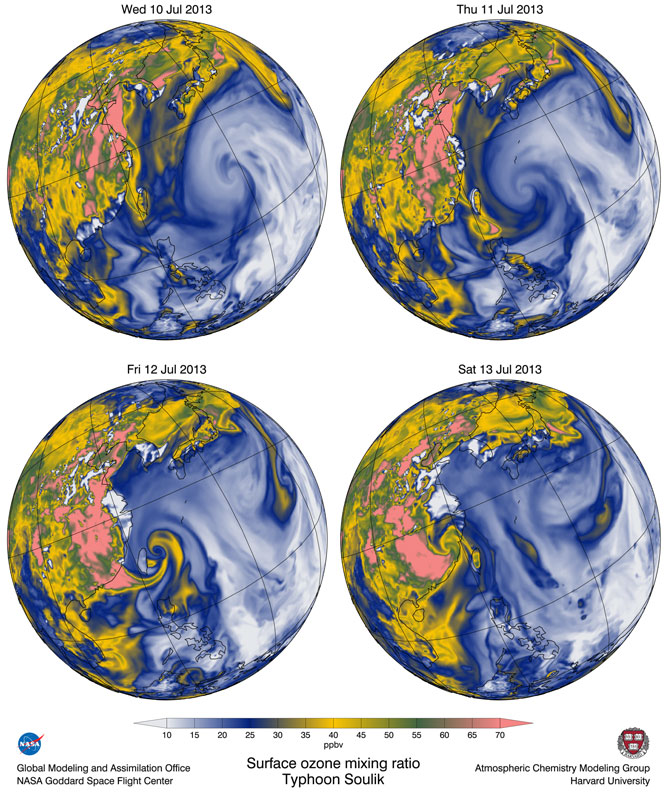
Image Caption
Surface ozone mixing ratio during Typhoon Soulik over four days from the high-resolution GEOS-Chem run. As the typhoon makes landfall, ozone is removed over the coastal regions of China due to the circulation of the typhoon. Eric Nielsen, NASA/GoddardDownload High-Res Image
Contacts
Benjamin Auer, NASA Goddard Space Flight Centerbenjamin.m.auer@nasa.gov Christoph Keller, NASA Goddard Space Flight Center
christoph.a.keller@nasa.gov