
Aeronautics Research
For more than 30 years, the NASA Advanced Supercomputing (NAS) Division has been one of the agency’s premier aerospace numerical modeling and simulation resources, supporting NASA aeronautics missions and projects from rotorcraft to supersonic flight. Researchers, engineers, and computational fluid dynamics (CFD) experts in the Computational Aerosciences and Computational Physics branches at NAS combine suites of code and tools with powerful supercomputing resources to better understand the complex flows within and around aircraft in order to improve flight efficiency, validate new designs, and reduce the impact on the planet.

Advanced Air Transport Technology
In support of NASA’s Advanced Air Transport Technology (AATT) Project, which seeks to advance fixed wing aircraft by improving energy efficacy and reducing the environmental impact of air transportation, NAS researchers are using the agency’s OVERFLOW and in-house developed Launch Ascent and Vehicle Aerodynamics (LAVA) and Chimera Grid Tools (CGT) software to validate and model several different types of fixed wing aircraft. This work includes accurate prediction of sonic booms, airframe designs for new propulsion systems, simulating the noise created by aircraft landing gear, and validation of transonic truss-braced wing vehicle designs to improve fuel economy.
Transformational Tools and Technologies
NAS has always been at the cutting edge of the development of new computational tools to understand and advance design and engineering in aviation. CFD experts at NAS support several endeavors under the Transformational Tools and Technologies (TTT) Project, including development of boundary-layer transition modeling techniques; multi-disciplinary design, analysis, and optimization tools; novel high-order methods; uncertainty quantification; and wall-modeled large-eddy simulation methods for computational certification of new aircraft designs. Additionally, part of the effort toward this work includes the development and improvement of specialized CFD tools, including LAVA, CGT, and the Discontinuous-Galerkin Spectral-Element Solver (eddy) software.
Flight Demonstration Vehicles
X-planes—experimental aircraft used to test and evaluate new technologies and aerodynamic concepts—have been part of NASA’s history for more than 60 years. As technology has advanced, the use of computational tools and resources for early design and validation of X-planes has been increasingly vital. Engineers and CFD experts at NAS are putting in-house tools and technologies, such as the LAVA and Cart3D flow solvers, to the test on new X-plane designs, supporting the development of both the X-57 Maxwell all-electric vehicle and the X-59 Low Boom Flight Demonstrator concepts, along with other research under NASA’s Commercial Supersonic Technology (CST) Project.
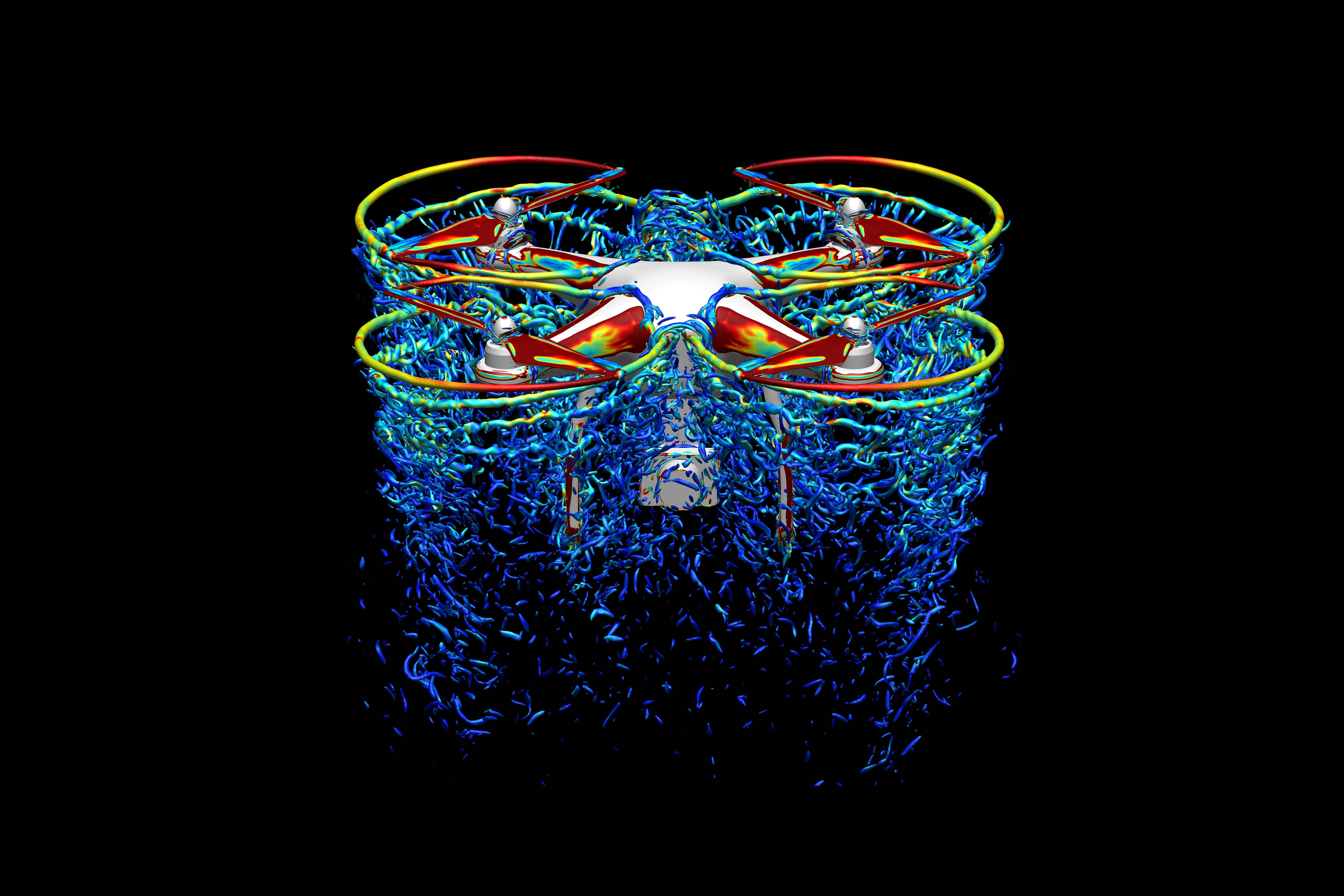
Multi-Rotor Vehicles
Aerodynamic researchers at NAS are putting their skills to work on multi-rotor and vertical-lift flight, supporting the agency’s Revolutionary Vertical Lift Technology (RVLT) and Advanced Air Mobility (AAM) projects to develop new aircraft that can be used in urban or underserved areas due to take-off requirements. Using the agency's OVERFLOW, LAVA, and Cart3D tools, our experts are developing and analyzing the performance of drone and air taxi vehicle designs, improving energy efficiency, and reducing the vehicle noise.
