
Heliophysics Modeling and Simulation
Solar activity is caused by magnetic fields generated deep inside the Sun, and the solar variability that results from this activity is a leading factor in determining space weather. Space weather has strong impacts on Earth’s environment—and often on human activities, as well. NAS heliophysics researchers develop high-fidelity modeling and simulation tools for space weather prediction and solar physics modeling of the Sun’s interior and atmosphere. These efforts contribute to NASA’s Living with a Star program.
Space Weather Prediction
Our planet is steadily impacted by a stream of charged particles from the Sun, called the “solar wind,” that can affect communication and electrical power networks, as well as spacecraft and space-borne technologies. The term space weather generally refers to the solar wind itself, conditions on the Sun that affect it, and regions of Earth’s atmosphere impacted by it. Researchers at NAS are working to understand the solar wind, its associated magnetic field, and the high-energy particles that flow from the Sun and our galaxy. Their findings are crucial to help mitigate space-weather impacts on human exploration of the Moon and beyond.
Solar and Stellar Physics Modeling
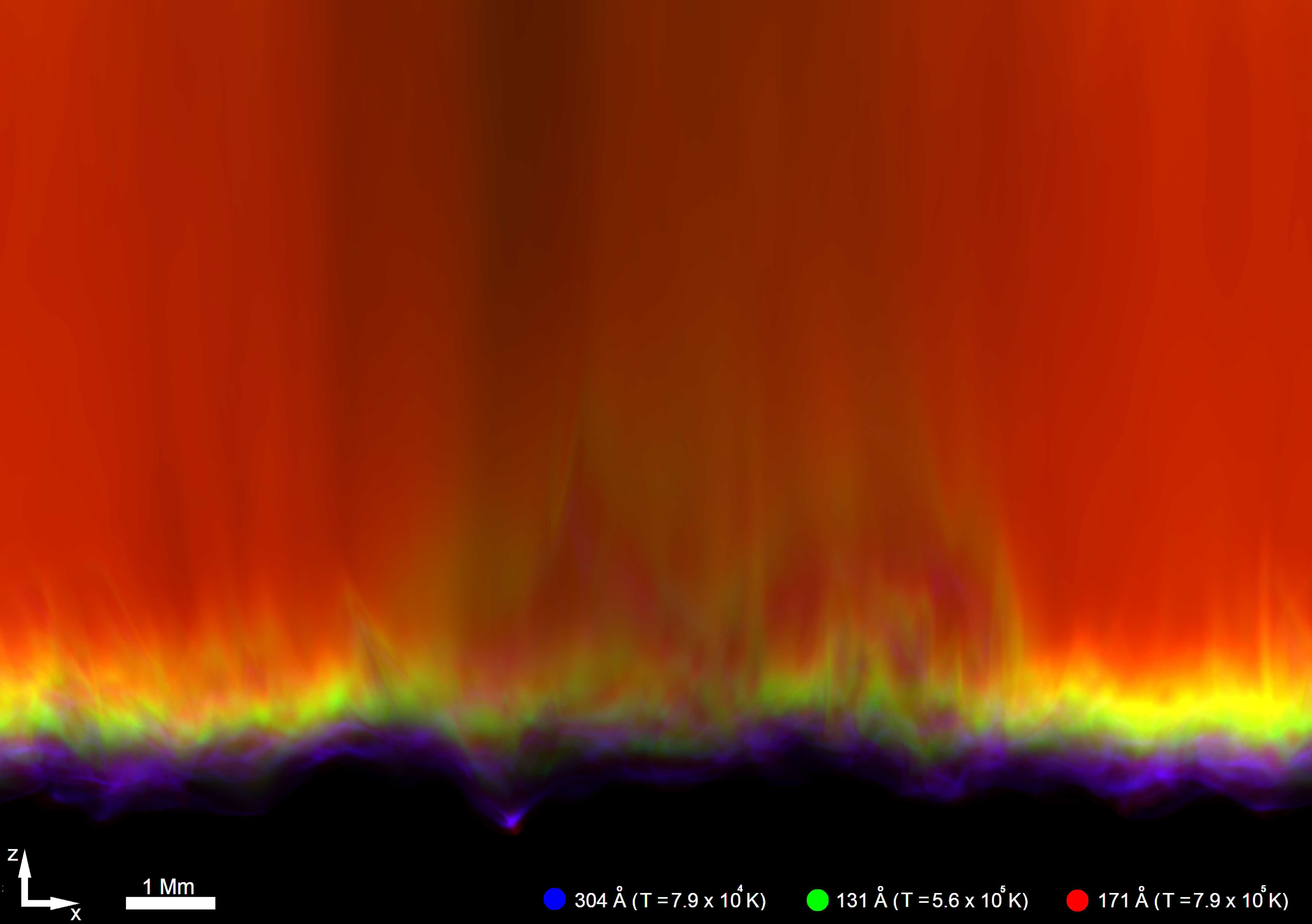
NAS-developed tools such as Stellarbox—a 3D magnetohydrodynamics code used to simulate the complex dynamics of the near-surface and lower atmospheric layers of the Sun and other stars—provide insight into the physical processes that are important for improving space weather forecasts.
Radiation Hazard Analysis
NAS heliophysics experts run supercomputer simulations to gain new insights into the physical mechanisms that drive violent solar events. Highly detailed images and other data are recorded by NASA satellite observatories, such as the Interface Region Imaging Spectrograph, or IRIS. These simulations advance our ability to interpret such data and that from other solar observatories. This combination of simulations and observations is crucial to solve fundamental puzzles in solar physics, such as how magnetic fields energize the Sun’s atmosphere.
AI, Machine Learning, and Data Mining for Solar Research
NAS researchers are leading important collaborations with the science community in the development of machine-learning and data-assimilation applications in several areas of heliophysics. One such effort is the development of the NAS helio portal, which provides a platform for collaborative heliophysics research. A key component of this ongoing project is the Interactive Multi-Instrument Database of Solar Flares. This unique multi-instrument platform provides an integrated database of flares reported from space- and ground-based observations, along with associated data search and classification tools, to facilitate the modeling and analysis of the impacts of solar flare radiation on the Earth, spacecraft, and astronauts.
