
Researchers Study ‘Memory’ Materials Using Pleiades
Researchers are giving the Pleiades supercomputer a workout while studying remarkable shape memory alloys for high-temperature applications.
Graduate student Nick Hatcher of Northwestern University, in collaboration with Ron Noebe at NASA Glenn, has used more than 2.5 million processor-hours on Pleiades since December 2009 to study the way Nickel-Titanium (NiTi) alloys change shape with temperature. These changes in shape with changes in temperature give NiTi unique properties, including super-elasticity and the shape memory effect.
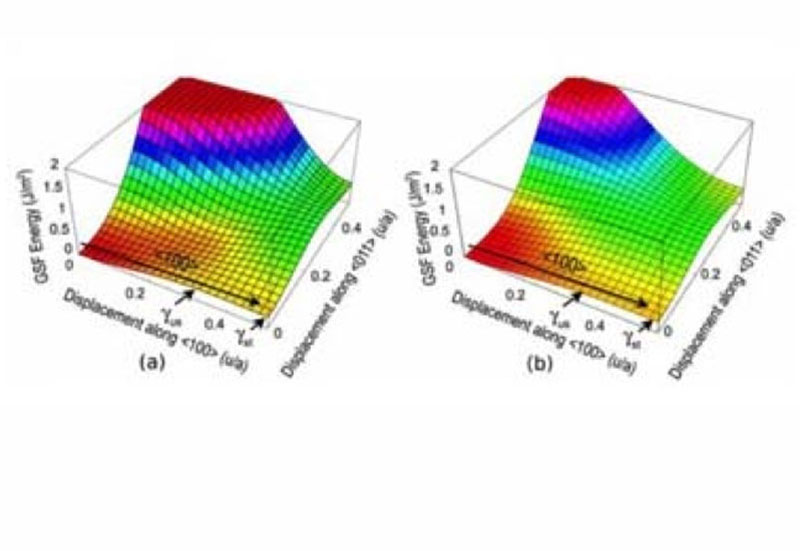
NiTi ternary alloys, using additions of Platinum or Palladium, have higher transformation temperatures and are believed to be ideal for high-temperature applications such as new actuation systems in jet engines, which is of great interest to NASA's Fundamental Aeronautics Program.
The super-elastic properties of NiTi alloys are currently being used in orthodontics, which no longer require periodic readjustments, and for new cardiac stents. The shape memory properties enable a new class of actuator materials, which will perform work without mechanical components simply using a heat source such as a tiny diode.
This work uses calculations based on first principles (calculating from the electron up to the macro-scale) to investigate these shape memory alloys to guide scientists at NASA and other research institutions in creating these remarkable materials.
Hatcher's goal is to expand calculations to include many ternary (three-element) alloys to help determine which alloys will have the best properties to expand functionality in high-temperature settings.
