
NAS Division Engineers Lead IPv6 Protocol Testing for NASA
Network and system engineers in the NASA Advanced Supercomputing (NAS) Division successfully operated the division's public web server using the next-generation Internet Protocol, IPv6. The NAS team joined over 400 organizations around the globe for World IPv6 Day on June 8, 2011—a global-scale trial of the new protocol.
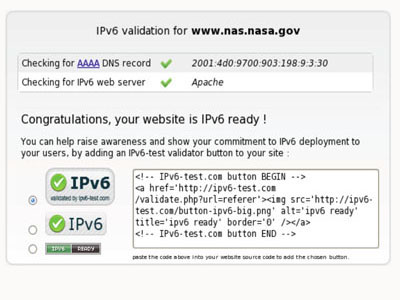
The NAS website received over 25,000 visits via IPv6 during the daylong event, giving NASA high-end computing information expanded visibility to the public, and demonstrating NASA's readiness-level to implement IPv6 agency-wide by the end of 2012, as mandated by the federal government.
Division engineers began pioneering IPv6 development over 10 years ago, starting with the Cisco 6Bone network set up to assist in the evolution and deployment of IPv6. Five years ago, using a subnet allocated by the Agency, NAS deployed IPv6 into its operational environment, and continues to operate the only local area network (NASLAN) across NASA to support IPv6 to its desktops and servers. NAS also set the requirement for newly implemented NASA services, such as DNS, to fully support IPv6 prior to deployment.
The NAS LAN environment concurrently runs both the IPv6 and IPv4 protocols, which spans across four different buildings at NASA Ames Research Center. The network routers are configured to use a separate routing protocol, called OSPFv3 (for IPv6) and support standard network features such as high availability and automatic failover using Cisco's proprietary Hot Standby Router Protocol (HSRP).
Most of the networking protocols in the NAS environment do not natively support IPv6, so different versions of software and protocols are deployed in order to allow IPv4 and IPv6 to co-exist across the LAN. Part of that work includes setting up special IPv6 peering with NASA Research and Engineering Network (NREN) and NASA Integrated Services Network (NISN) at the border, so IPv6 routes can be exchanged.
The IPv6 specification addresses issues with IPv4, the current Internet Protocol, such as address exhaustion throughout the world. It can support around 340 undecillion (2128) unique IP addresses, and also provides enhanced mobility and improved capabilities such as auto-configuration and built-in security.
