
NASA Supercomputers Support IRIS Discovery in the Sun’s ‘Region of Mystery’
Unprecedented simulations run on the Pleiades supercomputer at NASS’s Ames Research Center are helping to advance solar science research.
New discoveries by a team of scientists investigating a mysterious, fog-like layer of the Sun are helping to fill in pieces of the complex puzzle that will lead to a more complete picture of how Earth’s closest star works. Using observations from NASA’s Interface Region Infrared Spectrograph (IRIS) satellite, and running high-resolution simulations on the agency’s Pleiades supercomputer, one of the team’s findings confirms the existence of magnetic loops in the Sun’s transition region—the area between the million-degree F corona (outer atmosphere) and the 20,000-degree F chromosphere, near the surface.
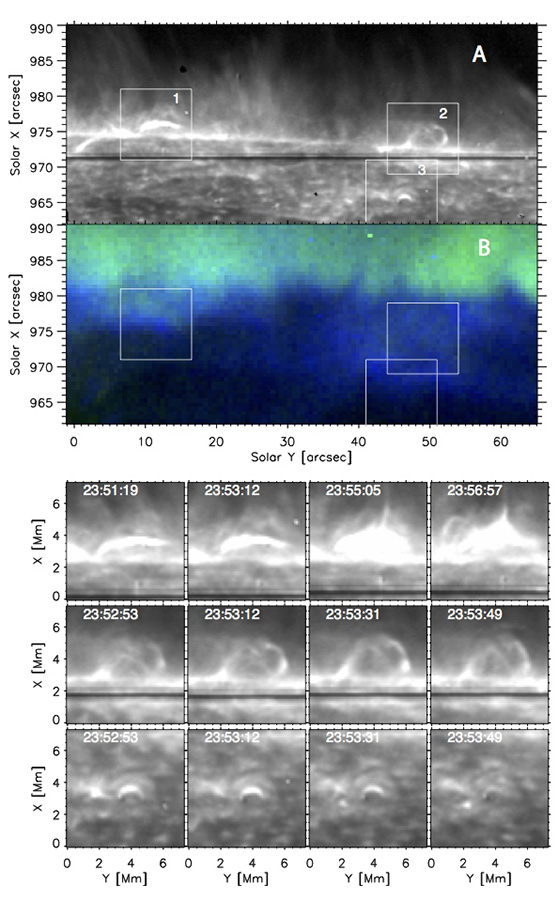
“Gigantic magnetic loops that span tens of thousands of miles are the building blocks of the Sun’s corona, but loops had never been observed before in the transition region," said Bart De Pontieu, IRIS science team lead at Lockheed Martin Solar & Astrophysics Laboratory in Palo Alto, California. “We had noticed them before launch in movies generated from our numerical models, but thought they were a fluke—some flaw in the model. But within a few days after opening the telescope aboard IRIS (on July 17, 2013), “we saw tiny little loops popping up all over the place."
“Exploring how these loops form in this region of mystery, and how much they contribute to the Sun’s ultraviolet light, is important for helping us understand how its atmosphere works and impacts Earth’s space environment," De Pontieu said.
By combining data from such exciting IRIS revelations with the parallel processing power of Pleiades (currently the ninth fastest system in the U.S), De Pontieu’s team is learning more about the fundamental physics of why and how these magnetic loops, and other solar phenomena, are energized. Understanding the unexplained rise of temperature in the Sun’s atmosphere—why it gets hotter further away from the relatively cool (10,000-degree F) surface—remains a major challenge for solar scientists.
And, as the complexity of today’s 3D simulations increases, so do the processor requirements—it takes several million processor hours on thousands of processors on the Pleiades supercomputer to calculate just one hour of solar time observed by the IRIS satellite, according to De Pontieu. “A decade ago, it wasn’'t very practical to run such advanced numerical simulations—it took too long,” he said. “Now, with Pleiadues, we can produce a new simulation every couple of months.”
Being able to continuously compare observational data with simulation results and then quickly do iterative runs on Pleiades allows the IRIS team to improve their model (called BIFROST, developed at the University of Norway). “We know the model isn’t perfect—finding differences with observations is exciting because it suggests what we need to change in the model,” said De Pontieu. “The advances in observations and simulations go hand in hand, and will eventually lead to a better understanding of the Sun’s atmosphere and other stars in our universe.”
Details of the IRIS science team’s discoveries are reported in a special section of the 17 October 2014 issue of Science.
