
NASA’s Seven-Minute Miracle, Revisited
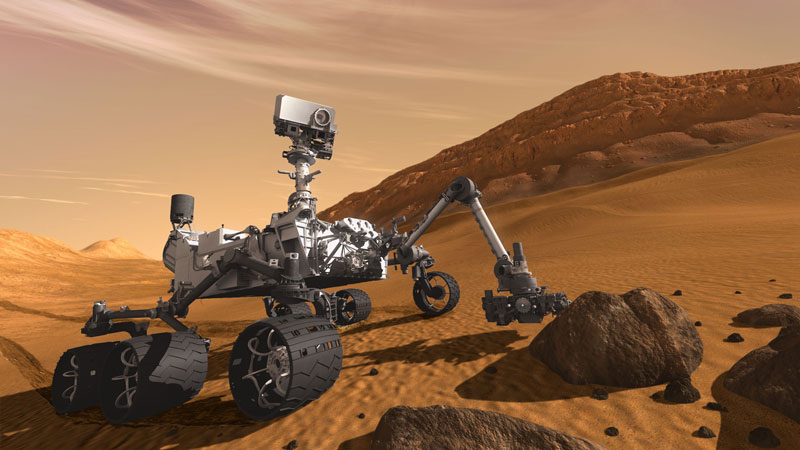
Before NASA’s Curiosity rover could begin its scientific mission on Mars, it first had to get there—with a little help from the agency’s supercomputers.
After a spectacular landing that took NASA’s Curiosity rover from 13,000 mph on entry to a controlled stop on Mars’s surface in just seven minutes, the rover has spent its first year on the Red Planet making discoveries that have astounded and delighted scientists and space enthusiasts alike.
It didn’t take long for the scientific data to begin transmitting back to Earth after the rover landed on August 5, 2012, right in the middle of scientists’ chosen spot inside Gale Crater—with immediate access to an area rich with geological signs of ancient water.
In previous Mars missions, landing sites had been determined more by engineering constraints than for their scientific value. This time, the Mars Science Laboratory mission team was able to accommodate the science team’s top choice, and they brought Curiosity down into the crater within the smallest target landing ellipse ever attempted. How was it possible to land a spacecraft with such precision on a remote planet after a nine-month, 350 million-mile journey?
NASA’s supercomputing resources dramatically reduced the risk involved in landing at Gale Crater.
Simulations Help Reduce Risks
Using sophisticated computer models that incorporated Martian atmospheric conditions, vehicle design and trajectory, and even local weather at Gale Crater, NASA engineers began running comprehensive landing simulations on supercomputers at the NASA Advanced Supercomputing (NAS) facility and on high-performance computing clusters at NASA’s Jet Propulsion Laboratory (JPL).
“NASA’s supercomputing resources dramatically reduced the risk involved in landing at Gale Crater,” said Timofey Ovcharenko, system administrator at JPL. “This gave us confidence in the design and helped to bring into reality the extraordinary landing sequence that some initially thought was impossible.”
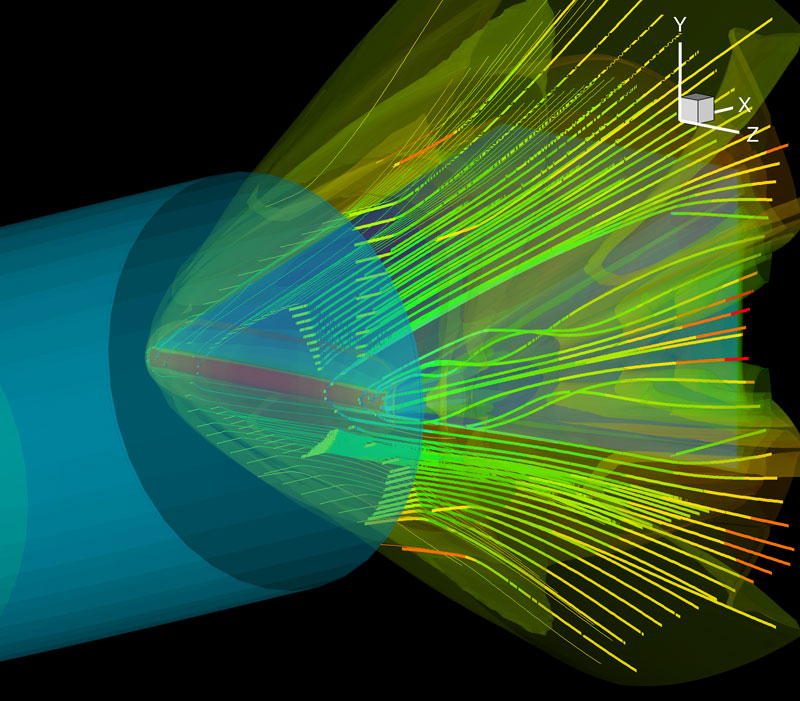
During Curiosity’s design phase in 2007, NASA engineers determined that the thermal protection system (TPS) originally intended to protect the rover for atmospheric entry did not hold up during material testing and could not be used. Fortunately, another modern TPS material, Phenolic Impregnated Carbon Ablator (PICA), had been developed and used successfully for Earth reentry in a previous NASA mission, Stardust. PICA had never been tested for Mars entry, however, or used in a tiled configuration—and Curiosity's large size precluded the use of a single-piece heatshield.
To analyze PICA’s suitability for use on the Mars Science Laboratory, TPS experts at NASA’s Ames Research Center generated numerous aerothermal solutions using highly complex computational fluid dynamics (CFD) grids, comprising millions of grid points. Using the Pleiades and Columbia supercomputers at the NAS facility, engineers ran dozens of CFD simulations of the Mars atmospheric flow over the heatshield during peak heating conditions. They also investigated the effects of unique geometric configurations, such protruding gap fillers between the tiles, successfully demonstrating that this first-ever tiled PICA heatshield would protect the rover from Mars's harsh entry conditions.
Coming in for a Landing
Every Mars mission requires years of preparation and builds on technology developed for previous expeditions to the Red Planet. When the Mars Exploration rovers Spirit and Opportunity successfully bounced to the Martian surface in 2004, their landing systems incorporated methods used by the Mars Pathfinder mission seven years before. But, at 2,000-pounds, Curiosity was too heavy to rely on the airbags used by earlier rovers, and the precision landing crucial to the scientific aims of the mission required the development of an innovative guided entry system.
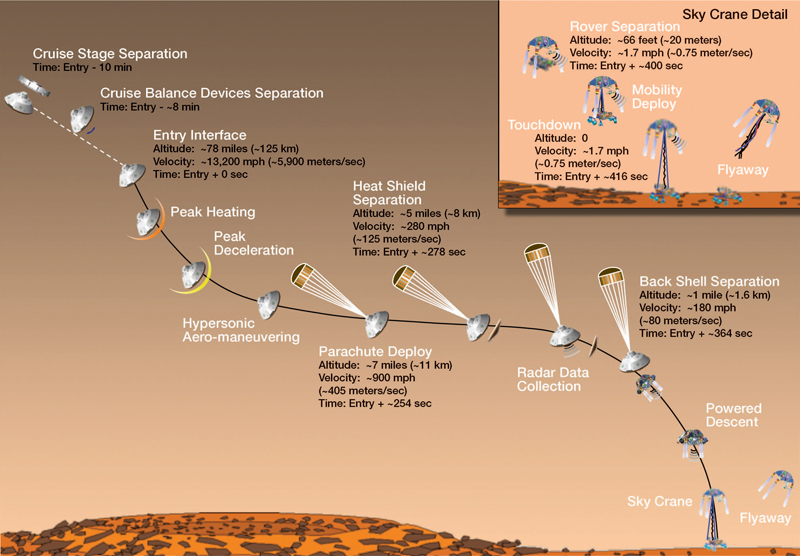
To steer itself through the Martian atmosphere, the spacecraft needed to use a series of S-curve maneuvers similar to those used by space shuttle pilots. Like the astronauts, Curiosity’s computer had to make fast, critical decisions based on the conditions it encountered during entry, descent, and landing (EDL). To ensure that Curiosity would be ready for anything, researchers ran millions of simulated landing scenarios on two high-performance computing clusters, named Nebula and Galaxy, at JPL.
Working with JPL’s supercomputing team, Curiosity’s EDL designers created a customized supercomputing environment capable of handling high-fidelity simulations and calculating the risk probability of each scenario. Based on these results, engineers programmed Curiosity's software to navigate correctly throughout its dangerous landing sequence.
The highly complex landing simulations performed on JPL’s Nebula and Galaxy clusters had to account for many new capabilities—for example, the small rockets that enabled the spacecraft to steer itself through the Martian atmosphere and avoid hazards such as large rocks on touchdown; a parachute that was 10% larger than the previous versions used for Spirit and Opportunity; and the famous sky crane that lowered Curiosity to the planet’s surface as rocket thrusters reduced the descent velocity to nearly zero.
The scale and availability of NAS supercomputers significantly reduced the amount of time needed to obtain [risk] results—from weeks or months to hours or days—and allowed us to run larger simulations.
Analyzing Descent Risks
To assess potential thermal and particulate hazards caused by the spacecraft’s retrorockets blasting into the Martian soil, CFD experts at NASA’s Langley Research Center used the NAS facility’s Columbia and Pleiades supercomputers to perform comprehensive analyses well before Curiosity’s launch date. Their results provided confidence that these known issues did not carry a significant amount of risk to the mission.
“We used Columbia and Pleiades quite extensively, to the tune of several million processor hours,” said John Van Norman, senior project engineer in the Atmospheric Flight and Entry Systems Branch at Langley. “The scale and availability of NAS supercomputers significantly reduced the amount of time needed to obtain results.”
Scientific Discoveries and Future Missions
Already, Curiosity has discovered new evidence that indicates the planet was once capable of providing a suitable home for microbial life. Using its chemical and mineral analysis instruments, Curiosity has found sulfur, nitrogen, oxygen, phosphorus, and carbon—elements necessary for life—in Martian rock samples. The rover has also found evidence of an ancient streambed, as well as a surprising diversity of soil and rock types that provide clues into the planet’s past.
Curiosity recently began its trek across Gale Crater to Mt. Sharp, a three-mile-high mountain whose exposed sedimentary layers provide a perfect opportunity to dig further into the planet’s history. During the journey, which is expected to take many months, the rover will continue to use its cameras and instruments to send home new scientific data and spectacular images from its Martian road trip.
As NASA engineers plan new spacecraft operations, researchers are continuing to use the agency’s supercomputers to help improve their understanding of Martian climate, analyze the effects of solar flares and dust storms on the planet’s atmosphere, and investigate other factors that will surely impact new missions to Mars.
“NASA always builds upon its past experience,” says Ovcharenko. “Curiosity’s landing is by far the most complex and challenging landing that the agency has undertaken, and future missions will, in turn, use this experience to produce spectacular results.”
— Michelle Moyer, NASA Ames Research Center
