
Supercomputers Help Reveal the Sun's Hidden Mysteries
Stunning new data from space-based observatories, combined with rapid advances in computing, are inspiring breakthroughs in space weather research.
Bursting from the Sun at up to 2,000 miles per second, explosive clouds of plasma and radiation can extend millions of miles into space with the energy of nearly a billion atomic bombs. The most powerful of these coronal mass ejections (CMEs) are associated with sunspots—short-lived dark areas of intense magnetic activity that can be bigger than the Earth—but scientists are not yet sure how the phenomena are related.
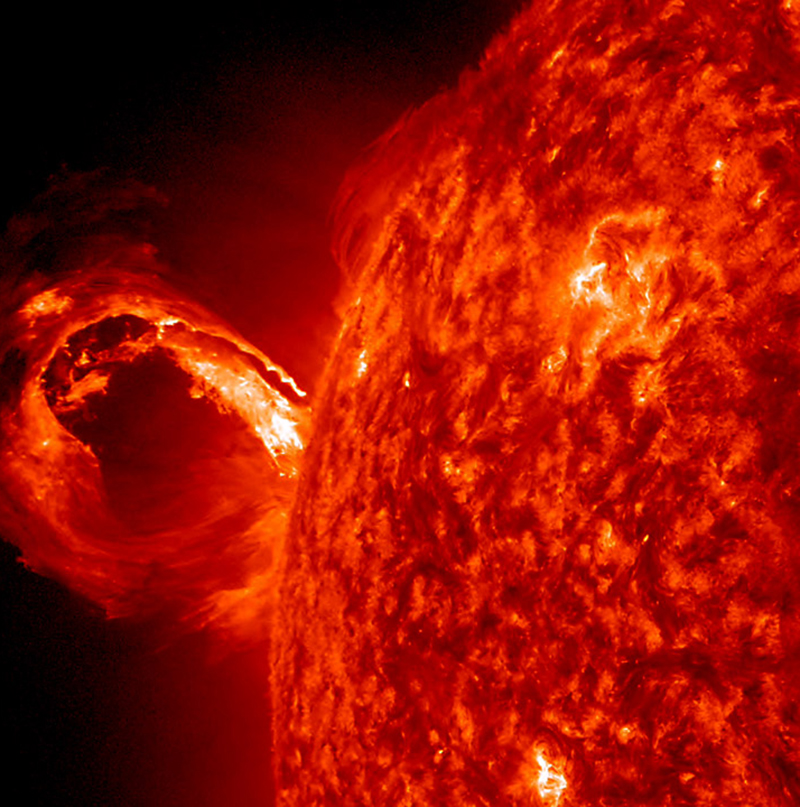
“We don't know exactly how sunspots form, or how sunspot regions initiate solar flares and CMEs,” said Irina Kitiashvili, research scientist with the NAS Divison’s Heliophysics Modeling and Simulation team. Solving these mysteries will help scientists forecast space weather events that can have an enormous impact here on Earth: magnetic storms caused by CMEs and other solar activity can disrupt radio and satellite communication, prompt airplanes to divert from polar routes, and even cause massive power blackouts.
To learn more about the conditions that lead to severe space weather, researchers are using the Pleiades supercomputer at the NASA Advanced Supercomputing (NAS) Facility at Ames Research Center, Moffett Field, Calif., to run simulations of the solar surface, interior, and atmosphere. “These realistic computer models go a long way toward improving our understanding of the Sun's structure and dynamics beneath the visible surface,” said Alan Wray, co-investigator on the Heliophysics project. The simulations help the researchers calibrate and interpret data from space- and ground-based observatories, such as NASA’s Solar Dynamics Observatory (SDO).
The Sun’s Magnetic Carpet
Using high-resolution instruments like the Helioseismic and Magnetic Imager (HMI), which continuously monitors the sun from SDO, scientists have observed small-scale, localized magnetic fields that carpet the entire surface of the Sun. This “magnetic carpet” swirls in dynamic patterns, as turbulent plasma flowing through the subsurface layers stretches and twists the magnetic field lines in a process known as the solar dynamo.
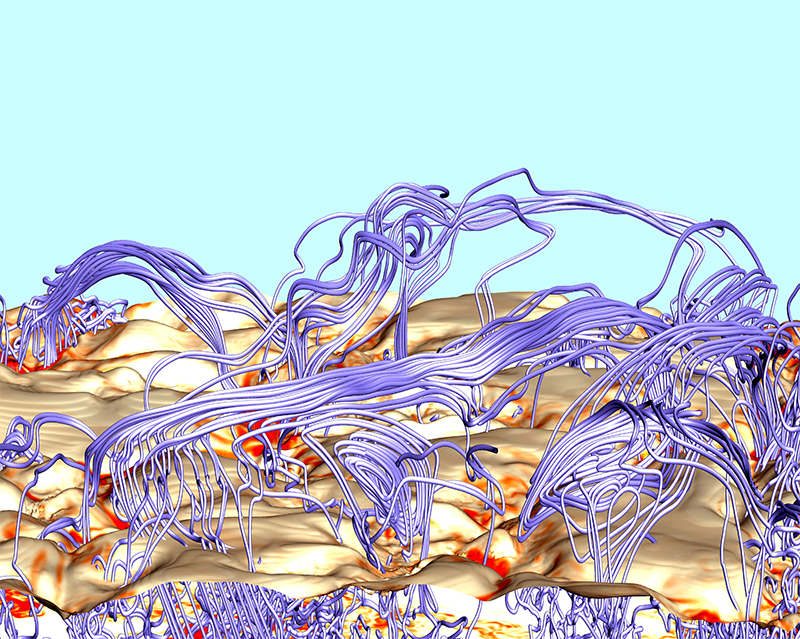
To investigate how this process amplifies the magnetic fields and affects active regions on the solar surface, Kitiashvili and her colleagues run simulations using a parallel 3D radiative magnetohydrodynamics code called SolarBox, which was developed by Wray to model conditions in these areas. The high-fidelity SolarBox simulations, which cover regions up to 50,000 miles wide and 15,000 miles deep, require massive computational resources—each one can run across 2,000 to 8,000 processors on Pleiades for more than a month.
The simulation results show that the turbulent plasma flows can efficiently amplify initially weak magnetic fields in the Sun’s convection zone by several orders of magnitude. This knowledge helps explain the dramatic changes that occur near the surface, providing a better understanding of the mechanisms that lead to the formation of sunspots and active regions. “Understanding the magnetic and energetic interactions within these layers is key to learning how and why solar storms develop in the Sun’s active regions,” Kitiashvili explained.
A New Era in Heliophysics
These realistic computer models go a long way toward improving our understanding of the Sun’s structure and dynamics.
- Alan Wray, NASA/Ames
Computer simulations supporting heliophysics studies began as recently as the 1990s, but a new era of space weather research is already emerging. “High-quality observations, with incredible resolution, have become available at the same time as advances in parallel computing and realistic physics software,” said Nagi Mansour, principal investigator of the project. “These advances enable simulations that were previously impossible—a transformative step in understanding solar magnetic activity, and crucial for developing space weather prediction capabilities.”
This is good news for NASA’s Living With A Star Program (see sidebar), which seeks to increase the accuracy of space weather forecasts and has set a goal to extend the forecasts by up to three days. Such improvements will be an immense service to satellite operators, airlines, power companies, and other organizations, helping them mitigate problems and protect critical infrastructure. Kitiashvili is enthusiastic. “This is an exciting time to be studying the Sun!”
—Michelle Moyer, NASA Ames Research Center
