
Modular Supercomputer Cluster to Save Millions of Gallons of Water
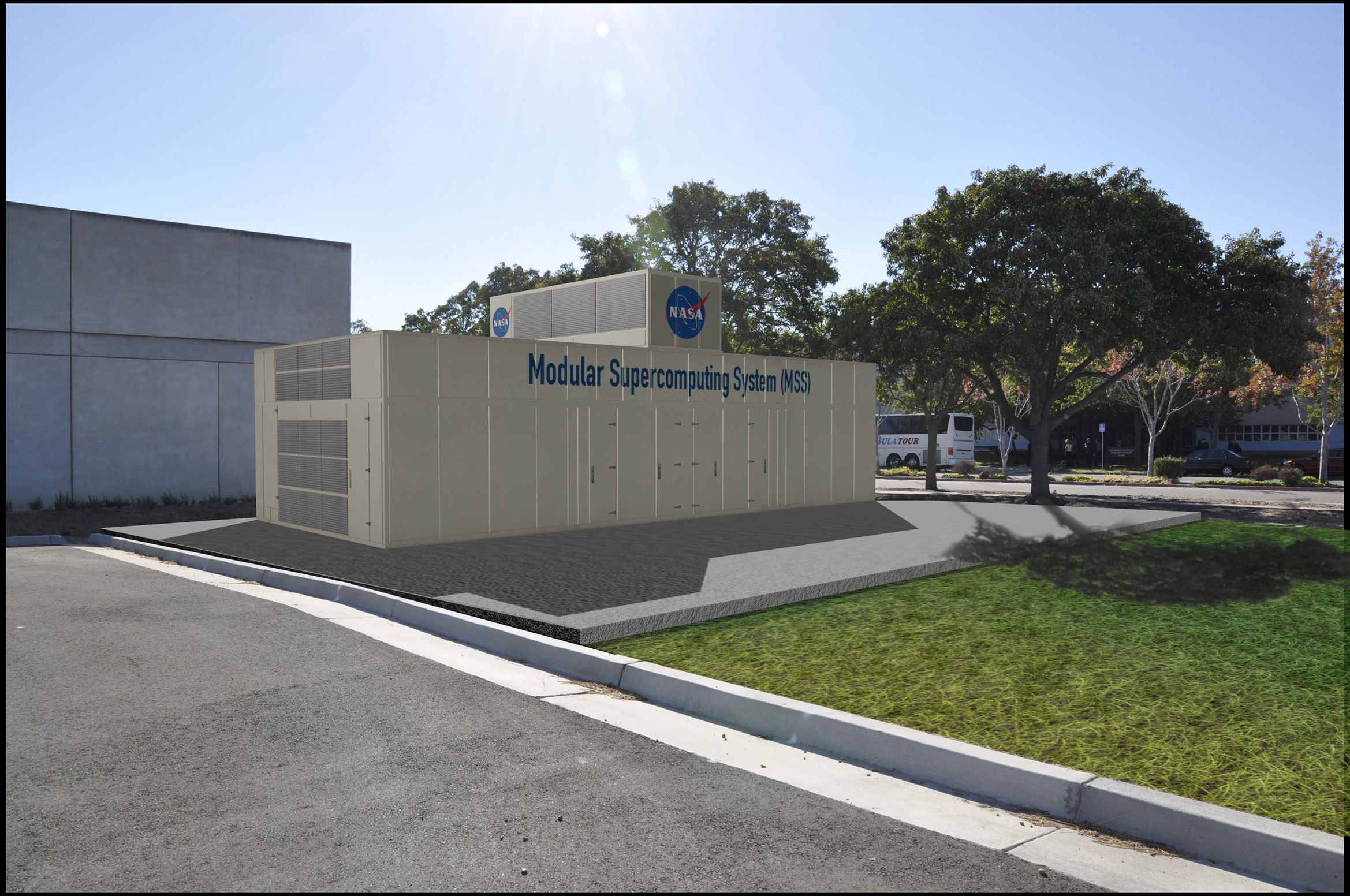
NASA’s Ames Research Center will soon break ground on a modular supercomputing system that will prevent millions of gallons of water from disappearing into thin air—literally.
Like most supercomputers, the Pleiades system at Ames Research Center’s NASA Advanced Supercomputing (NAS) facility—just a stone’s throw from San Francisco Bay—burns a lot of energy. One of the most powerful high-performance computers in the world, Pleiades requires water to carry away the heat generated by its 211,872 processor-cores. Each day, 50,000 gallons of water evaporates into the air through a cooling tower located next to the main NAS facility.
A new Data Center on Demand (DCoD) modular supercomputing environment from SGI, in partnership with CommScope, will reduce annual water evaporation by over 99 percent. Cooling the 2,300 processors that the container can hold will require an estimated 6,000 gallons of water per year—compared to the almost 2 million gallons it would take to cool those same processors in the current NAS facility.
The DCoD uses a combination of outdoor air and evaporative (adiabatic) cooling to get rid of the heat generated by the system. The initial system will contain four racks of SGI servers (containing the latest Intel Xeon processors) dedicated to scientific computation.
“Part of our vision of what NASA’s supercomputing technologies will look like over the next 10 years includes drastically reducing the amount of water needed to counteract the enormous amount of heat generated by systems like Pleiades,” said William Thigpen, chief of the NAS Division’s Advanced Computing Branch. “We work in an ideal climate for computing. Taking advantage of the Bay Area’s temperate climate to cool our systems saves NASA money and greatly reduces our impact on the environment,” Thigpen said.
NAS supercomputing resources are used by scientists and engineers around the country to understand climate change, make airplanes more fuel-efficient, design safe space vehicles, trace the origins of the universe, and solve many other scientific and engineering challenges. As a first step to installing the DCoD, contractors will begin in work in December to pour a concrete pad, install a new power transformer and water supply, and run the Mellanox MetroX long-haul system that will extend the high-speed network connection to the main NAS facility.— Jill Dunbar, NASA Ames Research Center
