
Predicting the Sun’s Corona for the Great American Solar Eclipse
On August 21, 2017, millions of people across the continental United States turned their eyes to the sun to witness the “Great American Solar Eclipse,” an event in which the totality of the eclipse was visible across 14 states from the Pacific to the Atlantic. While total solar eclipses are not rare, this was the first time since 1979 that one had been visible from anywhere in the mainland United States, and the first time in nearly 100 years that such an eclipse had crossed the entire continent. In addition to being a unique and fascinating sight, total solar eclipses provide unique opportunities for heliophysics researchers to study the corona—the region extending from the sun’s surface to several million kilometers into space—as they provide pristine, unobstructed views of the entire corona from Earth.
Using observations of the solar surface magnetic field from the Helioseismic and Magnetic Imager aboard NASA’s Solar Dynamic Observatory (SDO) as a boundary condition and new methodologies, including a wave-turbulence-driven heating model, the team was able to capture the fine details of the corona with one of the largest computational grids ever used for simulations of this type. The final high-resolution simulation used 65 grid million cells and simulated approximately 68 hours of solar activity, taking about 60 hours to complete on Pleiades—running in near-real-time to the period simulated. The ability to run these complex solar simulations at such a rate paves the way for future continuous, data-fed models that would improve our understanding of the sun’s complex physics and our ability to predict its features.
As a testament to the quality of the simulation, the team’s final eclipse prediction was used to help plan the collection of observational data by a team from the Southwest Research Institute (SwRI), who took visible-light and infrared measurements of the corona from a pair of NASA’s WB-57F airplanes during the eclipse. The SwRI team used the eclipse prediction model to help them choose which features might be the most interesting so they could point their cameras at the correct targets.
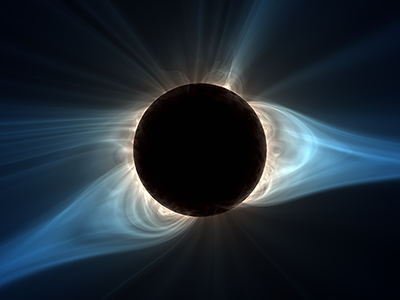
In the Nature Astronomy article, the researchers from Predictive Science, Inc. compared their eclipse prediction with photographs taken during the eclipse and spaceborne observations. Overall, the model was able to predict the general appearance of the corona, and the energization of the magnetic field—which was introduced in the model for the first time for this prediction—produced results that were consistent with extreme ultraviolet observations from SDO. While some features seen in the model and the eclipse photos are different, the team determined that these discrepancies were mostly caused by magnetic field data that was more than a month old by the time of the eclipse. Since current solar magnetic field observations are taken from the vantage point of Earth, scientists are limited to gathering measurements from this single perspective during the sun’s full rotation, causing some data to be considerably older than others.
This inability to measure the sun’s entire magnetic field in one snapshot limits the accuracy of these data-fed models. However, with improved data gathering tools such as the recently launched Parker Solar Probe and the future Solar Orbiter mission, predictive models such as these could give scientists the ability to forecast solar weather in the same way that weather on Earth is predicted and tracked.
—Katharine Pitta, NASA Ames Research Center
