
Simulations Give NASA Code Green Light for Space Launch System Testing
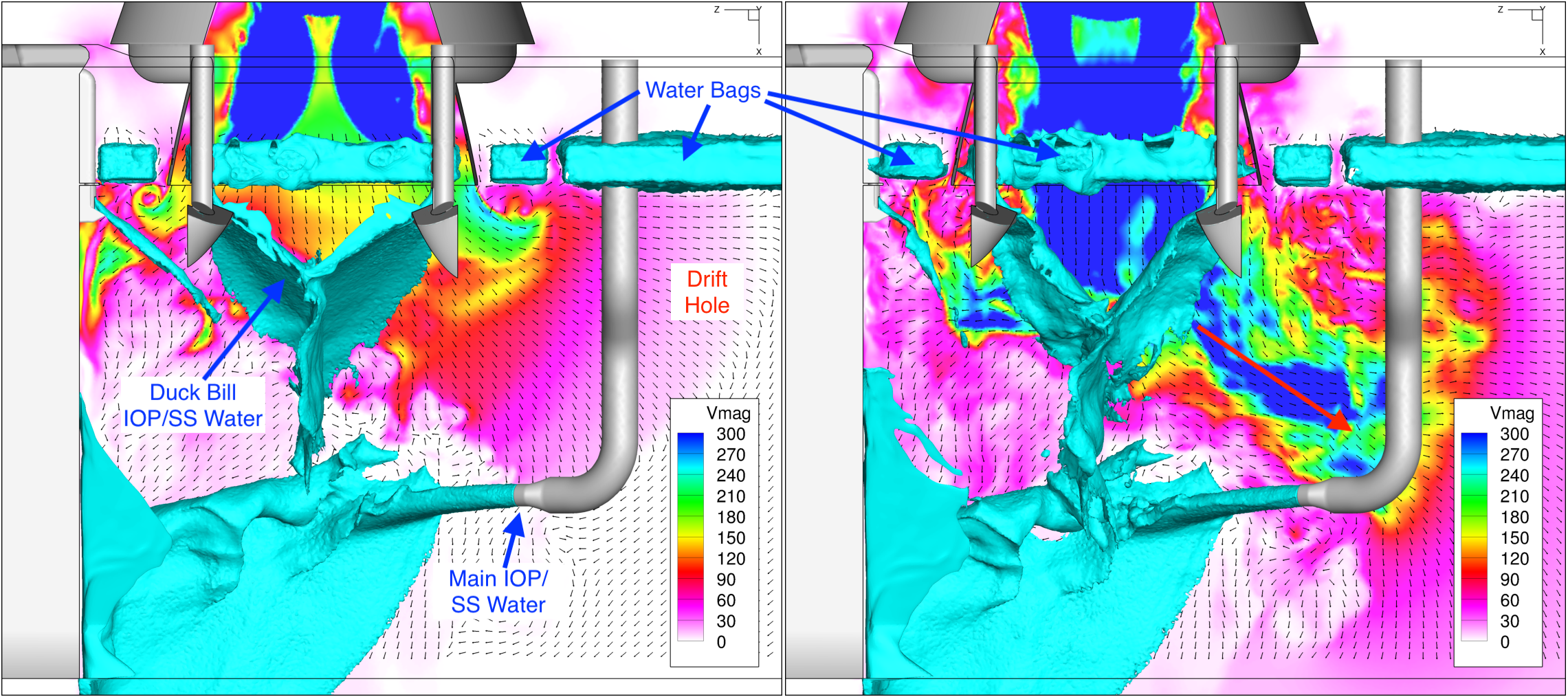
A team from NASA’s Marshall Space Flight Center has for the first time successfully completed a series of proof-of-concept tests to accurately model and predict the complex environment around the mobile launcher during ignition. The mobile launcher, the ground structure used for Space Shuttle Program, will be used to assemble, process, and launch the agency’s next-generation Space Launch System (SLS) for missions to the Moon, Mars, and beyond. Using NASA Marshall’s workhorse computational fluid dynamics (CFD) flow solver, Loci/CHEM, and the agency’s powerful Pleiades supercomputer at NASA’s Ames Research Center, CFD experts were able to validate the solver’s accuracy using high-speed video and pressure data gathered from previous launches during the space shuttle era.
The Space Shuttle Program (from STS-2 in November 1981 to STS-135 in July 2011) used a water-based sound suppression system to reduce the strength of pressure waves generated during the ignition period of a launch. This Ignition Overpressure and Sound Suppression (IOP/SS) water system used six “rain birds” to protect the top of the mobile launcher, around 60 water nozzles surrounding shuttle’s main liquid engines’ exhaust hole, and “water bags” surrounding each solid rocket booster (SRB) exhaust hole, in addition to three levels of water inside.
When the spacecraft’s engines ramp up to full power, the hot exhaust starts to push harder in the confined space of the mobile launcher, compressing the gases like a piston in an internal combustion engine. These pressure waves can cause vibrations that could potentially damage the mobile launcher, as well as the spacecraft about to take flight. The IOP/SS water system acts as a dampener, absorbing the acoustic energy and reducing the strength of the pressure waves.
“As an example, consider how the sound changes if you pluck a guitar string and then press your hand against it,” said Andrew Weaver, a propulsion systems engineer from the NASA Marshall team performing the computational tests. “Your hand is acting as a dampener for the guitar string in a similar manner as the water is dampening the engine exhaust gases.”
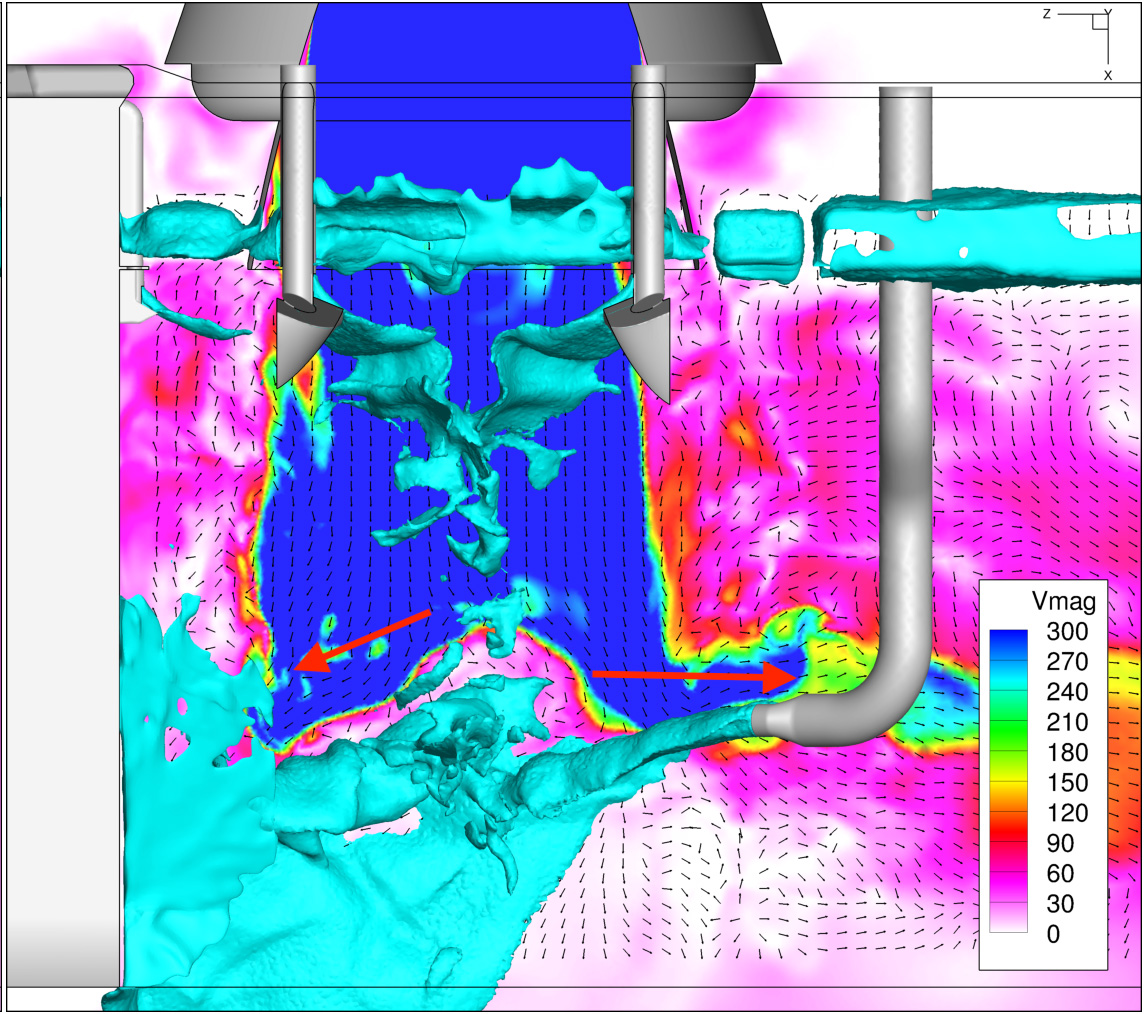
The IOP/SS water system used 350,000 gallons of water in 41 seconds, and was designed and implemented through empirical analysis and scale-model testing. Until recently, simulating this environment with CFD tools was impossible. However, over the past few years, CFD researchers at NASA Marshall have demonstrated the ability to model the complex interaction between water and supersonic plumes with Loci/CHEM’s “real fluids” module. Using a model of the IOP/SS system with a single SRB on the launch pad as a validation test, engineers were able to predict the correct timings of the plumes of water mist that exit out the top of the system, as well as the peak pressures inside the exhaust holes.
Additionally, researchers were able to closely analyze the simulations to determine that a temporary stop in the IOP/SS system was the cause of high wall pressures on the south wall of the mobile launcher. This effect had been previously observed during launches of the space shuttle over the three decades the system was in operation, but the cause was unknown.
Weaver and his team modeled a half-vehicle mesh of the SRB, containing 144 million cells. Each of the five different flow simulations they performed required 200 Intel Xeon Broadwell nodes on the Pleiades supercomputer (with 28 cores per node), used over five million processor hours, and took approximately two months to complete.
“Using a large supercomputer, such as the Pleiades system at NASA’s Ames Research Center, is essential for these simulations,” said Weaver. “Without it, these simulations might have taken a year to perform.”
NASA Marshall researchers are now applying the Loci/CHEM flow solver to NASA’s newest and biggest rocket, the Space Launch System. Changes to the mobile launcher and the IOP/SS water system have been made since the last shuttle launched in 2011 in order to modify the structure for the SLS, which requires one launch hole instead of the three needed by the space shuttle. These differences also affect how the water is distributed, meaning new challenges for the CFD team at NASA Marshall. Building on their experience simulating the launch environment for the space shuttle, the team has been moving forward. Simulations that include the redesigned mobile launcher and IOP/SS system are currently running on Pleiades, with over 69 million processor-hours to date.
— Katharine Pitta, NASA Ames Research Center
