
LAVA: NASA’s Hottest Flow Solver Contributes to Astronaut Safety
Safely delivering the first woman and the next man to the Moon and back is the top priority for NASA’s human exploration efforts. For the first crewed Artemis missions, the NASA Advanced Supercomputing (NAS) Division’s Launch, Ascent, and Vehicle Aerodynamics (LAVA) software is helping to reduce risk and ensure the safety of astronauts on the launch pad and during the moments after takeoff.
Introduced in 2016 to address key challenges of redesigning the launch environment at NASA’s Kennedy Space Center (KSC), LAVA is revolutionizing computational aeroacoustics (CAA) technology for accurate prediction of sound wave vibrations during launch and rapid iteration of launch hardware configurations—both of which are too costly to do in wind tunnels or ground tests for every design case.
“Until recently, no one thought the level of simulation accuracy and speed we have achieved could be done,” said NAS Division Computational Aerosciences Branch Chief Cetin Kiris, who initiated LAVA’s development effort. His team’s combined expertise in aerospace engineering, computational fluid dynamics (CFD), and advanced computing was the perfect environment to develop the LAVA framework.
“With LAVA’s predictive capability, the team gets answers to launch environment or hardware configuration questions for KSC project engineers more quickly and cheaply than with wind tunnel, ground, or flight tests,” said Kiris. “These tests are very expensive, so we’re pushing the envelope to incorporate relevant physics into the simulations and to validate the simulation results with real-life test data. The goal is to improve the agency’s confidence in the safety of its infrastructure, space vehicles, and overall mission success.”
Supporting Launch Pad Improvements
Before the Artemis program’s Space Launch System (SLS) can get off the ground, key components of KSC launch complex 39A—the site of the first SpaceX Crew Dragon spacecraft launch that carried astronauts to the International Space Station (ISS) in May 2020, and the SpaceX cargo Dragon launch that delivered supplies and equipment to the ISS in December—has been redesigned and rebuilt to prepare for Artemis missions.
Working with KSC engineers, Kiris’ team completed large-scale CFD simulations of the 39A and 39B launch pads. The latter will be used for the Artemis I (formerly Exploration-1) uncrewed flight around the Moon and back to test the SLS together with the Orion spacecraft.
The team investigated both pressure and thermal environments by running simulations of the main flame deflector (MFD), the mobile launcher, and the tower, including umbilical hardware and other key components of the launch pad.
To improve the fidelity of these launch environment simulations, this year the team added unique CFD methods for solving equations of multiphase flow that includes both liquids and gasses. This capability is needed to model the water-based Ignition Overpressure and Sound Suppression systems, which add an enormous amount of water to the launch environment in order to weaken pressure waves that might damage the payload or other systems.
“These simulations are incredibly complex, and the extreme nature of the problem makes traditional solution methods infeasible. LAVA uses novel numerical methods developed here at NAS that enable these challenging simulations and represents a powerful capability for the agency,” said Jordan Angel, a NAS research scientist on the LAVA team.
The multiphase simulations were run on the NAS facility’s Electra and Aitken supercomputers and post-processed using tools from the LAVA framework, along with custom visualization techniques developed by the Visualization and Data Analysis team at NAS.
“To address the extremely detailed geometry of KSC Launch Pads 39‑A and 39‑B, we specifically designed the high-performance LAVA Cartesian flow solver to automatically enable the simulation of arbitrarily complex geometries. The immersed boundary automated meshing technique we use makes possible rapid response to changing pad design configurations with high-order accurate multispecies and optionally multiphase simulation,” said NAS Research Scientist Michael Barad, who is working on the development of the LAVA Cartesian module.
According to Barad, these simulations are some of the largest ever conducted at NAS—typically containing over 550 million grid cells and more than 500,000 timesteps—and using more than 4,000 cores on Electra.
New Simulation Methods for Crew Safety
Sitting atop the SLS, NASA’s Orion spacecraft will carry the Artemis II crew to space. An integral part of ensuring safe spaceflight is Orion’s Launch Abort System, or LAS. This state-of-the-art crew escape system can outrun the speeding rocket and quickly pull astronauts to safety in case of an emergency during launch.
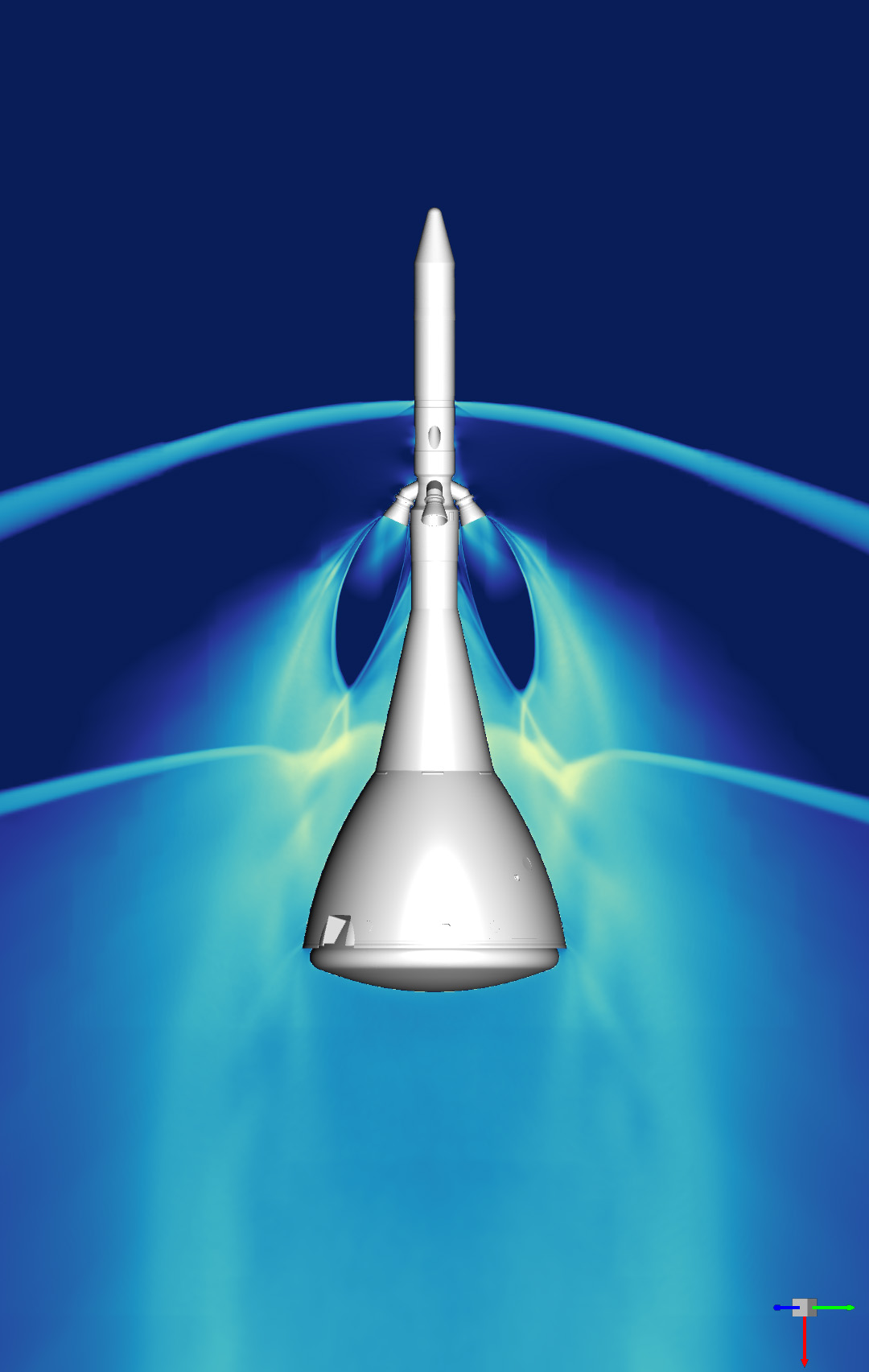
To propel Orion away to safety, the LAS uses a motor that produces four large, high-speed exhaust plumes that flow along the sides of Orion and generate extremely strong vibrations. To better understand the effects of altitude and velocity on the strength and distribution of these vibrations, the LAVA scientists produced turbulence-resolving simulations across a wide range of launch abort scenarios using supercomputers at the NAS facility.
The team validated LAVA’s powerful predictive capability with data acquired during two full stress-tests of the LAS, starting with the Pad Abort 1 (PA-1) flight test conducted in 2010—where the LAS accelerated to over ten times the gravity of Earth—and the Ascent Abort Test 2 (AA-2) conducted in summer 2019, which carried both the LAS and a 22,000-pound Orion test vehicle to an altitude of 31,000 feet and a speed of Mach 1.17, or just over 1,000 miles per hour.
The PA-1 flight test simulation was unprecedented in scale and scope, and demonstrated a new capability for NASA. This was the first turbulence-resolving simulation of an accelerating pad abort scenario with enough fidelity to accurately predict the acoustic vibrations on the surface of the LAS when compared to the flight test data.
The most recent AA-2 simulation was performed with an adapted Cartesian mesh with about 720 million cells, and completed more than 588,000 time steps corresponding to 1.3 seconds of real time. NAS visualization experts provided renderings that give an in-depth look at the fluid dynamics causing high sound pressure levels in certain areas.
Having validated the CFD predictions with the available PA-1 and AA-2 flight test data, this simulation capability will be used in collaboration with the Orion Loads and Dynamics team at NASA’s Johnson Space Center in Houston to augment wind tunnel, ground test, and flight test data. The objective is to help reduce uncertainty in the predicted vibrations on the vehicle, helping to finalize the LAS design—and ultimately enhance the safety of the Artemis team of astronauts during a potential launch abort.
“The success of these simulations opens the door to more analysis that can help reduce uncertainty for abort scenarios that are too difficult or too expensive to test,” said NAS Research Scientist Francois Cadieux.
Continuous Improvements to Save Time and Money
According to Kiris, LAVA’s unique capabilities enable the required space and time resolution needed to support NASA’s complex CAA scenarios for launch vehicles.
Kiris’ team continues to add more multi-physics capabilities to support other mission-critical projects such as simulations of parachutes for Mars entry and descent.
“I’m very excited that we are currently in a software optimization/re-factoring cycle, targeting NASA’s latest supercomputing hardware, and we anticipate reaching the next level of simulation performance and parallel scalability in the near future.” said Barad.
At the same time, the LAVA team is working to improve LAVA’s accuracy, and to speed up the turnaround time for engineering problems. Their efforts have already made impacts on numerous NASA projects in other areas, including the X‑59 low-boom flight demonstrator and the X‑57 Maxwell concept electric aircraft, where they have helped the design engineers save significant amounts of time and money.
—Jill Dunbar, NASA/Ames Research Center
