
Global, High-Resolution Chemistry in GEOS-5
Overview
A chemistry transport model (CTM) can provide a global 3D picture of atmospheric composition with insight into the complex physical and chemical interactions of chemical compounds. One of the most important of these compounds is tropospheric ozone, produced when nitric oxides (NOx) and hydrocarbon pollutants react in sunlight. The GEOS-Chem CTM is a state-of-the-art CTM that was re-engineered to serve as a chemistry module for Earth system models; it has been incorporated into the Goddard Earth Observing System (GEOS-5) General Circulation Model (GCM) to provide the meteorological inputs needed by the CTM.
Atmospheric chemistry and related processes are highly non-linear, making it crucial for atmospheric chemistry models to adequately capture the spatial and temporal heterogeneity of all involved species. For instance, concentrations of ozone precursors such as isoprene and NOx exhibit strong fluctuations in space and time due to highly localized emissions sources. Models running at coarse resolution inherently suffer from a misrepresentation of these sharp concentration gradients, which adversely impacts the quality of the simulation. To explore these issues, a very high-resolution 12-kilometer (km) run of GEOS-Chem in the GEOS GCM is being performed, the first time GEOS-Chem has been tested globally at these scales.
Project Details
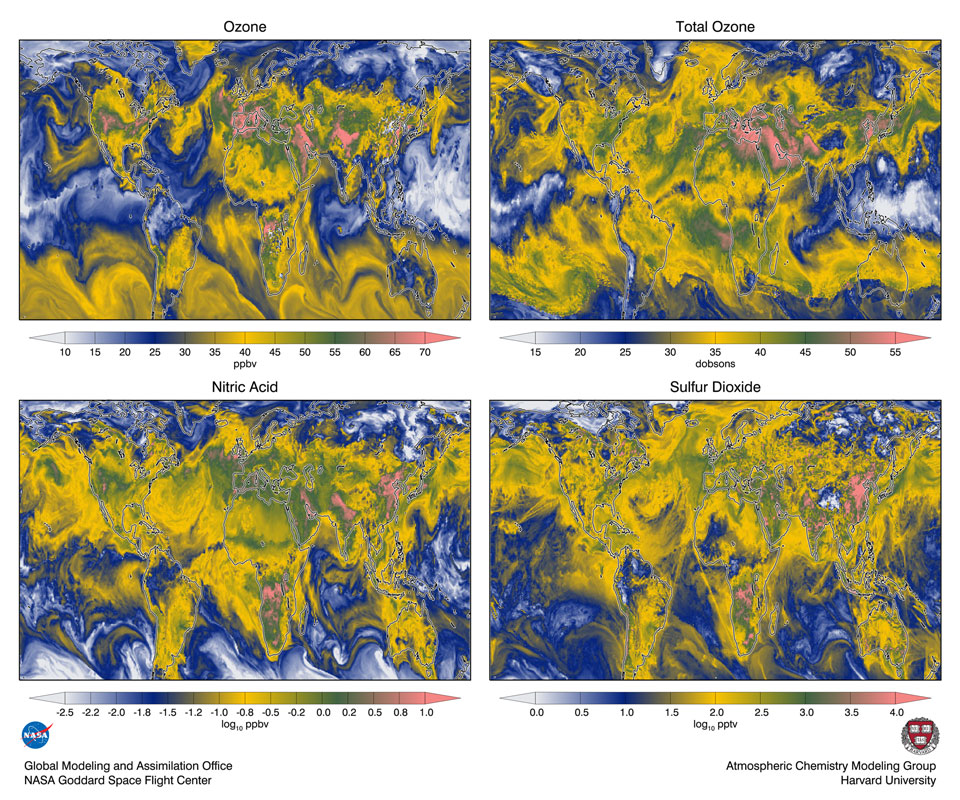
Researchers are performing a year-long run of the GEOS-5 GCM with GEOS-Chem for the period of June 2013 to July 2014 at 12-km resolution. This time period coincides with the Studies of Emissions and Atmospheric Composition, Clouds and Climate Coupling by Regional Surveys (SEAC4RS) field campaign that is being used for validation. The results will then be used as "nature run" input for observation system simulation experiments of the GEOstationary Coastal and Air Pollution Events (GEO-CAPE) mission. To provide realistic input fields to GEOS-Chem, the 50-km reanalysis from the Modern-Era Retrospective analysis for Research and Applications, version 2 (MERRA-2 ) project was first downscaled to 12 km with GEOS-Chem off to provide the forcings needed to constrain the meteorology for the year of the simulation. Then the year was re-run with GEOS-Chem only using the forcings from the downscaling.
Results and Impact
- Validation against the SEAC4RS field campaign data shows that the GESO-Chem module in GEOS-5 provides a realistic simulation of tropospheric chemistry.
- The validation efforts have also shown that some of the parameterizations currently used by GEOS-Chem are sensitive to resolution and will need to be adjusted for the finer resolution. This includes biogenic emissions, sea salt aerosols, and lightning NOx.
- For the first time, we are able to realistically simulate on a global scale the small-scale concentration patterns of chemical species that are critical for human health.
Why HPC Matters
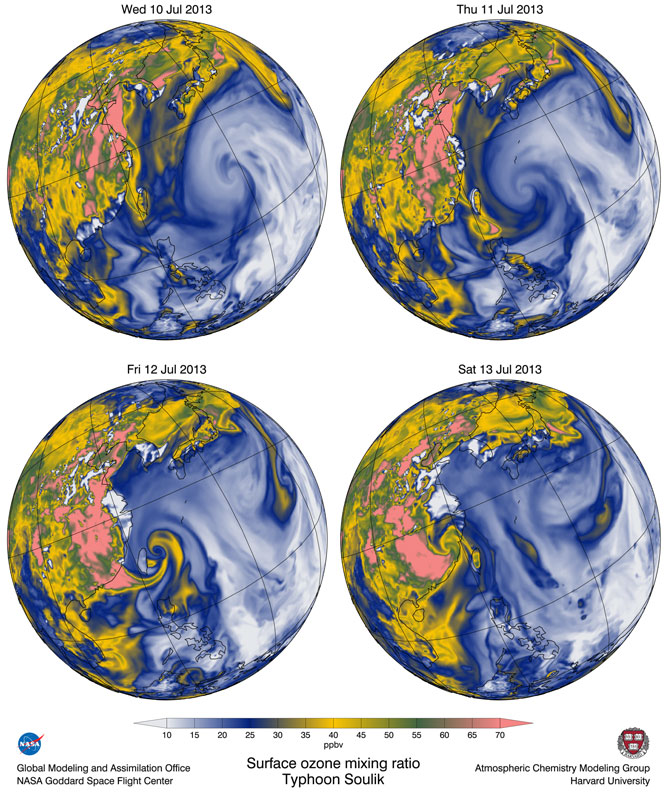
Performing high-resolution simulations with the GEOS-5 GCM requires large amounts of computational power and data storage that is only feasible in a high-performance computing (HPC) environment. The 12-km run of GEOS-5 with GEOS-Chem required approximately 5,000 cores on the Discover cluster at the NASA Center for Climate Simulation, had a throughput of about 10 model-days per day, requiring about 36 days of computer time for the year-long run, and produced just over 200 terabytes of data.
What's Next
This work has provided a rich dataset for future work to tune GEOS-Chem at high resolution. From an HPC perspective, this work highlighted the need to improve the input/output performance, as the large amount of emissions being read as input for GEOS-Chem is currently a performance bottleneck and roughly accounts for about 30% of the simulation time in this run.
Benjamin Auer, NASA Goddard Space Flight Centerbenjamin.m.auer@nasa.gov Christoph Keller, NASA Goddard Space Flight Center
christoph.a.keller@nasa.gov