
Astrophysics – Supercomputing the Universe
Great observatories like the Hubble Space Telescope are providing an ever broader and deeper picture of our universe. As Hubble and its kin observe objects at vast distances, they can peer back billions of years in time. Guided by such observations, Princeton University researchers are using NASA's Pleiades and Endeavour supercomputers to simulate how galaxies and the surrounding intergalactic medium evolve from the young universe, and then mine the resulting reams of data.
The ability to analyze such a large sample of galaxies grants us an unprecedented opportunity to gain deep physical understanding of the fundamental mechanisms underlying galaxy formation and other cosmological phenomena.
Renyue Cen, senior research astronomer, Princeton University Observatory
The researchers employ adaptive mesh refinement to cover a 1-million-fold range of spatial scales and a 10-billion-fold range of object masses. These cutting-edge simulations enable researchers to follow the formation and evolution of thousands of galaxies simultaneously for the first time. Among the results is that galaxies with redshifts greater than 6 (existing about 900 million years after the Big Bang) not only contain massive amounts of dust (an important seed for stars and planets to form) but also a significant number of old stars—an unconventional finding to be explored by future observations and simulations.
Quick Facts
- The current estimated age of the universe is 13.82 billion years.
- Simulations of high-redshift galaxies are in excellent agreement with Hubble Space Telescope observations in terms of stellar mass function, ultraviolet (UV) luminosity function, far-UV to near-UV color, optical to UV color, and other traits.
- Data from the new 66-antenna Atacama Large Millimeter Array in Chile will enable verification of additional simulation predictions about the galaxies' far-infrared properties.
- The infrared James Webb Space Telescope, scheduled for launch in 2018, will supply greater insights into the high-redshift frontiers of galaxy formation.
Key Image
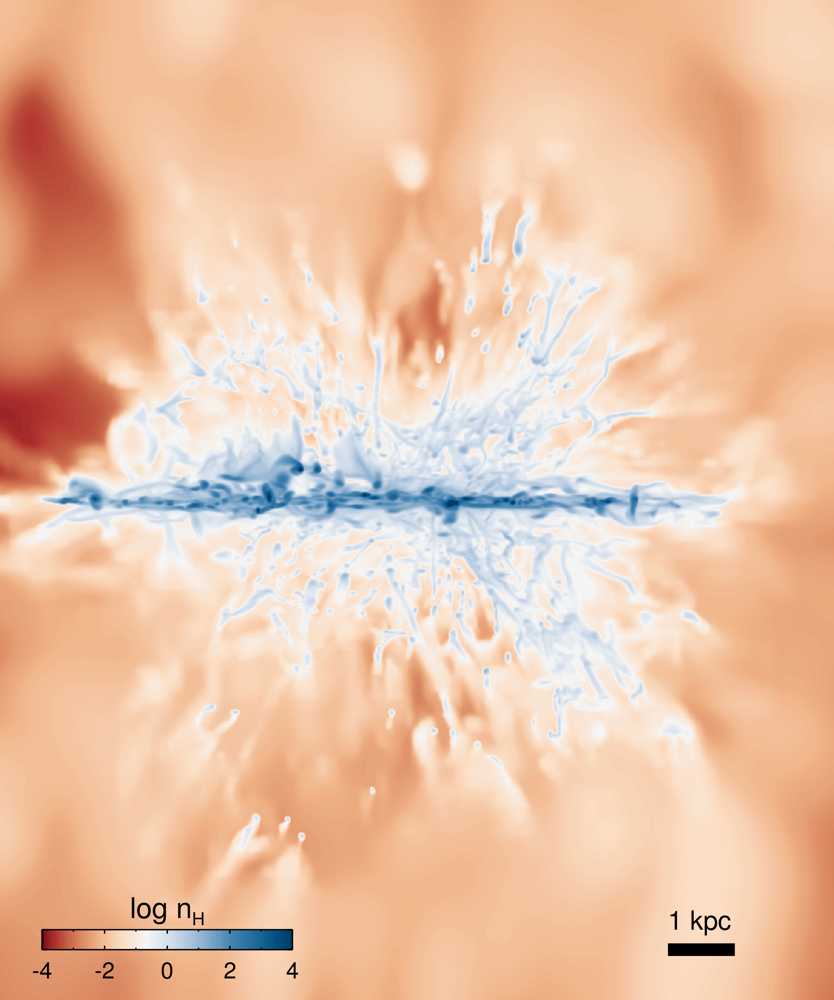
Image Caption
Visualization showing an edge-on projection of gas density in the inner 14-kiloparsec (kpc) region of a simulated galaxy with a velocity dispersion of 50 kilometers per second. Dense clumps and filaments seen above the galactic plane are a clear indication of strong outflows. The rate of outflow measured through planes parallel to the disk at 5 kpc is comparable to the star formation rate (about three solar masses per year). Taysun Kimm, Princeton UniversityDownload High-Res Image
Contacts
Renyue Cen, Princeton Universitycen@astro.princeton.edu