
Aeronautics – An Approach That's Easy on the Ears
Noise from aircraft adversely impacts communities around airports and is expected to increase considerably with the growing demand for air travel. To alleviate this problem, NASA's Environmentally Responsible Aviation (ERA) project is performing large-scale aerodynamic simulations to develop and evaluate novel noise-reduction concepts for aircraft. Using the space agency's Pleiades supercomputer, scientists perform high-fidelity simulations of the airflow around key airframe components, which produces noise that can be even louder than the plane's engines during landing approach.
Our high-fidelity simulations have enabled us to probe into the underlying noise-generation mechanisms associated with flow over aircraft flaps and landing gear, and to develop and improve several promising noise-reduction concepts.
Mehdi R. Khorrami, senior scientist, NASA Langley Research Center
The project's recent studies target the noise generated by the landing gear and wing flaps, based on an 18-percent scale semi-span model of a Gulfstream aircraft. These simulations have provided new insights into the complex flow interactions around the flaps and landing gear, and how they increase the sound field radiating toward the ground. Using these insights, the team has developed, evaluated, and refined several viable noise-reduction concepts. Enabled by NASA's powerful supercomputing resources, these efforts are paving the way for future air travel that will be much easier on the ears.
Quick Facts
- The ERA project's high-fidelity simulations capture the complex aerodynamic effects that impact aircraft noise, such as vortex formation, bluff body flow separation, and flow interactions between multiple airframe components.
- The large-scale, time-dependent airframe noise simulations were performed using the Exa Corporation's PowerFLOW Lattice-Boltzmann flow solver, with two to five billion volumetric cells used to discretize the space surrounding the aircraft surfaces in the computational model.
- All of the ERA project's simulations were performed on NASA's Pleiades supercomputer using approximately 3,000 processors for two to four weeks each, and resulted in several petabytes of data.
- The ERA project has demonstrated the effectiveness of the noise reduction technologies it has developed, both through wind tunnel testing and simulation.
- The project's recent simulation efforts represent a major step toward predicting the radiated noise field from a full aircraft in landing configuration.
Key Image
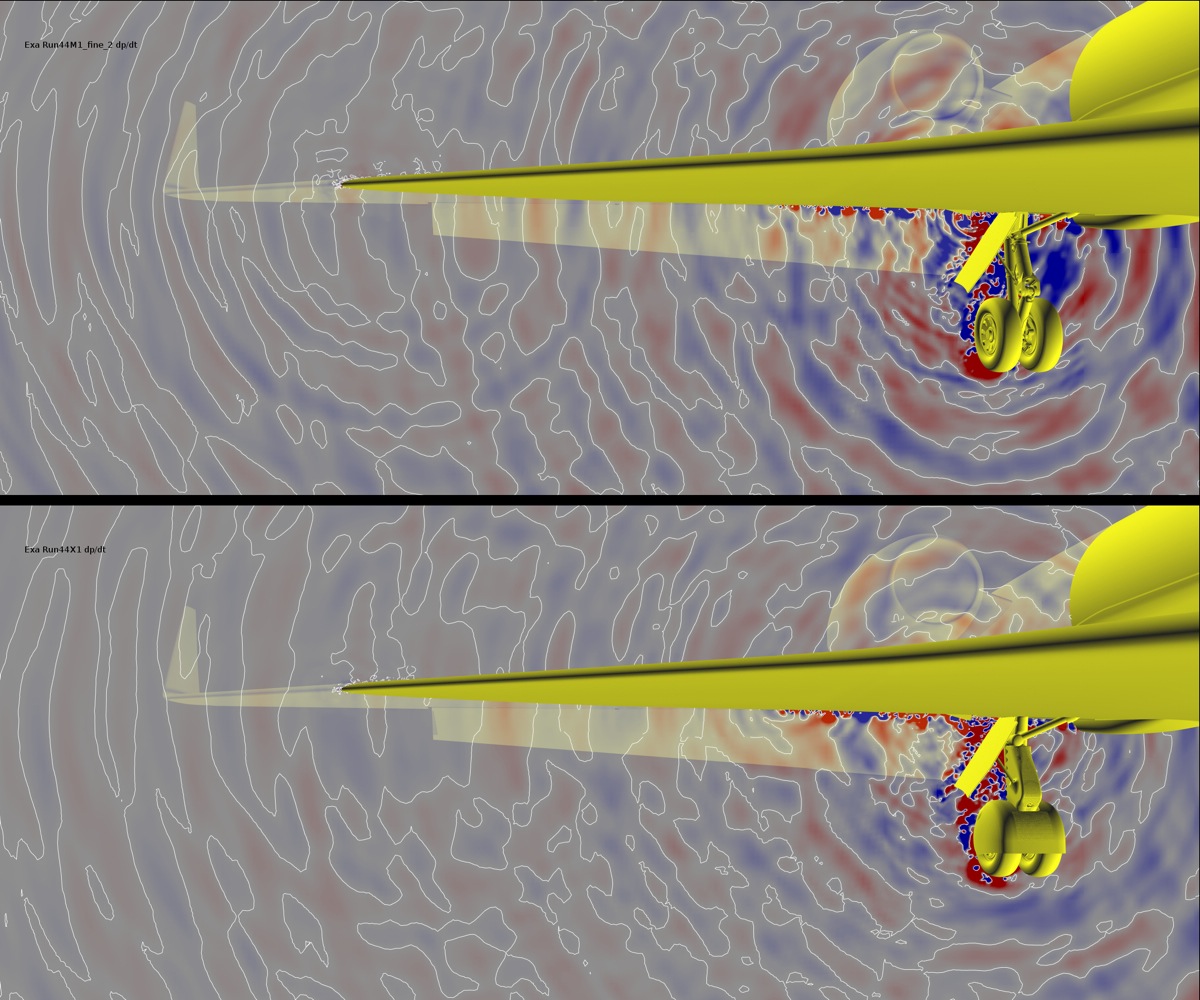
Image Caption
Visualizations of the simulated airframe noise sources for a Gulfstream aircraft, showing the acoustic fields emanating from the deployed landing gear and wing flap region, without (top) and with (bottom) noise-reduction concepts applied to the flap tips and main landing gear. Ehab Fares, Exa Corporation; Patrick Moran, NASA/AmesContacts
Mehdi R. Khorrami, NASA Langley Research Centermehdi.r.khorrami@nasa.gov