
Space Exploration – Streamlining the Design of Launch Systems
From the intense blast of rocket engines on the launch pad to acceleration through supersonic speeds and the precise separation of solid rocket boosters, space launch involves many complex and powerful aerodynamic phenomena that can make or break NASA's exploration missions. A team of scientists in the NASA Advanced Supercomputing (NAS) Division at Ames Research Center is performing high-fidelity simulations of critical aerodynamic factors to support the design of the agency's next-generation space launch vehicles and launch structures. Using specialized, NASA-developed codes, run on the Pleiades supercomputer, these scientists model evolving vehicle designs and compute the detailed aerodynamic flows, forces, and interactions that could affect a vehicle during ascent.
Our simulations are an efficient source of design data due to the quick turnaround times and minimal cost to produce results for a large number of aerodynamic performance databases and launch pad configurations.
Cetin Kiris, chief, Applied Modeling & Simulation Branch, NASA Ames Research Center
The team also performs extremely large-scale simulations of conditions during ignition and takeoff to determine whether NASA's current launch structures can safely handle new vehicles and to assess potential launch pad modifications. These efficient, detailed analyses help streamline the speed and cost of developing new launch systems while also ensuring the highest possible performance and safety standards. Current simulation efforts are focused on NASA's heavy-lift Space Launch System (SLS), which will carry spacecraft, cargo, and crew for future space exploration missions.
Quick Facts
- Computational fluid dynamic (CFD) simulation results have provided critical data during two design analysis cycles of NASA's heavy-lift Space Launch System.
- CFD simulations of launch vehicle ascent provide detailed data on aerodynamic forces, moments, surface pressures, and structural line loads over the entire trajectory for potential vehicle shapes and design variations.
- Simulations of solid rocket booster (SRB) separation under various conditions are performed to assess the potential for re-contact between the boosters and core stage and ensure safe separation.
- High-fidelity simulations of pressure waves and acoustic vibrations during liftoff help engineers redesign the launch pad to ensure vehicle stability, payload safety, and launch pad durability for heavy-lift vehicles and commercial vehicles.
- The Pleiades supercomputer enables NAS CFD experts to perform hundreds of high-fidelity viscous ascent cases in under a week, thousands of efficient inviscid cases in as little as two days, and large-scale unsteady launch environment simulations that each require 1,000 cores for a week.
Key Image
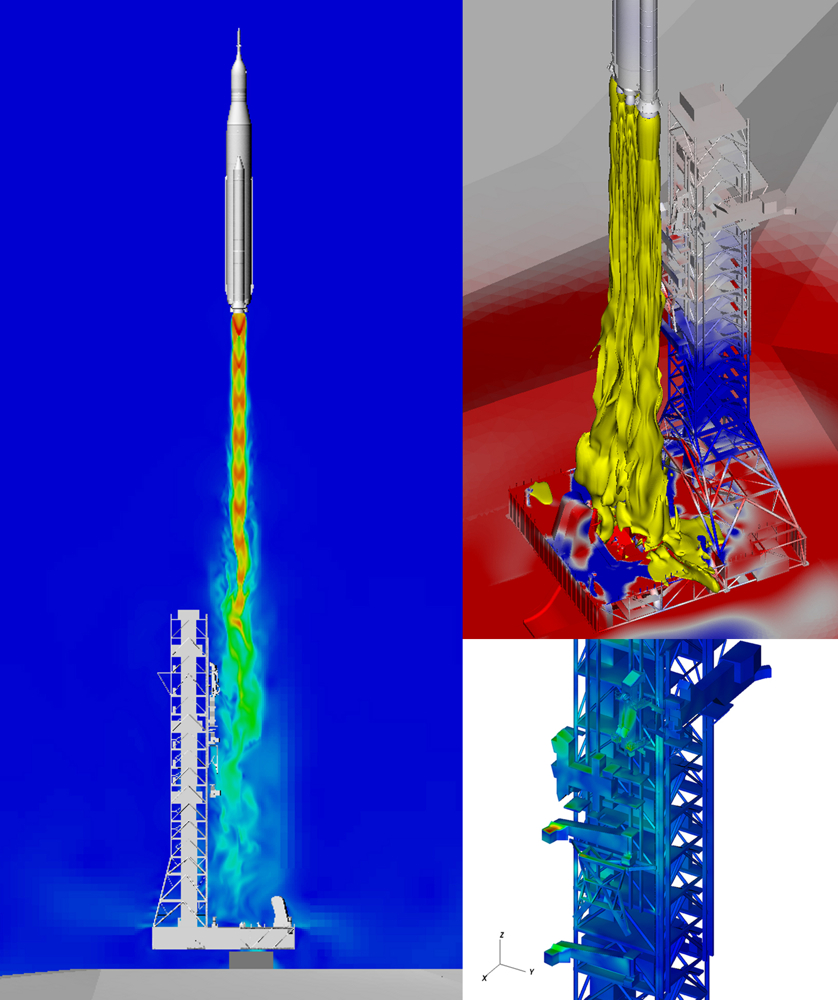
Image Caption
Computational fluid dynamics simulation of a Space Launch System drift scenario with the vehicle plume impinging on the launch tower and platform. This simulation provided engineers with unsteady pressure forces to assist in the redesign of the tower and "umbilical" hardware. Michael Barad, NASA/AmesDownload High-Res Image
Contacts
Cetin Kiris, NASA Ames Research Centercetin.c.kiris@nasa.gov