
Enabling a Quieter Approach for Aircraft Landing
Overview
Aircraft noise adversely impacts population centers near major airports. With the expected growth in air travel, these noise exposure levels will increase considerably. To alleviate this problem, the Environmentally Responsible Aviation (ERA) project within NASA's Aeronautics Research Mission Directorate is working to simultaneously reduce aircraft noise, fuel consumption, and engine emissions.
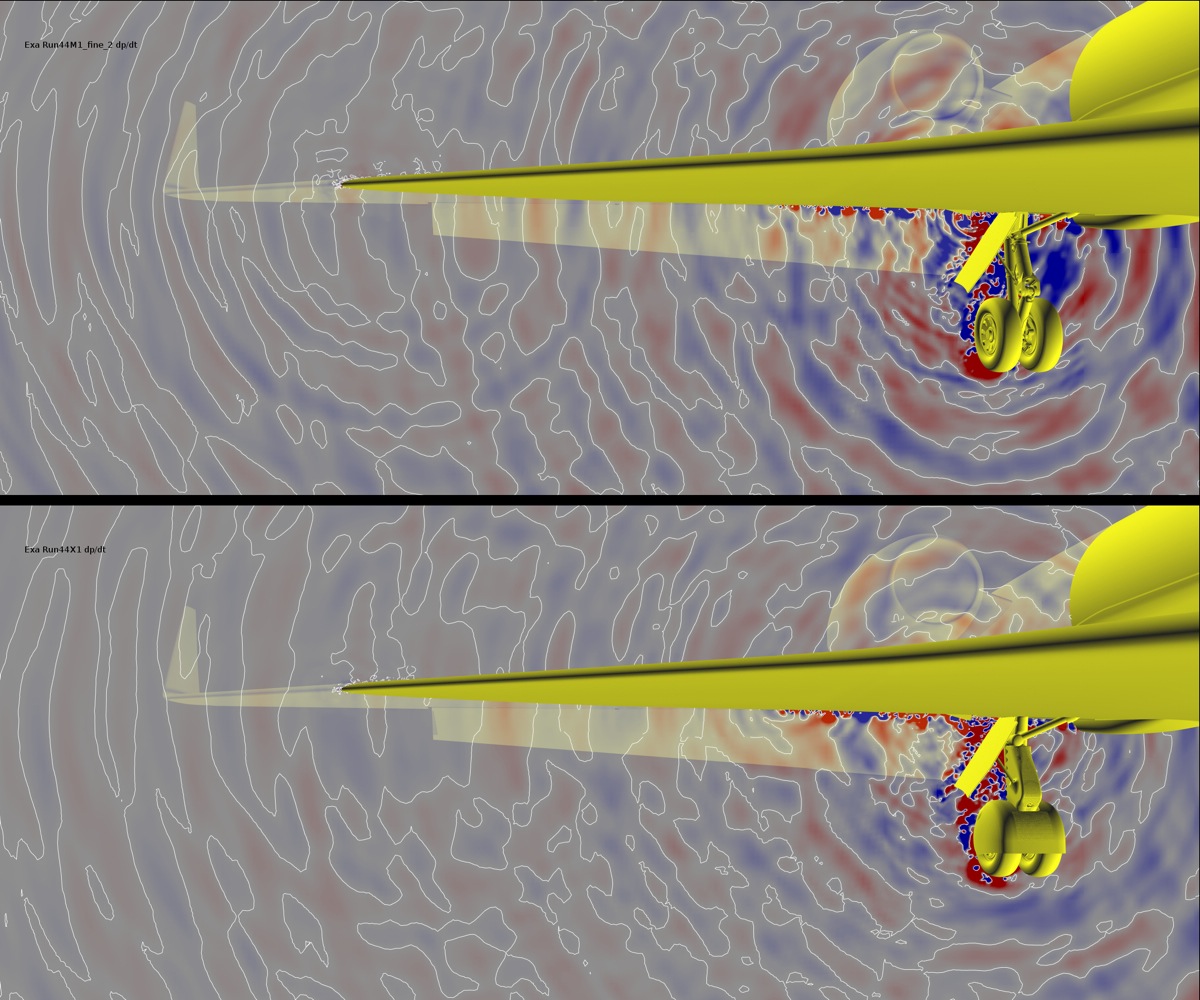
During landing, noise generated by the airframe is as loud, or even louder, than propulsion noise. The prominent sources of airframe noise are the landing gear and high-lift devices such as wing flaps and slats. In order to successfully mitigate airframe noise, contributions from all the major sources must be reduced concurrently. We apply large-scale, high-fidelity computational simulations to develop and evaluate novel noise-reduction concepts.
Project Details
As part of an ERA-Gulfstream partnership on airframe noise research, we extended our previous simulations involving the noise sources associated with deployed wing flaps. For our new studies, we added the main landing gear components to the same 18 percent scale semi-span model of a Gulfstream aircraft that was used for the flap tests. Using this model, we simulated the noise sources associated with deployed landing gear, flaps, and interactions between the two. We focused on accurately capturing the dominant noise sources at both flap tips and the main landing gear for the baseline configuration. We also evaluated the effectiveness of several viable noise-reduction technologies applied to the flap tips and main landing gear.
This effort represents a major step toward predicting the radiated noise field from a full aircraft in landing configuration. Our time-dependent simulations were performed using the Exa Corporation PowerFLOW Lattice-Boltzmann flow solver. Between two and five billion volumetric cells were used to discretize the space surrounding the aircraft surfaces.
Results and Impact

Our high-fidelity simulations have enabled us to probe into the underlying noise-generation mechanisms associated with flow over aircraft flaps and landing gear. The knowledge gained from these computations allowed us to develop and improve several concepts that reduce the noise generated by these components. We have demonstrated the effectiveness of these noise-reduction technologies, both numerically and through wind tunnel testing. We have also used our recent simulations to study complex gear-flap flow interactions for the first time and assess whether they produce undesirable noise.
Role of High-End Computing Resources
The extremely large number of mathematical operations needed to execute our simulations requires the largest supercomputers. All of our computations were performed on NASA's Pleiades supercomputer using approximately 3,000 processors. Depending on the nature of the problem being analyzed, the computational runs could last from two to four weeks and resulted in several petabytes of data. The NASA Advanced Supercomputing (NAS) Division's visualization team supported the rendering and visualization of these massive datasets.
Mehdi R. Khorrami, NASA Langley Research Centermehdi.r.khorrami@nasa.gov