Computational Study of a Small Ducted Propeller
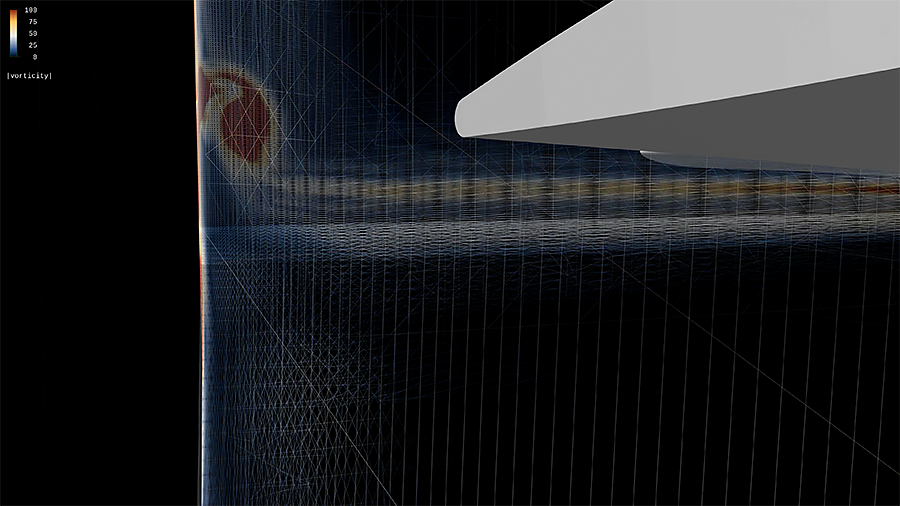
As part of the Revolutionary Vertical Lift Technology (RVLT) project to help develop the next generation of vertical lift vehicles, ranging from air taxis to large cargo transports, researchers from NASA’s Ames Research Center are using agency supercomputers to simulate the physics around a ducted propeller design. The Tiltduct—a six-passenger prototype being developed under the RVLT project—uses six ducted propellers that can tilt 90 degrees to allow for vertical and forward flight. The Ames Computational Aerosciences team simulated a single propeller of the Tiltduct design, with the goal to better understand what methods and grid resolutions are required for computational analysis to be an accurate and cost-effective tool for agency engineers. This ducted propeller is ideal to achieve that goal, since experimental data from a wind tunnel test performed at NASA’s Glenn Research Center was available and used to assess the accuracy of the computational simulation results. The results of the single ducted propeller simulations and lessons learned will then be used to establish the best methods for future simulations of a full vehicle where multiple ducted propellers are present.
Quick Facts
Accurately capturing the physics involved in this problem required running large simulations for long periods of time. Each case was using a few hundred CPUs and required a week of wall-clock time to run, which is something that is only made possible through the use of NASA’s supercomputers.
- The project involved running time-accurate simulations of a rotating propeller using NASA’s OVERFLOW computational fluid dynamics code, while studying a variety of simulation parameters, including refinement of the computational mesh and selection of different numerical schemes to optimize and improve simulation accuracy.
- Over the course of the study, the team found that using the automated mesh adaption tool in OVERFLOW led to much more accurate predictions of the physics around a ducted propeller without much penalty to the amount of computational resources needed to run a case.
- The results and best practices developed over the duration of this Tiltduct study will used by groups across NASA for future analysis of vehicle concepts that utilize ducted propellers.
- On average, each simulation from this case required the use of about 300 CPUs run for over a full week on the systems at the NASA Advanced Supercomputing facility at Ames.
Researchers
- James Jensen, NASA Ames Research Center Please enable Javascript to see email address.
- William Chan, NASA Ames Research Center Please enable Javascript to see email address.
