Understanding How Biphilic Surfaces May Improve Electronics Cooling
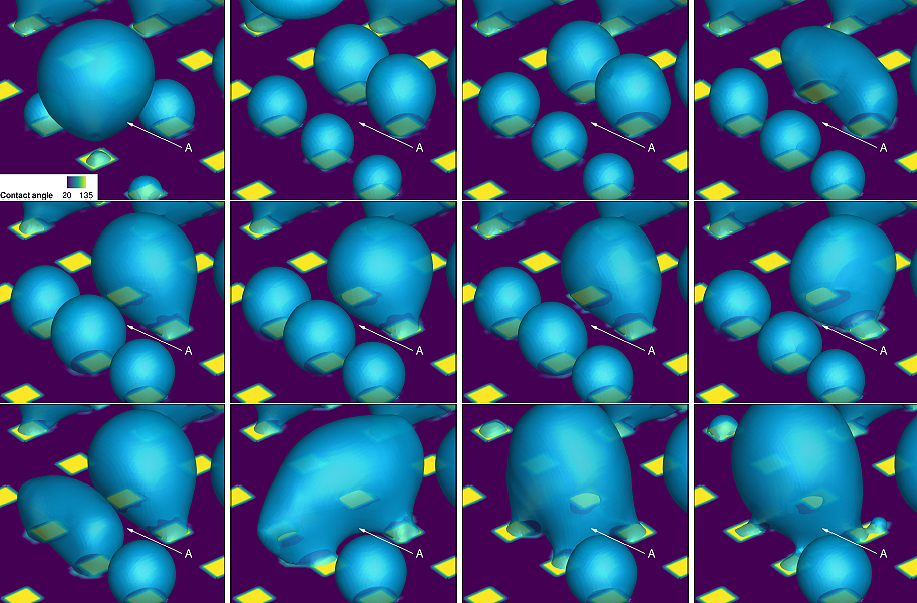
As we continue to develop more powerful electronics, it is vital to also improve systems that keep them cool. Researchers from the University of Maryland, College Park are using NASA supercomputers to simulate liquid cooling behavior on a biphilic surface—a surface with areas that repel water (hydrophobic) and attract water (hydrophilic)—which experiments have shown to have increased cooling properties compared to normal surfaces. However, experiments are unable to properly explain the underlying physical mechanisms at play. Using numerical experiments and an in-house multiphase solver, the team simulated pool boiling (vaporization) of coolant liquid under normal gravity on a simple model of a heater surface that has a uniform pattern of square hydrophobic and hydrophilic surfaces. Their simulations varied the ratio of hydrophobic areas to understand its effect on heat flux and thermo-fluid characteristics, and showed that a ratio of 0.25 showed the highest average heat flux under these conditions.
Quick Facts
NASA’s high-end computing resources have been indispensable for this project, as the computational simulations were carried out on the agency’s Pleiades supercomputer. I am also extremely thankful for the services offered by the NASA Advanced Supercomputing Division for assistance with data visualization and computing environment optimization.
- The in-house multiphase computational fluid dynamics solver FLASH was used to conduct these pool boiling simulations on the Intel Xeon “Broadwell” nodes of NASA’s Pleiades supercomputer, requiring a total of 1.2 million wall-clock hours and four terabytes of storage.
- Three cases were considered, with hydrophobic surface ratios of 0.01, 0.25, and 0.75. The 0.25 case showed the highest average heat flux at steady state, and the team was able to identify the different heat transfer mechanisms and their contributions, which have been difficult to understand in real-world experiments.
- The cooling of electronics is also required in space, so these simulations can also be applied to low-gravity conditions, helping to design better cooling systems for future space missions to reduce energy consumption and increase cooling efficiency.
- Future work will address more cases of hydrophobic surface behavior to establish a larger dataset for analysis and the project will also be extended to a model that includes flow boiling.
Researchers
- Shantanu Vachhani, University of Maryland, College Park Please enable Javascript to see email address.
- Amir Riaz, University of Maryland, College Park Please enable Javascript to see email address.
