Predicting Supersonic Parachute Inflation for Mars Sample Return
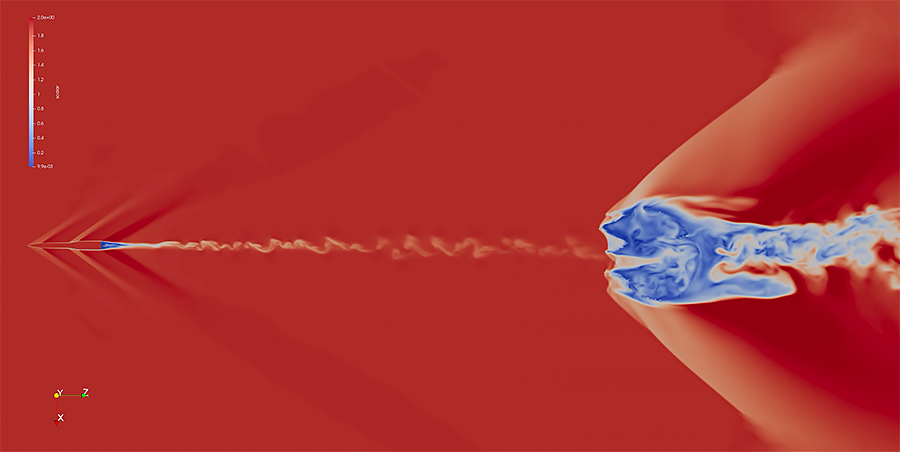
NASA’s Mars Sample Return campaign is developing the largest Mars lander to date, which will be used in the next decade to retrieve the planetary samples being taken by the Curiosity rover. To safely land on the surface of Mars, this new vehicle will require the largest supersonic parachute ever flown to the red planet, so the agency is developing computational tools that can be used to help test the design prior to flight. To model this complex environment, researchers at NASA’s Jet Propulsion Laboratory are using the AERO computational suite, which gives them the ability to perform coupled fluid-structure interaction (FSI) simulations on agency supercomputers. These high-fidelity simulations incorporate both computational fluid dynamics and structural responses of the parachute model to understand how the two interact. The team’s current goal is to use flight data from the Advanced Supersonic Parachute Inflation Research Experiment (ASPIRE)—tests that helped design the parachute used for the Perseverance rover’s decent to Mars—to validate the AERO FSI model’s code and assumptions. This will enable the tool to be used in estimating the performance of the Mars Sample Return lander’s supersonic parachute system.
Quick Facts
With model mesh sizes on the order of hundreds of millions of points, agency supercomputing systems made running these high-fidelity coupled fluid-structure simulations possible in a reasonable timeframe, which would be infeasible to do on small workstations or computer systems.
- This project leverages the Electra and Aitken supercomputers operated at the NASA Advanced Supercomputing facility, with recent FSI simulations running for approximately two weeks on 21 AMD “Rome” nodes (using 96 cores/node) for a total of 2,016 cores.
- The results so far have identified the importance of the suspension line structure model during the simulated parachute inflation, as well as the need to model the motion of the payload and parachute system in six-degrees-of-freedom in order to accurately match the parachute inflation drag.
- This effort has established many best practices for modeling the complex and varied physics of FSI simulations, which are being incorporated by groups inside and outside NASA for other computational tools.
- Future work will include performing and comparing additional simulations against validation data to finalize how to best approach the FSI simulations, eventually applying these to simulations of the Mars Sample Return lander and parachute system.
Researcher
- Marcus Lobbia, NASA Jet Propulsion Laboratory Please enable Javascript to see email address.
