Simulating Capsule Free-Flight for Planetary Entry, Descent, and Landing
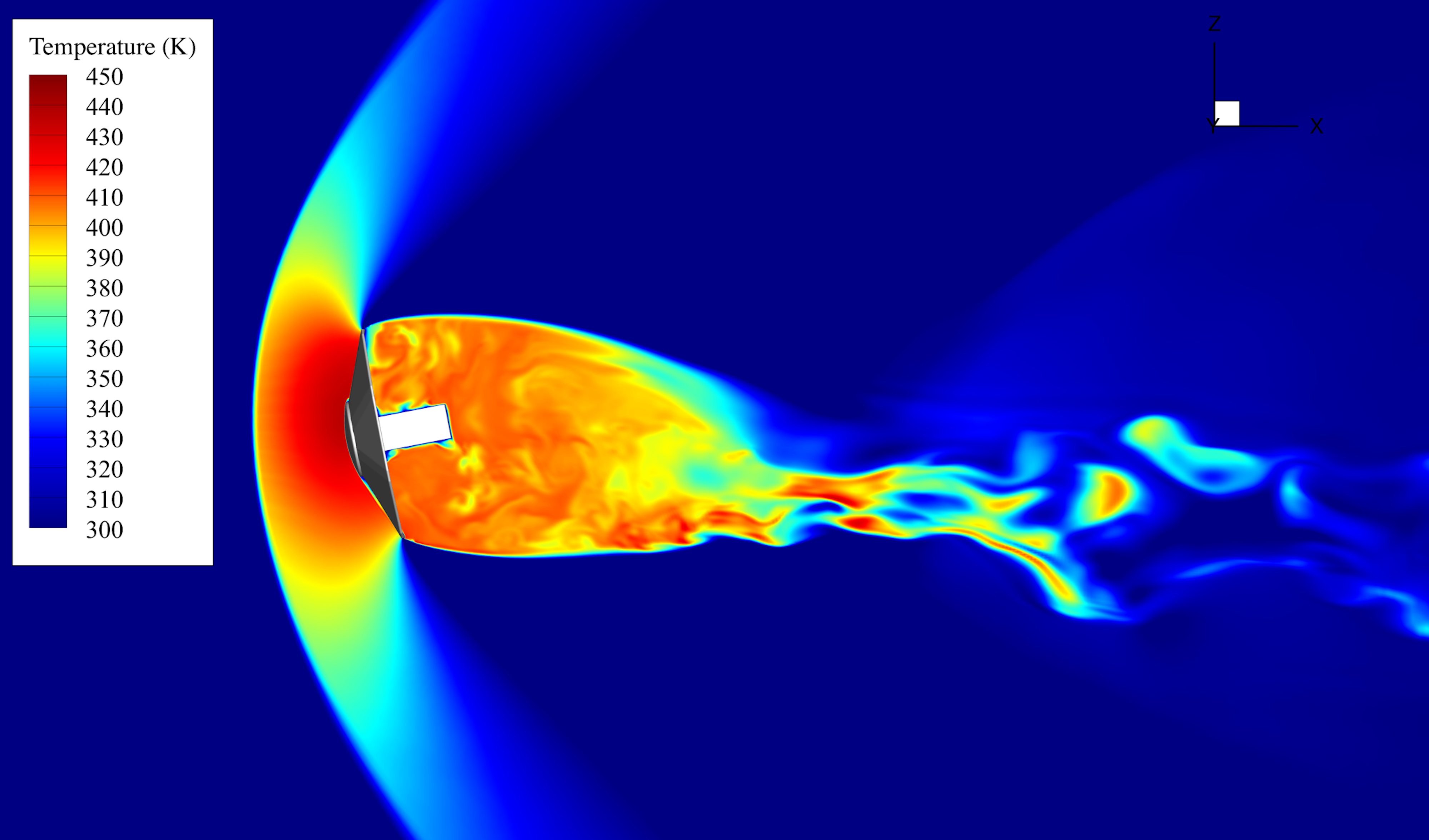
NASA designs capsules to survive the intense conditions of entering a planetary atmosphere at hypersonic speeds. These capsules protect their payloads from the high temperatures encountered early in the entry flight trajectory, but they can encounter dynamic instabilities as they are slowed down by aerodynamic drag. To quantify and understand these dynamic instabilities, researchers at NASA’s Ames Research Center used the agency’s Pleiades and Electra supercomputers to simulate the free-flight conditions of capsules during the full trajectory of planetary entry. These complex simulations involve coupling an existing computational fluid dynamics solver, US3D, to a trajectory code and allowing an object to rigidly rotate about a center-of-gravity in response to aerodynamic forces. This enables a full six-degrees-of-freedom simulation of free-flying objects, which are used by researchers at NASA Ames to analyze the flight dynamics of capsules and identify any risks these instabilities may pose during the later stage of the flight trajectory—helping ensure the success of flagship NASA missions, including the Artemis Program and the upcoming Dragonfly mission to Saturn’s largest moon, Titan.
Quick Facts
These free-flight simulations are a powerful, computationally intensive tool for engineering analysis, with a single simulation requiring about 250,000 core hours on NASA supercomputers.
- These free-flight simulations required intensive computing resources to cover the flight trajectory, and heavily utilized NASA’s Pleiades and Electra supercomputers to generate the aerodynamic databases.
- The simulations were conducted as part of the NASA Entry Systems Modeling (ESM) Project. Results compare well to ballistic range data and complement experimental methods for assessing the dynamic stability of these high-speed vehicles.
- The simulations enable mapping of the entry vehicle dynamics for the full flight trajectory and are being used for dynamic analysis for flagship NASA planetary exploration missions.
- As a next step, a simplified approach that uses reduced degree-of-freedom simulations is being investigated to reduce computational cost.
Researchers
- Kyle Thompson, NASA Langley Research Center Please enable Javascript to see email address.
- Justin Haskins, NASA Ames Research Center Please enable Javascript to see email address.
