NASA’s Use of Supercomputing in the Artemis Program
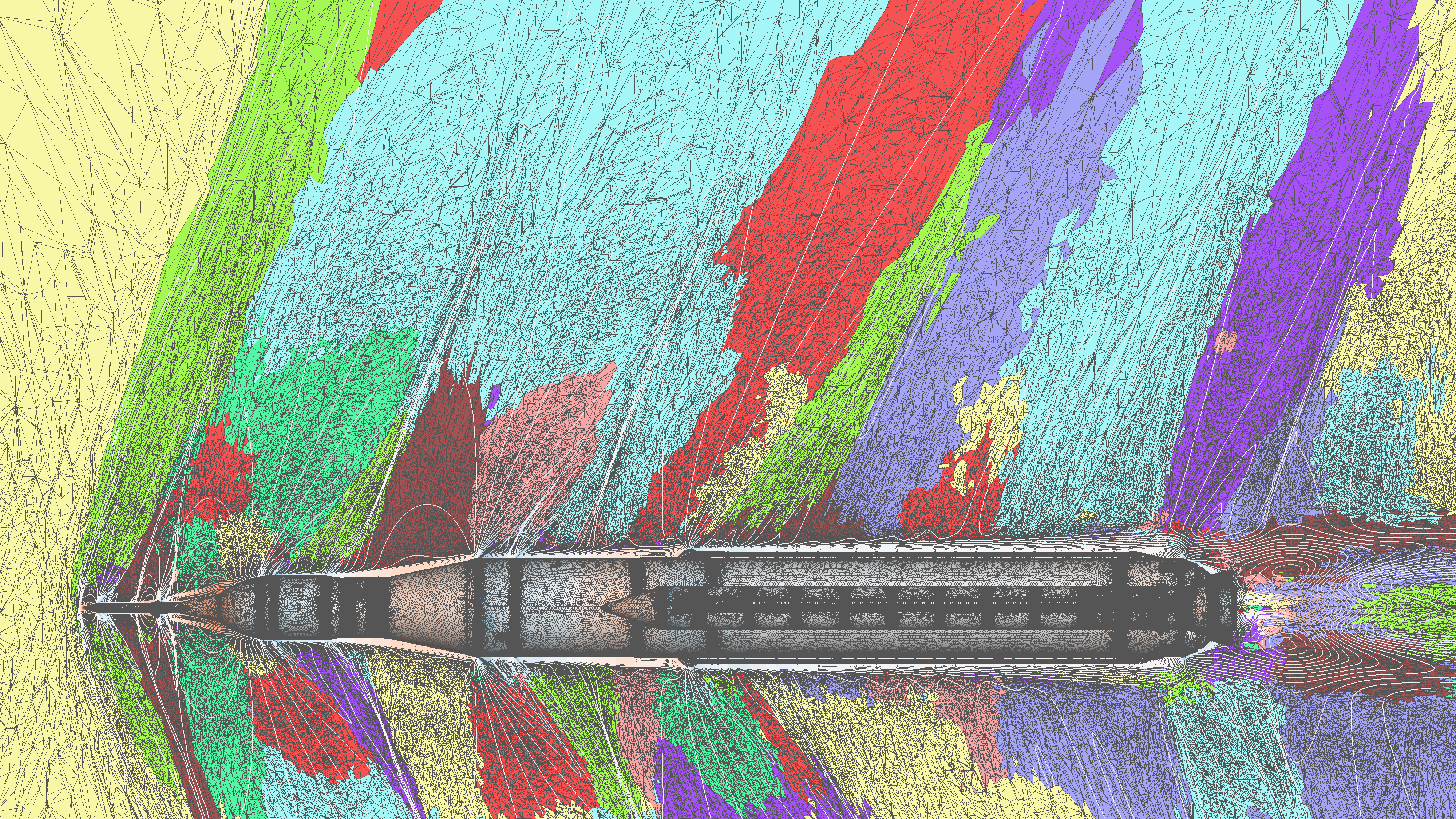
NASA has one of the largest supercomputing centers in the U.S. at Ames Research Center, as well as one of the world's most exciting endeavors, the Artemis Program, which will return humans to the Moon. Unlike the Apollo era, the agency now has significant high-performance (HPC) computing capabilities available to help develop a human spaceflight program. Groups from across the agency are using these resources for computational modeling in support of all aspects of Artemis: the Orion capsule, the Space Launch System, and Exploration Ground Systems (EGS). While a spacecraft spends most of its time in space, the beginning and end of each mission includes a rapid traverse of Earth's atmosphere. The aerodynamics, heating, and acoustics of these ascent and descent phases are the primary focus of Artemis-related supercomputing efforts. These phases are difficult to model and challenging to test, and it takes many groups at multiple NASA centers to understand them sufficiently to ensure safety and mission success. Thousands of computational fluid dynamics (CFD) simulations, run on NASA HPC systems, are used to provide mission planners an unprecedented amount of data to make decisions about mission safety.
Quick Facts
Although Apollo showed that it is possible to get to the Moon without modern HPC, NASA supercomputing resources provide different kinds of information than other types of testing. The improved understanding we obtain by analyzing the simulation data reduces risk and enhances safety.
- All of the CFD simulations needed to build aerodynamic databases for the Orion, SLS, and EGS programs were run on the Pleiades, Electra, and Aitken supercomputers at the NASA Advanced Supercomputing facility, often using NASA-developed CFD codes like LAVA, Cart3D, FUN3D, and OVERFLOW.
- The resulting data from the computational simulations flows to all parts of the Artemis Program (including commercial partners Boeing, Lockheed Martin, and Northrup Grumman), informing trajectory simulations and criteria for the day of launch, giving mission planners an unprecedented amount of data to make decisions on mission safety.
- Scale-resolving simulations of the SLS rocket on the launch tower were integral in the classification of ground wind loads on the rocket, which were crucial in the decision to leave the Artemis I mission rocket on the launch pad during Hurricane Nicole.
- Groups from all over NASA are continuously improving models and leveraging the agency’s new computer hardware, including GPUs, to ensure the safety of the future crewed Artemis missions.
Researchers
- Derek Dalle, NASA Ames Research Center Please enable Javascript to see email address.
- Jamie Meeroff, NASA Ames Research Center Please enable Javascript to see email address.
