
High-End Computing Capability
Computing power to answer NASA's complex science and engineering questions
Columbia (2004–2013)
HECC Legacy System
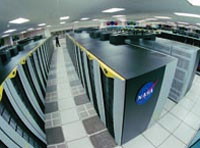
The Columbia supercomputer gained worldwide recognition in 2004 for increasing NASA's key high-end computing capability ten-fold for missions in aeronautics, space exploration, and Earth and space sciences. Its combined speed and productivity made Columbia the most powerful supercomputer of its time. The system was critical to NASA's Return to Flight (RTF) effort, and for near-real-time simulations that contributed to the safety of subsequent shuttle missions. The system was named to honor the crew of the Space Shuttle Columbia STS-107, lost in 2003.
The One-Minute Installation Video
- Download video:
- MP4 format
Impact
Among the many important scientific and engineering projects benefiting from Columbia's computational capabilities during its nine years of service:
- Space Vehicle Analyses: In addition to critical contributions to RTF, early work on Columbia included simulations to analyze and redesign the Space Shuttle Main Engine flowliner, and to assess damage and repairs during the successful Space Shuttle Discovery flight in July 2005. After the shuttle's return to service, scientists ran near-real-time analyses before each launch and during orbit to help determine any possible debris damage—ultimately clearing vehicles for safe lift-off, reentry, and landing. The system was also used extensively for high-fidelity modeling to design future crew exploration and launch vehicles.
- Global Ocean & Weather Modeling: High-resolution simulations of Earth's oceans and atmosphere were run on Columbia to study ocean and sea-ice systems, monitor climate change, and improve our understanding of tropical storm formation. In 2004, scientists used the system to produce numerical weather predictions to track and rate the intensity of hurricanes near the U.S. East Coast and the Gulf of Mexico. Later, they used the system to produce realistic simulations that predicted the landfall and storm intensity of hurricanes Frances, Ivan, Rita, and Katrina three to five days in advance. Better prediction of these events could ultimately save lives and reduce property damage.
- Study of the Universe: Columbia was used to simulate astronomical phenomena to help further our understanding of the origins of the universe. For instance, scientists used new simulation techniques to more accurately predict the gravitational wave signatures produced by two black holes over time as they approached each other and collided. Researchers also used the system to run the largest simulation (at that time) of the formation and evolution of the dark matter halo that envelops the Milky Way galaxy.
Notable Stats
Built in a joint effort by NASA and industry partners Silicon Graphics (SGI) and Intel, Columbia was a single-system image (SSI) supercomputer.
- Original architecture: 20 interconnected SGI Altix 3700 nodes with 512 Intel Itanium 2 processors running the SUSE Linux Enterprise operating system
- Configured with 2,048 processors used with a single shared memory
- Original theoretical performance: 62 teraflops
- At its peak in 2008, Columbia contained 13,824 cores, 27 terabytes of memory, and achieved a theoretical performance of 82.9 teraflops peak performance
- Delivered over 3 billion hours of computational time to NASA research projects
History
Columbia was installed at the NASA Advanced Supercomputing (NAS) facility at Ames Research Center by a team of computer scientists and engineers from NAS, SGI, and Intel. The team received the 2005 Government Computer News Agency Award for Innovation for installing the original 10,240-processor system in an unprecedented 120 days. At the 2005 International Supercomputing Conference, NASA was recognized for reinventing its approach to high-end computing, and for deploying one of the most successful "constellation" supercomputers in history.
The system debuted in the second spot on the Top500 list of the world's most powerful supercomputer in November 2004, with a LINPACK rating of 51.9 teraflops peak performance.
In 2006 and 2007, four new SGI Altix 4700 nodes containing dual-core processors replaced some existing nodes, decreasing the physical footprint and power costs associated with the system. This allowed room for additional resources to support work in all NASA mission organizations. These four nodes remained active until early 2013 as Columbia was phased out to make way for the Pleiades and Endeavour supercomputers.
Quick Links
- News
- User Documentation
- myNAS User Portal
- System Status
- FAQ
- Get Accounts
- New User Orientation
- Training Webinars
Can't find what you're looking for? NAS User Support is available 24x7x365:
(800) 331-8737
(650) 604-4444
support@nas.nasa.gov
Other Projects
During its nine years of service, Columbia supported many other important NASA projects, including:
- A high-end computational method to guide the optimal design of solid-state nanopore devices with the capability of ultra-rapid DNA sequencing.
- Parallel, high-performance aerodynamic simulation packages that enabled high-fidelity characterization of aerospace vehicle design.
- Improvements in the field of nanophase thermal and structural composite material to be used in systems for future robotic and human exploration missions in space.
More Columbia Info
Want even more details? See Wikipedia:
Columbia (supercomputer)

