
High-End Computing Capability
Computing power to answer NASA's complex science and engineering questions
HECC Legacy Systems
Over the last three decades, HECC and the NASA Advanced Supercomputing (NAS) Division have managed and supported more than 40 supercomputing systems, and have significantly influenced the state of the art in high-end computing and related technologies. Today, in collaboration with industry partners, HECC continues this rich legacy, providing a premier production supercomputing environment that includes Pleiades and Electra, ranked as two of the most powerful systems in the world.
Starting with the installation of the Columbia supercomputer in 2004, HECC funded the following legacy systems under the agency's Strategic Capabilities Assets Program.
Merope (2014–2021)
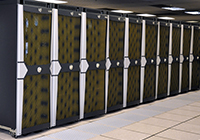
The Merope supercomputer was a cluster comprised of Intel Xeon X5670 (Westmere) and Intel Xeon 5400 (Harpertown) processors from repurposed Pleiades supercomputer nodes to accommodate jobs that ran more efficiently on older hardware. The system was used for running both real-world computational jobs for NASA scientists and engineers and for testing purposes. Housed in an auxiliary processing center located about 1 kilometer from the NAS facility at Ames Research Center, Merope was named after one of the seven stars that make up the Pleiades open star cluster in the constellation Taurus.
Columbia (2004–2013)
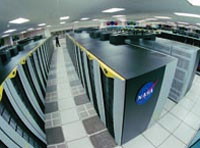
The Columbia supercomputer gained worldwide recognition in 2004 for increasing NASA's key high-end computing capability tenfold for missions in aeronautics, space exploration, and Earth and space sciences. Its combined speed and productivity made Columbia the most powerful production supercomputer of its time. The system was critical to NASA's Return to Flight (RTF) effort, and provided near-real-time simulations that contributed to the safety of subsequent shuttle missions. The system was named to honor the crew of the Space Shuttle Columbia STS-107, lost in 2003. Read More
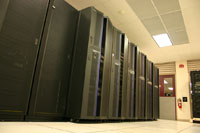
Schirra (2007–2010)
The Schirra supercomputer, an IBM Power5+ system, was among several systems being evaluated to determine its potential as a key production resource to help meet NASA's future computing needs. Schirra was particularly useful for code optimization and parallelization efforts. For example, NAS experts obtained a tenfold speedup on a code used to support entry descent and landing research challenges for the agency's Fundamental Aeronautic Research Program. The system was named after Mercury 7 astronaut Wally Schirra.
Quick Links
- News
- User Documentation
- myNAS User Portal
- System Status
- FAQ
- Get Accounts
- New User Orientation
- Training Webinars
Can't find what you're looking for? NAS User Support is available 24x7x365:
(800) 331-8737
(650) 604-4444
support@nas.nasa.gov
Computing Resources
Related Links
More information on our pioneering achievements in high-end computing.

