
High-End Computing Capability
Computing power to answer NASA's complex science and engineering questions
Data Storage Systems
The HECC environment includes temporary storage systems, home filesystems, and long-term archival storage space for our science and engineering users.
Temporary Storage Filesystems
These filesystems allow users to store their working data prior to transferring it to the archive system for long-term storage. Data is housed on RAID storage to minimize risk. While HECC does not back up the data on these filesystems, users may transfer any data they want to keep to the archive system.
HECC provides Lustre and Network File System (NFS) filesystems to support different I/O usage patterns required by our users.
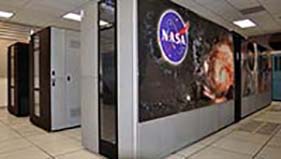
- Two NFS and twelve Lustre filesystems
- 116.5 PB of RAID storage
Home Filesystems
Each user is provided a home directory on the HECC home filesystems, and data is backed up twice daily.
- 4 HPE Enhanced Network File System (NFS) filesystems
- 24 TB of RAID storage
Archival Storage Systems
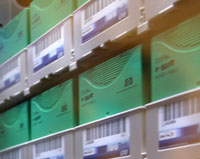
For long-term storage, HECC provides an exascale tape storage system that allows users to archive and retrieve important results quickly, reliably, and securely. Data stored on RAID is migrated to tapes as needed. Copies of user data are written to two separate tape media in silos located in two different buildings. HPE's Data Management Framework (DMF) and OpenVault manage data migration (disk-to-tape) and de-migration (tape-to-disk), respectively.
Our storage experts provide custom training to help users efficiently manage their large datasets, as part of the Supercomputing Systems services.
System Architecture
- "Lou" Mass Storage System
- HPE parallel DMF cluster with high-availability clustering software
- Four front-end systems, each with an 18-core Intel Xeon Gold processor
- 192 GB of memory per front end
- 7.6 PB locally attached SATA RAID
- Spectra Logic tape storage: 1,400 PB maximum capacity (with normal 35% compression)
- 6 TFinity tape libraries, 60 frames total, 64,820 slots total
- 84 LTO-8 tape drives (12 TB media)
- 14 LTO-9 tape drives (16 TB media)
- 213 PB current unique data stored
- HPE Data Management Framework and OpenVault
Quick Links
- News
- User Documentation
- myNAS User Portal
- System Status
- FAQ
- Get Accounts
- New User Orientation
- Training Webinars
Can't find what you're looking for? NAS User Support is available 24x7x365:
(800) 331-8737
(650) 604-4444
support@nas.nasa.gov

