
Reducing Soot Emissions from Jet Engines
Overview
Aero combustors have been around since the advent of jet engines. However, soot and particulate emissions from these combustors are not yet fully understood. With tens of thousands of flights a day just in the United States alone, soot emission represents operational inefficiency, resulting in higher fuel consumption and a mobile health hazard. In order to reduce soot from combustion, a few different approaches can be taken. First, the fuel blend can be modified to chemically reduce the formation of soot. Second, the operating condition and configuration of the combustor can be optimized to produce less sooty flames. Third, dilution jets can be injected at a downstream location to dilute the mixture and provide oxygen to oxidize the soot. Our team is investigating the reasons why these methods are able to reduce soot, with the goal of informing engineers on better ways to design clean, efficient jet engines.
Project Details

Aligning with NASA’s objective to improve the quality of life on our home planet, our current research goals are to develop a model capable of simulating and predicting soot formation from aero combustors; simulate and understand soot formation in a combustor at different operating conditions, from lean blowout to full-power take-off (fuel-rich) conditions; and to develop new strategies to aerodynamically reduce soot formation in a combustor.
We run our large eddy simulations on the Pleiades supercomputer using the Advanced Propulsion Concepts Lab’s umFlameletSoot model, which fully couples fluid dynamics, combustion chemistry, soot particle dynamics, and radiation function to resolve microscale turbulent eddies and reveal the intermittent nature of soot agglomerates. The goal is to help answer fundamental questions about how soot forms, coagulates, and grows to large agglomerate structures. A longer-term goal is to understand how to use aerodynamic straining to oxidize soot particles before they grow into larger particles—eventually helping to reduce soot emissions.
Results and Impact
The results of this numerical study allowed us to develop a validated reacting flow model that is coupled to soot particle dynamics. Comparison with experimental results was good, and analysis shows how recirculation zones within the combustor help stabilize the flame and reduce soot. Using Lagrangian particle tracking, we identified different types of particle trajectories that informed us of the time scale of soot formation and oxidation. The end result is the reduction of soot via dilution jet injection that enhances the strength of the inner recirculation zone.
Why HPC Matters
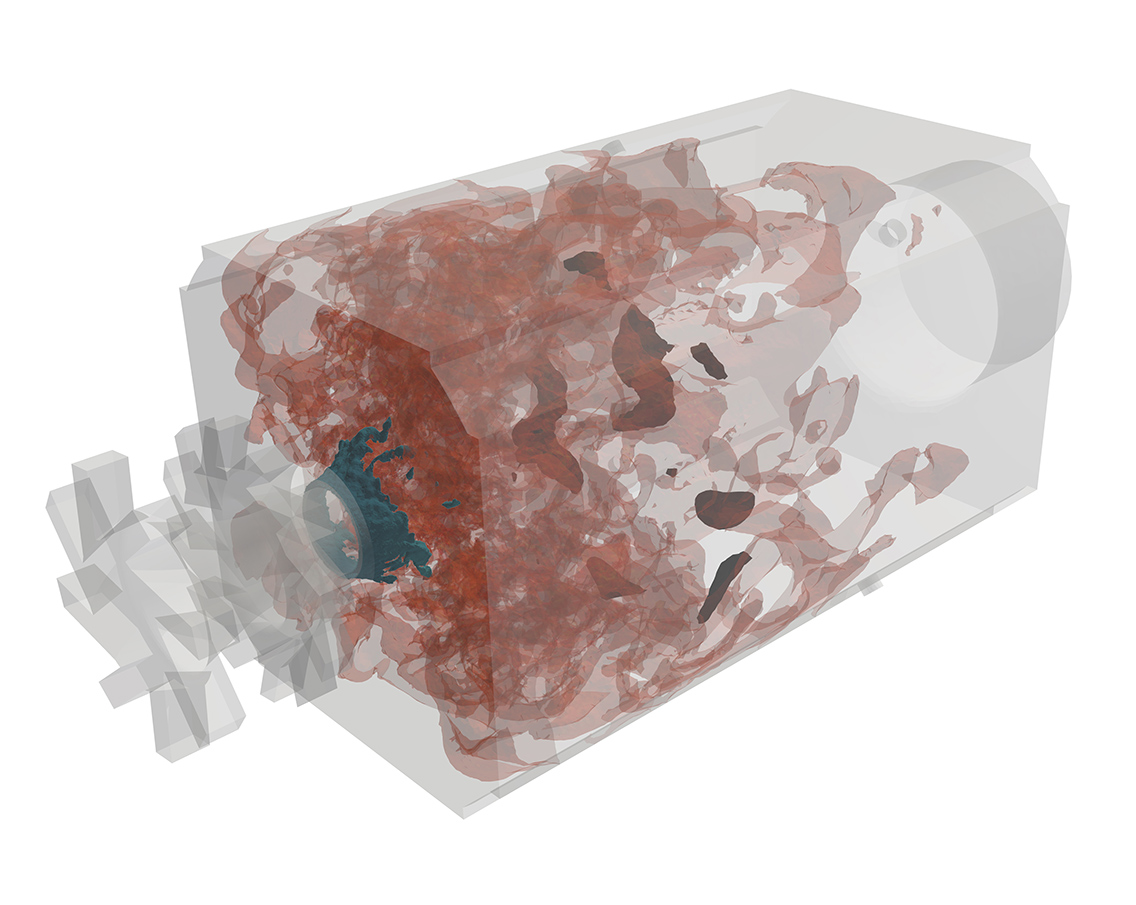
Our large eddy simulations of the aero combustor are based on a 12-million-cell grid, and required multiple runs for cold flow development, reacting flow, and subsequent soot formation simulations. A typical simulation (single operating condition) from cold flow to fully converged, time-averaged data takes approximately 80,000 processor-hours on the Pleiades supercomputer at the NASA Advanced Supercomputing (NAS) facility. The facility’s Lou mass storage system holds about 2 terabytes of data generated from these simulations.
More Information
- See the poster for this demonstration (PDF, 4.0MB), as shown in the NASA booth at SC17.
stchong@umich.edu Venkat Raman, University of Michigan
ramanvr@umich.edu