
Simulating Next-Generation Clean, Sustainable Jet Fuels
Overview
Modern jet engines are designed to be highly efficient while simultaneously limiting the amount of harmful emissions produced. Researchers are working to develop new jet fuels that are renewable, sustainable, and can contribute toward the goal of achieving U.S. energy independence. However, the performance of these fuels must be carefully considered before they can be used in current or next-generation jet engines.
As part of a collaboration between NASA, the Federal Aviation Administration, and industry partners, our team is developing state-of-the-art, multiphysics computer simulations and applying them to investigate the behavior of new fuels and compare their performance to that of currently used jet fuels. These high-fidelity simulations determine the relative performance of new jet fuels at operating conditions near lean blowout (LBO), where the combustion process can be highly unstable.
Project Details
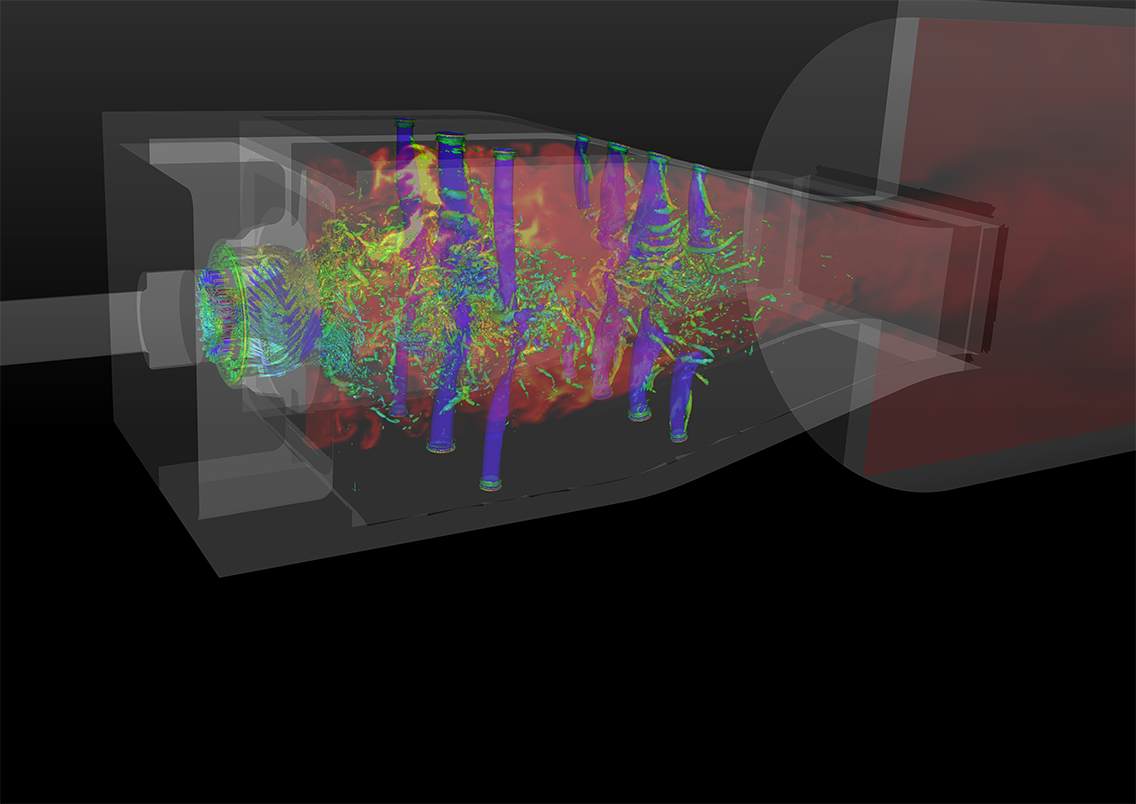
Before a new fuel can be used in a jet engine it must go through an extensive certification process, including small- and large-scale experimental validation. Key performance targets, including cold restart, altitude relight, and LBO behavior, determine whether a candidate fuel is certified for use in existing and future jet engines. However, the certification process is both time consuming and expensive.
Over the past year, our team has conducted comprehensive simulation studies of the transient and stable operating conditions for a gas-turbine combustor. We are investigating the ability of computational fluid dynamic (CFD) tools to correctly predict the physico-chemical properties of the candidate fuels, in order to determine whether CFD tools can be applied to reduce the cost and duration of the certification process. At present, the project is focused on predicting LBO behavior of candidate and reference fuels for a small-scale model jet engine. Because the model contains the same major features of large-scale commercial engines, and the same physical processes are observed, the experimental and numerical study of this combustor allows for the evaluation and development of current CFD tools.
Results and Impact
Our state-of-the-art flamelet/progress-variable combustion model was found to accurately reproduce the experimental LBO behavior of the candidate fuels. Further, this combustion model was able to show how fuel evaporation rate, gaseous-fuel deposition, and flame anchoring was affected by the specific fuel properties. By comparing the behavior between different fuels, additional insight is gained on the sensitivity of important physical characteristics, such as chemical reactivity and gas temperature, to small changes in fuel properties. This study is the first step toward demonstrating that CFD tools can be used to screen candidate fuels within the certification process to reduce cost and time requirements.
Why HPC Matters
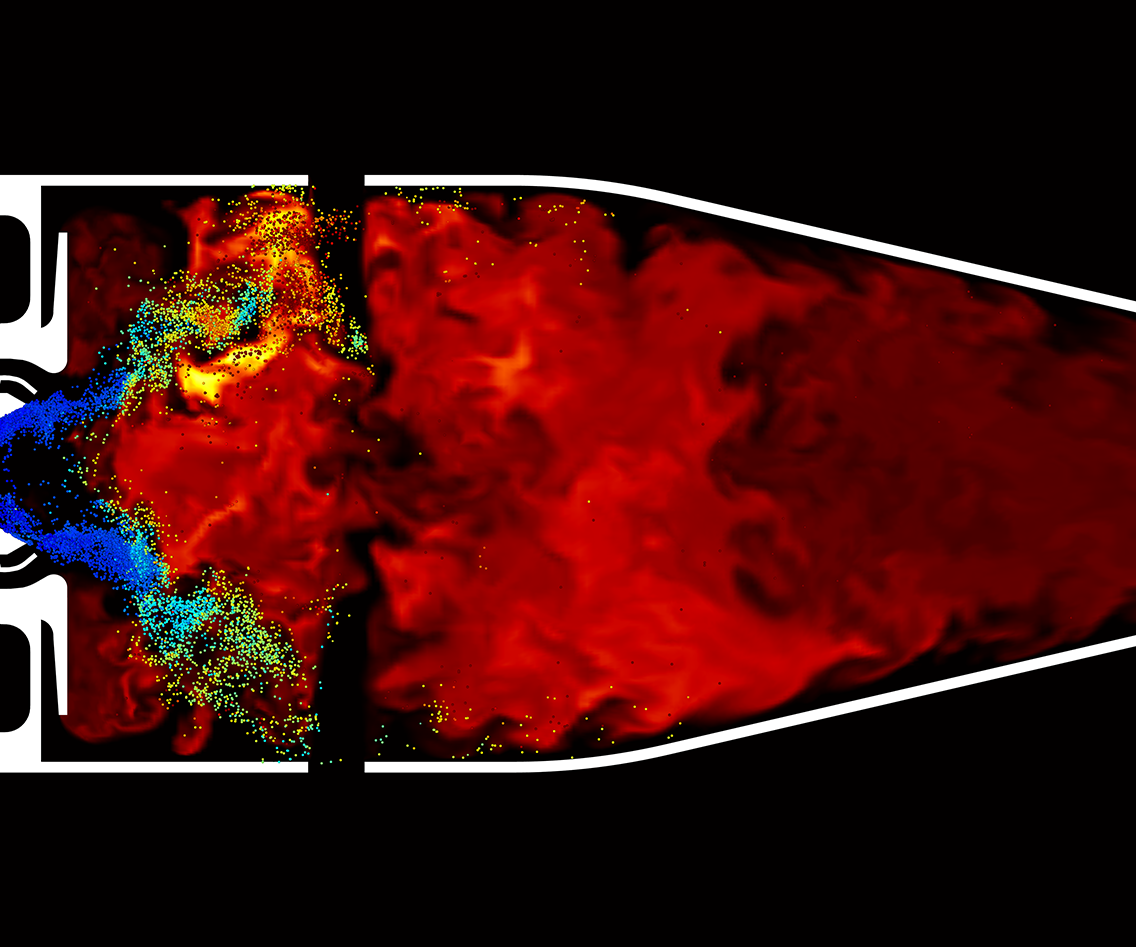
Without the support of NASA and the resources provided by the NASA Advanced Supercomputing Division, this project would not be feasible. The Pleiades supercomputer and the division’s data storage facilities enable our team to run massively parallelized, high-fidelity multiphysics simulations for realistic jet engine configurations. Over the past year our team has used approximately 19 million CPU hours to run different CFD tools and analyze their ability to predict LBO. In the process, we have been able to further improve the predictability of these tools.
More Information
- Fuel Effects on Lean Blowout in a Realistic Gas Turbine Combustor
- See additional images/videos related to this demo in our media gallery.
- See the poster for this demonstration (PDF, 4.5MB), as shown in the NASA booth at SC17.
jwllabah@stanford.edu Matthias Ihme, Stanford University
mihme@stanford.edu