
Assessing and Analyzing Energy Usage of NASA Workloads on HPC Systems
Overview
Assessing and analyzing the performance and energy usage of NASA applications on state-of-the-art and emerging high-performance computing (HPC) architectures are critical for understanding resource constraints and suitability to meet the agency’s current and future needs. Also, efficient utilization of HPC resources is important for improving time-to-solution of applications. The Application Performance and Productivity (APP) team in the NASA Advanced Supercomputing (NAS) Division has therefore implemented a framework for measuring and monitoring power used by the agency’s scientific and engineering applications. The team has investigated the power requirements of a representative set of codes to see how those statistics correlate to application performance, and to understand the power efficiency of different architectures.
Project Details
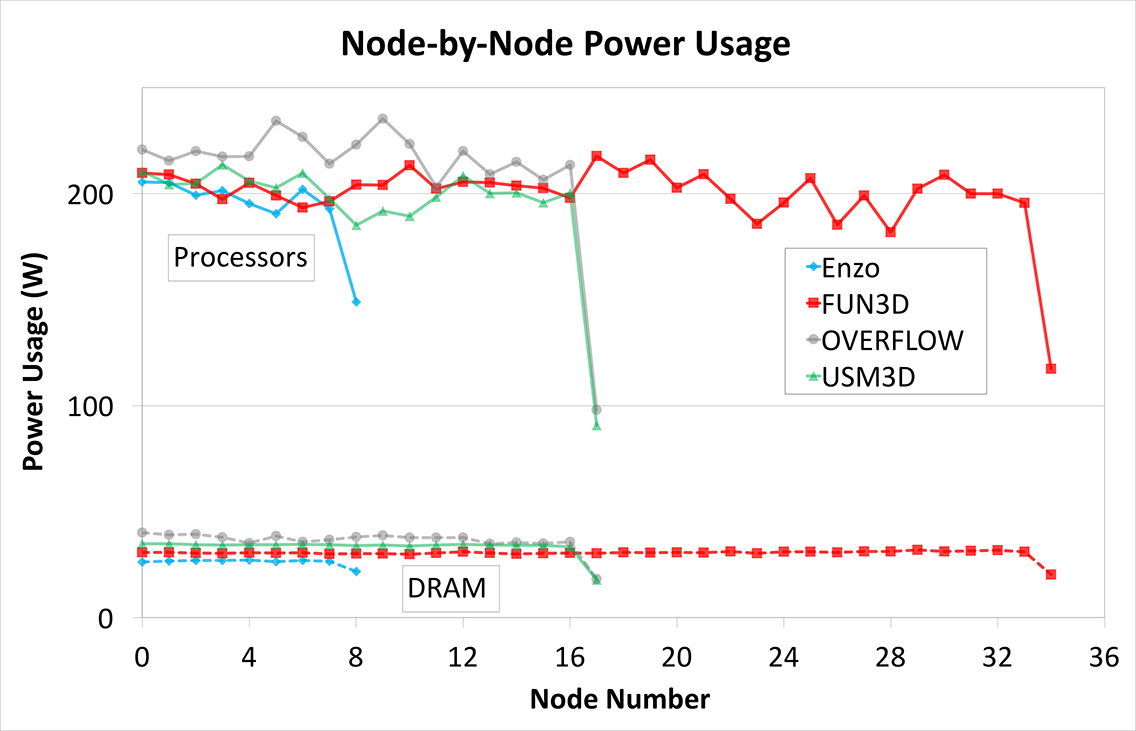
The power measurement framework developed by the APP team builds on the availability of real-time power readings on recent generations of Intel processors, such as Haswell, Broadwell, and Knights Landing, running newer Linux operating systems, such as SUSE Linux Enterprise Server 12. The framework consists of two components: a new version of the NAS-developed MPIProf tool, which can be configured to report power usage for an MPI code; and a dynamic library and runtime daemon that can be invoked from the prologue and epilogue of a Portable Batch System (PBS) job, in order to record its power usage in system logs.
This setup allows reporting of power usage on either a per-job or a per-application basis. For this project, jobs were run on the Pleiades supercomputer.
Results and Impact
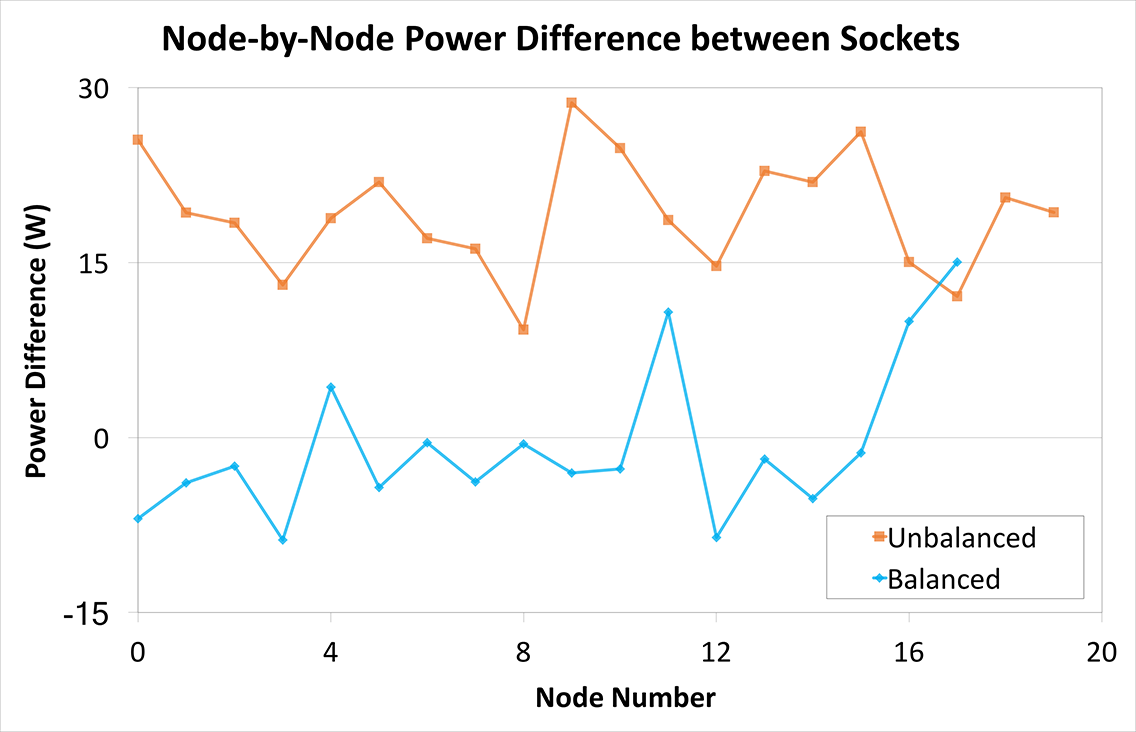
We applied this framework to collect power usage data for a selected suite of codes that served as benchmarks to determine NASA’s standard billing unit (SBU), which is used for allocating and tracking usage. These benchmark codes are representative of the most common applications run on the Pleiades supercomputer. Our results show that node power usage is correlated with application characteristics, as well as with imbalances in resource utilization. Measuring the amount of power used by specific nodes running a particular application helps clarify the application’s performance characteristics and determine whether it has been mapped appropriately to the hardware, enabling us to make adjustments for optimal use of system resources.
Why HPC Matters
In the coming months, the APP team will continue to use the framework to investigate the power requirements of additional codes. We will also work with the NAS Division’s systems engineers to begin recording power usage data in system logs, with the goal of discovering applications currently running on NAS systems that are not using resources effectively. In addition, we will expand our study to more system components, such as network and cooling.
More Information
- NAS Application Optimization Services
- See the poster for this demonstration (PDF, 3.3MB), as shown in the NASA booth at SC17.
robert.hood@nasa.gov Henry Jin, NASA Ames Research Center
haoqiang.jin@nasa.gov