
Scientists Explore Ocean Currents Through Petascale Simulations and Visualization
Overview
A team from the NASA Advanced Supercomputing (NAS) Division at Ames Research Center has developed a new interactive visualization tool that is being used by researchers from the Estimating the Circulation and Climate of the Ocean (ECCO) project to study the behavior of ocean currents. This tool provides high-resolution views of the entire globe on the NAS hyperwall, allowing the scientists to see details that they had missed in previous analyses of their 1/48º global ocean simulation, which was run on the Pleiades supercomputer. Together with Pleiades, the high-capacity network bandwidth and data processing capabilities of the hyperwall provide one of the most powerful visualization systems in the world, enabling the ECCO scientists to discover previously unknown ocean features and their effect on the larger ocean system.
Project Details
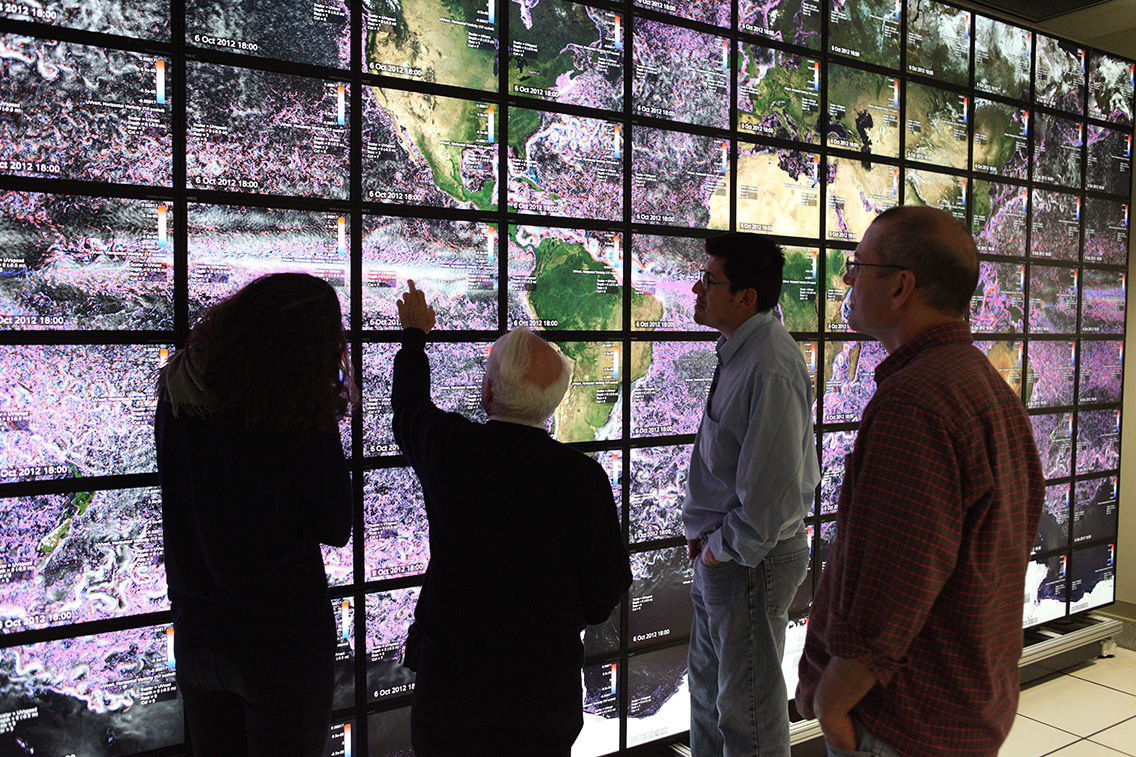
A key requirement for the ECCO project is the availability of ocean observations that are global in scope, in particular from satellites such as TOPEX/Poseidon, QuikSCAT, Jason, GRACE, and Aquarius, and from the Argo autonomous floats. To prepare for an upcoming satellite mission called Surface Waves and Ocean Topography (SWOT)—a wide-swath altimeter that will measure ocean features with ten times the resolution of current technologies—the ECCO researchers produced a global ocean simulation with nominal 1/48º horizontal grid spacing, requiring a model configuration with approximately 22 billion grid cells. The new NAS-developed visualization tool allows scientists to interactively explore the results of this simulation—about 5 petabytes of data—by zooming into selected areas and producing time-evolving scatter plots that show the distribution of various ocean properties.
Results and Impact
Simulation results help the ECCO researchers better understand how the ocean interacts with sea ice, ice sheets, and the atmosphere, and enables them to learn more about ocean ecology and its role in the carbon cycle. The first time ECCO researchers used the new visualization tool, they discovered several ocean features that were missed in previous analyses of the simulation, for example: artifacts of the model’s surface forcing due to the interpolation of atmospheric fields; small salty lenses of fluid rotating at depth after ice cracking events; and seasonal changes of relative vorticity and vertical velocity. The 1/48º ECCO simulation is also being used to help NASA engineers and scientists design satellite missions, retrieval algorithms, and calibration/verification experiments. For example, for the upcoming SWOT mission, the simulation provides a virtual ocean with realistic variability for observing system simulation experiments (OSSEs).
Why HPC Matters

The ECCO team ran their high-resolution computational fluid dynamics simulations on Pleiades for a period of 14 months, using the Massachusetts Institute of Technology general circulation model (MITgcm) with 22 billion ocean grid cells. This effort required a sustained throughput of 20 gigabits/second when redistributing and streaming output to disk. The computations required about 24 million processor-hours on up to 70,000 cores.
The hyperwall visualization tool enables the researchers to explore their entire 5-petabyte dataset on their choice of time scales, providing global as well as detailed, custom-tuned, multivariate views of any part of the time series—an unprecedented capability for data of this size.
What’s Next
The ECCO team is now working with researchers at NASA’s Goddard Space Flight Center to couple their ocean model with a high-resolution global atmospheric model. The success of this project would transform understanding of the highly complex interaction between the sea and the atmosphere.
More Information
- Exploring the Ocean’s Depths with a New Hyperwall Visualization Tool
- NASA Silicon Valley Podcast: Modeling Oceans and Ice with Supercomputers
- See the poster for this demonstration (PDF, 772.1KB), as shown in the NASA booth at SC17.
cnh@mit.edu Dimitris Menemenlis, NASA Jet Propulsion Laboratory
menemenlis@jpl.nasa.gov