
3D Heat Shield Simulations for Designing Future Space Vehicles
Overview
The most dangerous phase of a space exploration mission occurs during a spacecraft’s entry into a planetary atmosphere. NASA is developing new heat shields to keep planetary probes safe as they enter atmospheres at hypersonic speeds, where atmospheric gases turn into a high-energy plasma due to the extreme speed. Thermal protection systems (TPS) safeguard payloads—like the Mars rovers—from the extreme plasma temperatures. For such scenarios, the only option to protect the spacecraft is a single-use, ablative heat shield that will erode when entering the atmosphere.
During the TPS design phase, accurate estimation of the heat shield thickness is critical to ensuring an optimum trade-off between mission safety and vehicle mass. Underestimation increases the risk of burning the probe during entry, and overestimation limits the scientific payload mass. Another important design factor is the temperature inside the material. A bonding agent is used to attach the heat shield tiles to the vehicle, and if the internal temperature were to exceed the bonding agent detachment limit, there would be a risk of catastrophic loss of the spacecraft during entry.
Project Details

Developing heat shields for future space vehicles involves an extensive design and test cycle. Material response—a key factor for a successful heat shield design—includes internal gas velocity, temperature, and recession rate. NASA is developing modeling and simulation tools that enable analysis of heat shield thermal material response in order to reduce the need for extensive testing and to accelerate the design cycle process.
Aerospace engineers at NASA's Ames have developed the Porous-material Analysis Toolbox based on OpenFOAM (PATO) to simulate the multiphysics phenomena that occur in TPS material during hypersonic entry. NASA’s Data Parallel Line Relaxation (DPLR) software, which computes the extreme aerothermal environment around the heat shield, provides the necessary inputs to PATO after temporal and spatial interpolations. The Ames team used the Mars Science Laboratory (MSL) 4.5-meter diameter heat shield as a test case to show that PATO can successfully perform massively parallel simulations of the thermal response and recession rate. The MSL heat shield was made of Phenolic-Impregnated Carbon Ablator (PICA) with a silicon bonding agent to fill tile gaps.
Results and Impact
Our PATO simulations provide a better understanding of the material thermal response and recession process for an ablative heat shield with tiles. The OpenFOAM library enables studies of non-uniform thickness heat shields and material thickness optimization around complex geometries. We compared PATO’s 3D heat shield thermal response with traditional 1D computations for monolithic and tiled configurations of the heat shield. The differential recession between the PICA material and the gap filler promotes the formation of a "fence," which poses design challenges as it may promote transition to turbulence—an important factor in the prediction and control of heat transfer in the extreme temperatures encountered during atmospheric entry.
Why HPC Matters
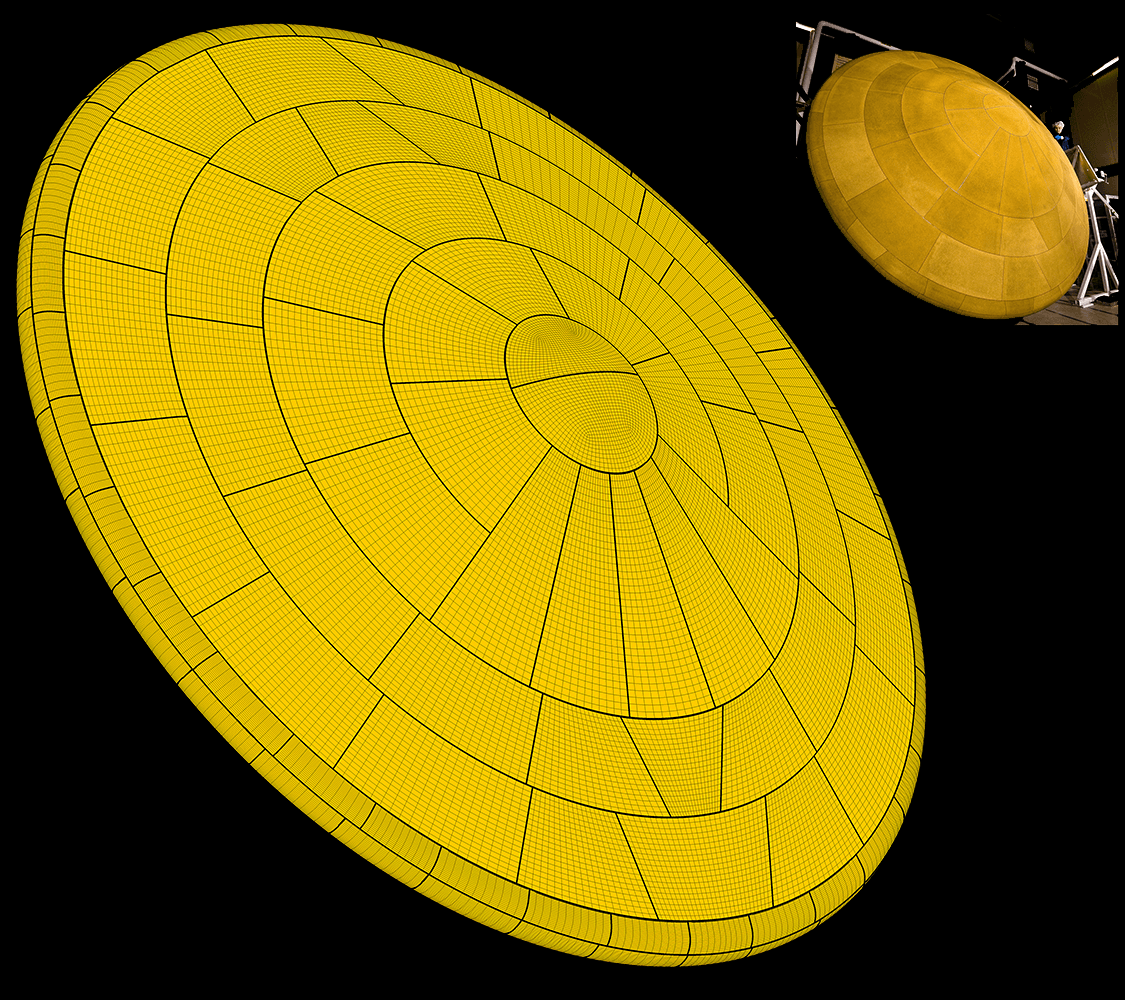
Traditional simulations of material response are computed in 1D with a 100-cell grid. In comparison, our unique, 3D material response simulations of a full-scale tiled heat shield are computed in a 2-million cell domain, requiring massive parallel compute power. We used the OpenFOAM library included in PATO to run our simulations in parallel on the Pleiades supercomputer at the NASA Advanced Supercomputing (NAS) facility. One PATO simulation used 840 processors during 24 hours.
What’s Next
Our project goal for the next four years is to develop a material design framework that will enable rapid development of mission-tailored TPS materials, as NASA contemplates large-payload missions to Mars, Venus, Jupiter, and Saturn.
More Information
- Porous materials Analysis Toolbox based on OpenFOAM (PATO)
- Curiosity Rover Movie Trailer
- See additional images/videos related to this demo in our media gallery.
- See the poster for this demonstration (PDF, 4.2MB), as shown in the NASA booth at SC17.
jeremie.b.meurisse@nasa.gov Nagi N. Mansour, NASA Ames Research Center
nagi.n.mansour@nasa.gov