
Building Aerodynamic Databases for the SLS Design Process
Overview
NASA’s new Space Launch System (SLS) will be the first rocket since the Saturn V (1967-1973) to carry astronauts beyond low earth orbit—and will carry 10% more payload than Saturn V and three times the payload of the space shuttle. The SLS configuration consists of a center core and two solid rocket boosters that separate from the core as their fuel is exhausted two minutes after lift-off. During these first two minutes of flight, the vehicle powers its way through strong shock waves as it accelerates past the speed of sound, then pushes beyond strong aerodynamic loads at the maximum dynamic pressure, and is ultimately enveloped by gaseous plumes from the booster-separation motors. The SLS program relies on computational fluid dynamic (CFD) simulations to provide much of the data needed to build aerodynamic databases describing the structural load distribution, surface pressures, and aerodynamic forces on the vehicle.
Project Details
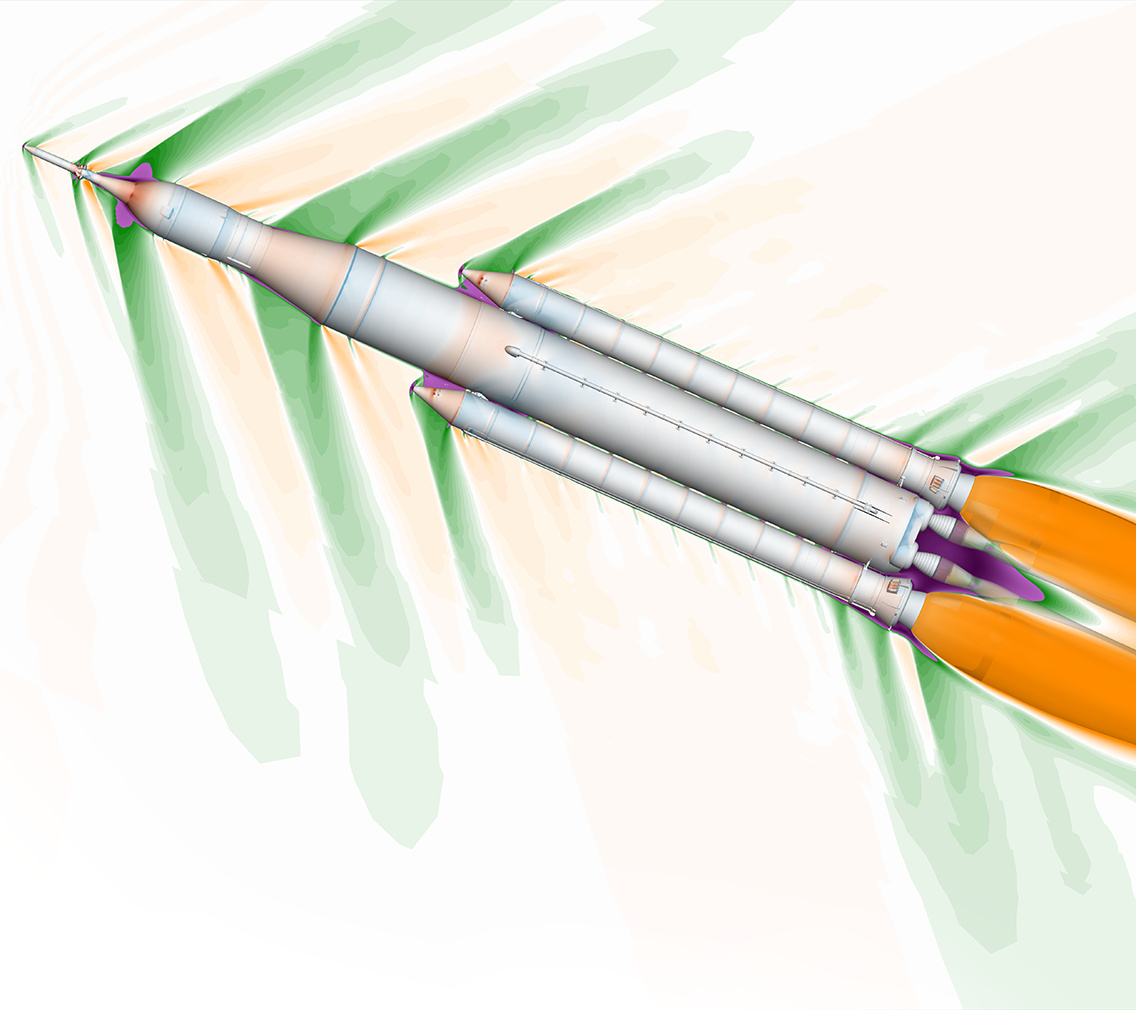
The SLS CFD team at NASA’s Ames Research Center uses simulations to build multiple aerodynamic databases to support the SLS design process. The goal is to quantify the aerodynamic forces of the SLS vehicle from ascent through booster separation via computational simulations, and provide data to build numerous aerodynamic databases. Previous launch systems relied almost entirely on data from expensive wind tunnel tests for these databases. Fortunately, with the continued growth of computational resources and capabilities, it is feasible to use more CFD and rely less on such tests.
We use multiple CFD codes to perform our analysis, including the NASA-developed flow solvers Cart3D, OVERFLOW, and FUN3D.
Over the life of this project, NASA has continually analyzed different SLS vehicle designs, including: multiple design iterations of the uncrewed Block 1 vehicle for Exploration Mission-1 (EM-1); multiple designs of the second SLS Block 1B vehicle, which will be the first to carry astronauts during the EM-2 mission; and SLS 27000, the cargo version of the rocket.
Results and Impact
The project team has created several different aerodynamic databases that engineers need during the SLS design process, including distributed line loads used in structural analysis; surface pressures used in venting and other dynamic analysis; protuberance aerodynamic loads used in the design of the vehicle; and forces and moments on the vehicle during booster separation used to verify the booster-separation system. This data is critical in ensuring a successful SLS launch.
Why HPC Matters
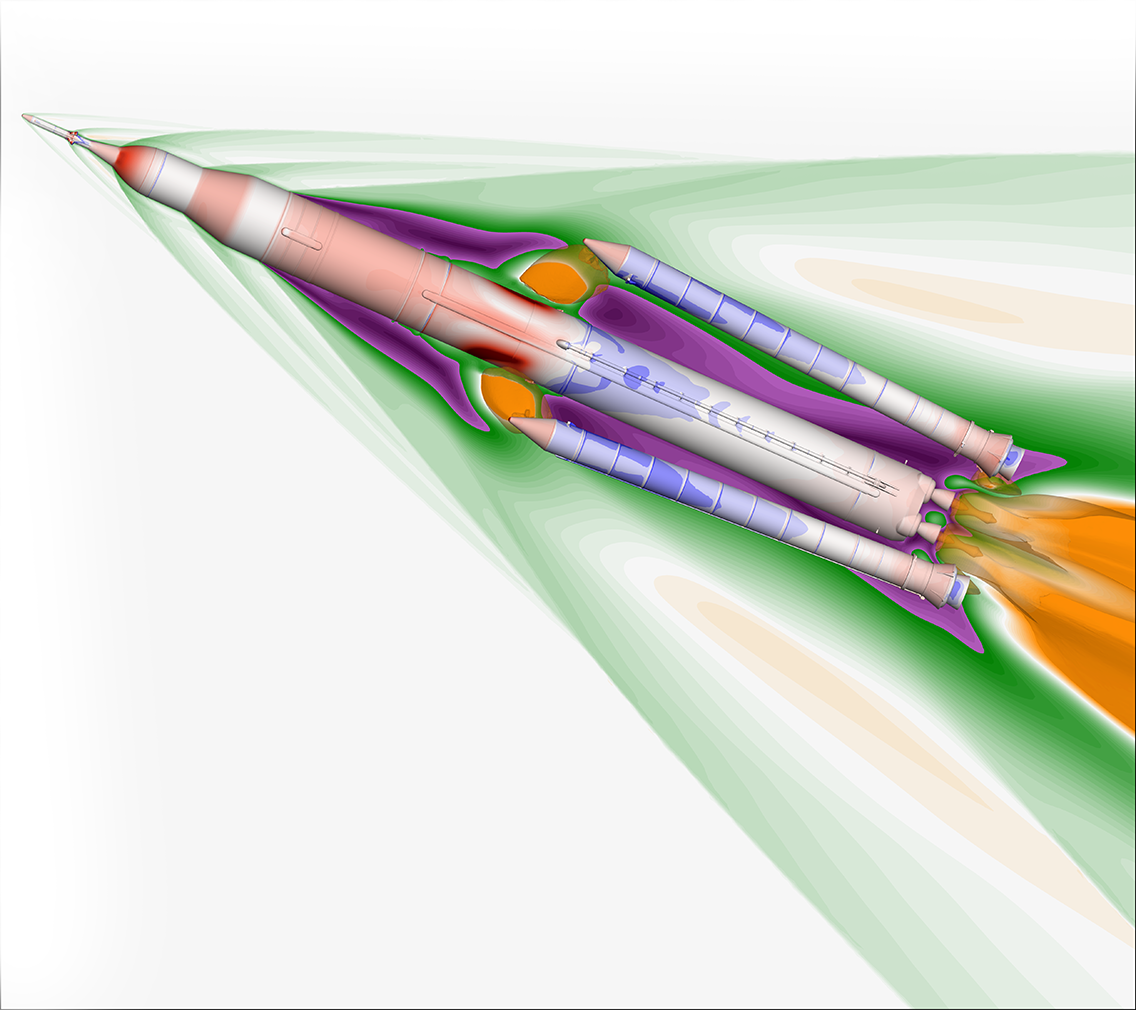
All of our CFD simulations of the SLS vehicles were run on the Pleiades supercomputer at the NASA Advanced Supercomputing (NAS) facility, using over 25 million core hours over the past year. Depending on the configuration and flow conditions, each FUN3D simulation requires about 3,000–6,000 core hours, and the OVERFLOW runs require 10,000–30,000 core hours. Approximately 8,100 FUN3D simulations and 900 OVERFLOW simulations, using a total of 55 million core hours, were used to build the various databases including aerodynamic forces and moments, distributed line loads, surface pressures, and protuberance air loads. The project typically uses 50–100 terabytes of short-term disk storage at any given time.
What’s Next
The SLS program increasingly relies on very detailed computational simulations of the vehicles in ascent. Our recent success in verifying the accuracy of the computational aerodynamic simulations for the EM-1 vehicle, together with the continued rapid growth of the Pleiades and Electra supercomputers, have led to expanded plans for the coming year. We expect to produce an unprecedented amount of aerodynamic data for the Block 1B crew and cargo vehicles, and to produce eight separate aerodynamic database products in the coming year.
More Information
- See the poster for this demonstration (PDF, 4.1MB), as shown in the NASA booth at SC17.
henry.c.lee@nasa.gov Stuart Rogers, NASA Ames Research Center
stuart.e.rogers@nasa.gov