
Simulating Atmospheric Impacts: From Pebble- to Mountain-Size Meteoroids
Overview
The hypersonic entry of meteoroids generates shockwaves that propagate through our atmosphere, with potentially hazardous consequences when they reach the ground. As part of the Asteroid Threat Assessment Project (ATAP) within NASA’s Planetary Defense Coordination Office, new high-fidelity simulation techniques have been developed to accurately predict the ground overpressure footprints generated by meteoric airbursts. More broadly, the goal is to provide a comprehensive hazards modeling and simulation framework that includes surface impacts, airburst-generated tsunamis, and blast propagation to support the formulation and validation of engineering methods needed for accurate and efficient probabilistic risk assessment.
Project Details

The ATAP team recently extended the capabilities of NASA’s Cart3D simulation package for computational fluid dynamics to include a model of the atmosphere and the source terms needed to accommodate energy deposition profiles used to represent meteoroid entry and airburst. Moreover, since meteoroid events are more likely to occur over oceans, Cart3D has been coupled to a tsunami propagation model to investigate the hazards of airburst-generated tsunamis.
To deal with the propagation of weaker pressure disturbances from small, fist-size meteoroids, Cart3D has been coupled with an atmospheric propagation solver. While not hazardous, the entry of small meteoroids occurs frequently enough to provide well-calibrated datasets that we use as validation benchmarks for simulations. The purpose is to verify luminous, ionization, and acoustic efficiencies to improve meteoroid mass estimates.
The code development effort and resulting simulations are closely coordinated with the asteroid characterization, surface impact, and probabilistic risk assessment groups within the ATAP project.
Results and Impact
To date, we have investigated airbursts of meteoroids up to several hundred meters in diameter—larger than the Eiffel tower. These airbursts release an energy equivalent of a gigaton of TNT. A detailed reconstruction of the 2013 Chelyabinsk event produced excellent agreement between the simulation and actual recorded arrival times and ground overpressures. These high-fidelity simulations are currently being used to improve overpressure footprint estimates in ATAP’s Probabilistic Asteroid Impact Risk (PAIR) model. In particular, eccentricity and strength of the footprint as a function of entry conditions are being incorporated into PAIR to improve damage prediction, such as the likelihood of hazardous fragments from shattered windows and building debris.
Why HPC Matters
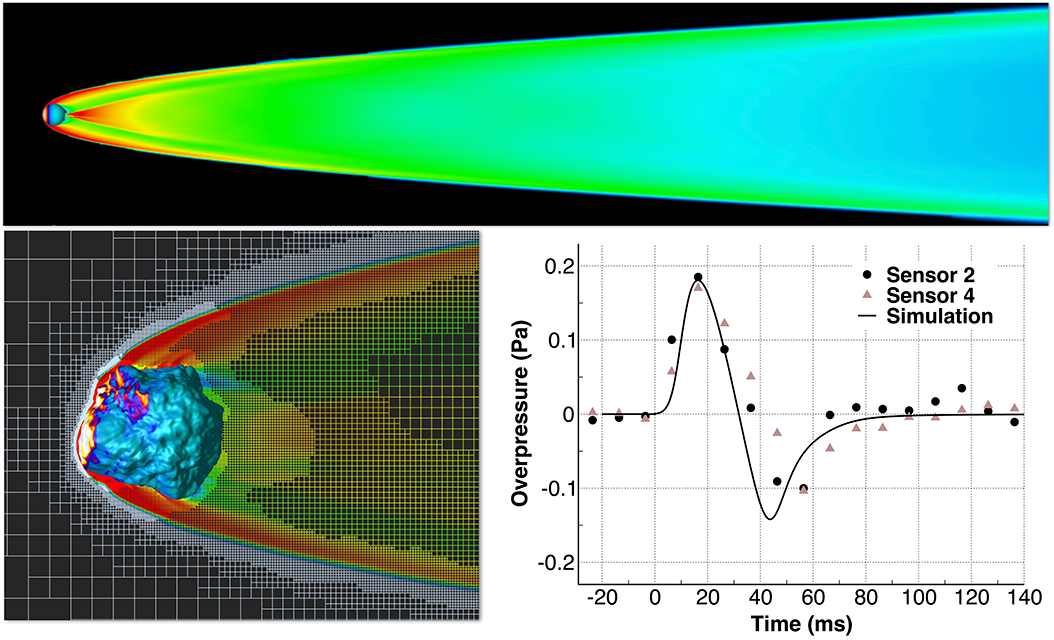
Our simulations are run on the Pleiades supercomputer at the NASA Advanced Supercomputing (NAS) facility. Typical cases use 2,000 cores (Broadwell processors) and turn around in about a day. High-resolution, fine-mesh cases use 4,800 cores and run for several days. Entry simulations of the small, fist-size meteoroids typically run on the Endeavour system at NAS and use 256 cores for about 8 hours. The large capacity of Pleiades is critical for handling the numerous uncertainties associated with atmospheric impacts of meteoroids. For example, current investigations involve a parametric study of the burst height, entry angle, and meteoroid strength to determine the influence of these variables on the ground overpressure footprint of the blast wave.
More Information
- Cart3D Simulation Software
- NASA Planetary Defense Coordination Office
- Numerical Simulation of Bolide Entry with Ground Footprint Prediction
- Numerical Prediction of Meteoric Infrasound Signatures
- See additional images/videos related to this demo in our media gallery.
- See the poster for this demonstration (PDF, 726.6KB), as shown in the NASA booth at SC17.
marian.nemec@nasa.gov Michael Aftosmis, NASA Ames Research Center
michael.aftosmis@nasa.gov