
Keeping Astronauts Safe: Predicting Vibrations on the Launch Abort Vehicle
Overview
Since the retirement of the Space Shuttle Program, NASA has been developing its new Orion spacecraft for deep-space missions. To ensure the safety of astronauts in the unlikely event that the rocket malfunctions during takeoff, the spacecraft is outfitted with a launch abort vehicle (LAV) that is designed to rapidly separate from the rocket and carry the astronauts away to safety. This is achieved with small, solid rocket motors placed on top of the LAV.
Pad abort and launch abort scenarios feature highly complex fluid flows that need to be carefully analyzed to avoid damage to the LAV and ensure the safety of the astronauts who will explore Mars and other destinations in deep space. We have produced detailed simulations of launch abort scenarios to help assess key aspects of vehicle performance during launch aborts.
Project Details
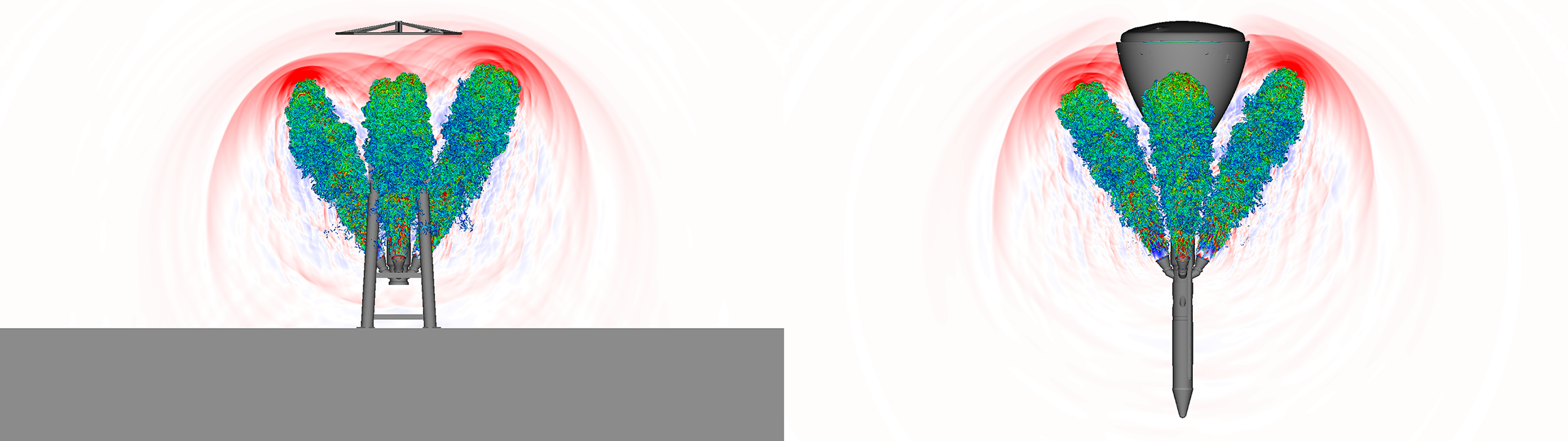
Our turbulence-resolving simulations of three launch abort scenarios were performed using NASA’s Launch Ascent and Vehicle Aerodynamics (LAVA) computational fluid dynamics code to investigate the ignition overpressure (IOP) wave strength over the LAV and to help characterize the vibrations imparted by the flow onto its structure. We use cutting-edge technology to locally adapt the resolution to the flow. The simulations are run until 0.3 seconds after ignition of the launch abort motors, allowing the characterization of the vibrations ranging from 10 Hz all the way to 3,500 Hz over most of the crew vehicle. Simulations of the launch abort motor test (QM-1), which took place this past June in Utah, were also performed in advance of the test to ensure the test would proceed safely and minimize risks associated with data collection.
Results and Impact
The predicted maximum transient load from the LAVA simulations for the QM-1 test closely match the experimentally measured peak. The vibrational loads coming from acoustic waves are also well captured, leading to agreement within 2% of measured vibrations. This increases the confidence in LAVA's ability to accurately simulate the complex physics at play during launch abort scenarios. The QM-1 and pad abort LAV simulations were used to help understand how the vibration levels change when taking into account the surface of the crew vehicle. The transonic and supersonic launch abort simulations then provided insight into how the location of maximum loads change, and how the vibration levels are reduced over much of the LAV as its velocity increases.
Why HPC Matters
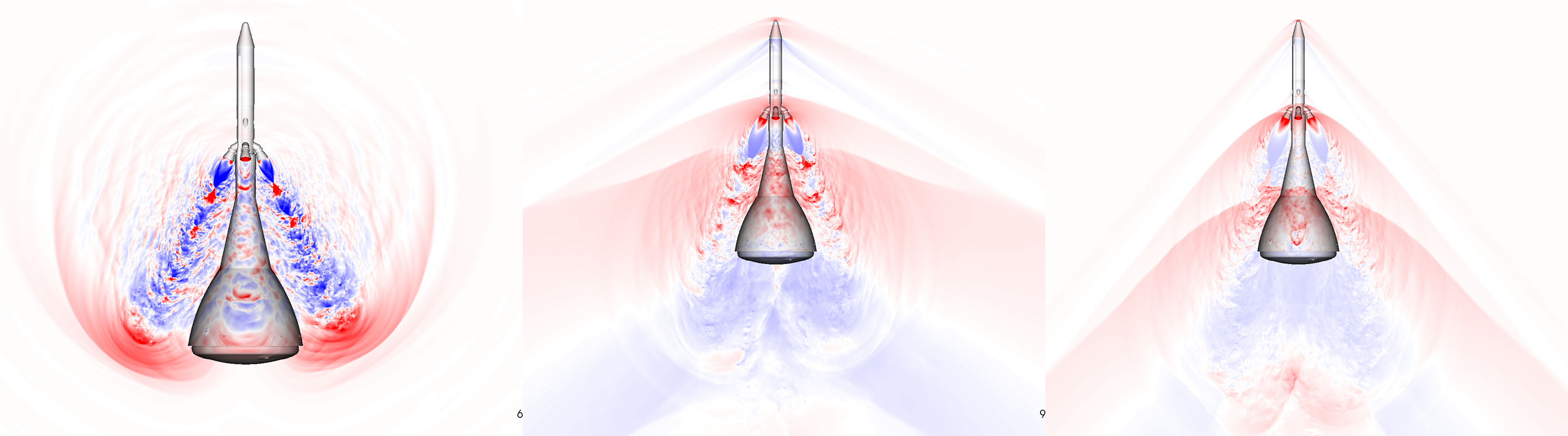
Parallelized across 80 Broadwell nodes (for a total of 2,240 cores) on NASA's Pleiades supercomputer, our 350-million degrees-of-freedom simulations were completed and post-processed in under 50 days. The NASA Advanced Supercomputing (NAS) facility’s visualization experts provided passive particle renderings that helped enrich our understanding of the fluid dynamics in the plume of the launch abort motors. The availability of this rich dataset is directly influencing the requirements for the final LAV design.
More Information
- Computational Framework for Launch, Ascent, and Vehicle Aerodynamics (LAVA)
- NASA’s Space Launch System
- Orion Launch Abort System Fact Sheet (PDF)
- Launch Abort Motor Qualification Motor 1 (QM-1) Static Test video (Orbital ATK)n
- See additional images/videos related to this demo in our media gallery.
- See the poster for this demonstration (PDF, 4.0MB), as shown in the NASA booth at SC17.
francois.cadieux@nasa.gov Cetin Kiris, NASA Ames Research Center
cetin.c.kris@nasa.gov