
Simulating the X-57 Electric Concept Aircraft
Overview
Since its inception in 1946, the NASA X-plane series has yielded many conceptual designs that have addressed the most prominent challenges in flight. Today, the X-57 concept addresses the increased demand for energy-efficient and environmentally friendly solutions with its state-of-the-art distributed propulsion system. Analyzing this unique design requires high-quality computational grids and robust numerical algorithms that can handle its complex geometry, all of which can be studied under NASA’s Launch Ascent and Vehicle Aerodynamics (LAVA) solver framework. With the help of supercomputing resources, it has been shown that this level of complexity is within LAVA’s capability and that X-57 aerodynamic performance can be predicted accurately.
Project Details

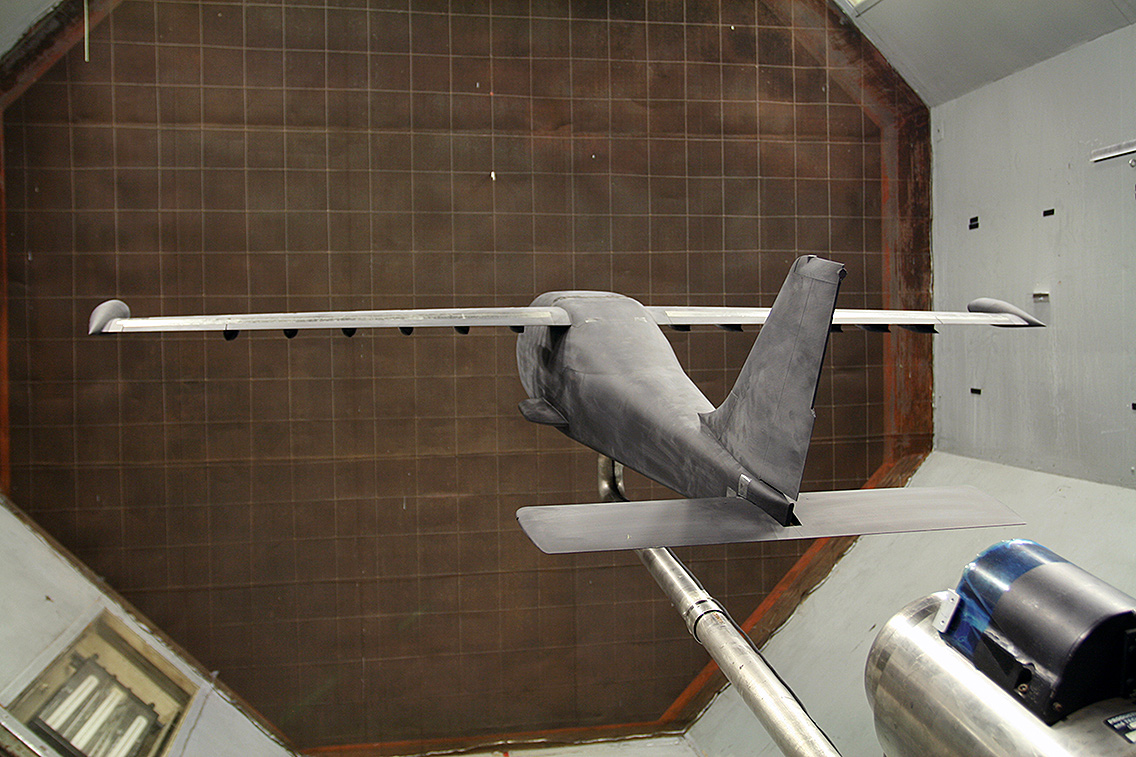
The ultimate objective of this study is to verify that this design will provide a 5x decrease in energy consumption at high-speed cruise. To do this, NASA’s Ames, Armstrong, and Langley Research Centers are using computational fluid dynamics (CFD) to collaboratively build an aerodynamic database and to predict the aero-propulsive effects of the wing tip propulsors. While experimental data exists for a 19% scale model, CFD tools are needed to adjust this tunnel data to the flight Reynolds number and report these modified results. Each research center tested a variety of grid paradigms, mesh fineness levels, and solver algorithms.
One of the greatest challenges was to model as much design complexity as possible while still allowing the structured overset grid paradigm to be utilized. Furthermore, many control surface deflections needed to be tested in order to estimate control power derivatives, requiring some development work to efficiently generate nearly 100 unique grids. The aerodynamic loads for all these cases could then be quantified by running these grids through NASA’s LAVA curvilinear and unstructured Reynolds-Averaged Navier-Stokes (RANS) solver.
Results and Impact
Initial results suggested that the aircraft is best modeled in the turbulent flow regime, due to unsteadiness and inaccuracy in the laminar flow simulations. For 90% of the low-Mach cases analyzed to date, lift and drag was predicted within 10% of the test data for both the unstructured and the curvilinear simulations, while agreement between the CFD solutions was within 5%. Differences between experimental and simulation results were also studied, including the addition of test stand equipment into the simulation. This additional modeling dropped the 10% maximum discrepancy to about 8%.
These results suggest that our model fidelity is now sufficient enough to conduct the high-speed cruise condition simulations. They also verify the instability of RANS while using fine grids for simulation during the grid convergence study. Furthermore, throughout the course of this study, we were able to assess load sensitivity to slight modifications in geometry—such as artificial gap creation and surface blending—while altering the geometry to accommodate structured overset grids. Finally, wind-tunnel blockage effects are now better understood by including a variety of tunnel features during simulation that can impact aerodynamic performance.
Why HPC Matters
The steady-state flow simulations were performed on the Pleiades supercomputer at NASA Ames using 80–100 Intel Ivy Bridge cores, with each case requiring 24–48 hours of wall time. During the grid generation process, the parallel domain connectivity algorithm used for the large structured overset grids required 40–50 Intel Haswell cores, which have more memory. Finally, nodes with 256 GB of memory were required to perform an “optimized hole-cutting routine”—a pre-processing step completed before the curvilinear flow simulations.
More Information
- See additional images/videos related to this demo in our media gallery.
- See the poster for this demonstration (PDF, 4.0MB), as shown in the NASA booth at SC17.
jared.c.duensing@nasa.gov Cetin Kiris, NASA Ames Research Center
cetin.c.kiris@nasa.gov