
Quantum Computing Research at NASA
Overview
Successful NASA missions require the solution of many challenging computational problems. The agency established its Quantum Artificial Intelligence Laboratory (QuAIL) at Ames Research Center to explore the potential of quantum computing to solve computational challenges arising in future missions. The power of quantum computation comes from encoding information in qubits—non-classical units of information that enable computations to take advantage of purely quantum effects, such as quantum tunneling, interference, and entanglement, that are not available with classical methods. While large-scale universal quantum computers are likely decades away, the next few years will be exciting with the emergence of prototype quantum computational hardware, enabling exploration of a broad array quantum heuristic algorithms for optimization, machine learning, and beyond. In our past work, we have concentrated on quantum hardware that runs one type of quantum optimization algorithm, quantum annealing. With the emergence of small, universal gate-model quantum hardware, our breadth of research has expanded to include more general quantum heuristic algorithms..
Project Details

In the last two decades, quantum algorithms have been proven in several instances to outperform the best classical algorithms. For most problems, however, it is currently unknown whether quantum algorithms can provide an advantage, and if so by how much—or how quantum algorithms can be designed to realize such advantages. Many of today’s most challenging computational problems are tackled by heuristic algorithms that have not been mathematically proven to outperform other approaches, but have been shown to be effective empirically. While quantum heuristic algorithms have been proposed, empirical testing becomes possible only as quantum computation hardware is built. NASA’s QuAIL team evaluates emerging quantum hardware, develops programming principles and compilation strategies, characterizes hardware capabilities, and explores small-scale versions of quantum algorithms to determine the potential of quantum computing and the breadth and range of its applications to NASA missions. The array of application areas we have explored include planning and scheduling, fault diagnosis, and machine learning.
Results and Impact
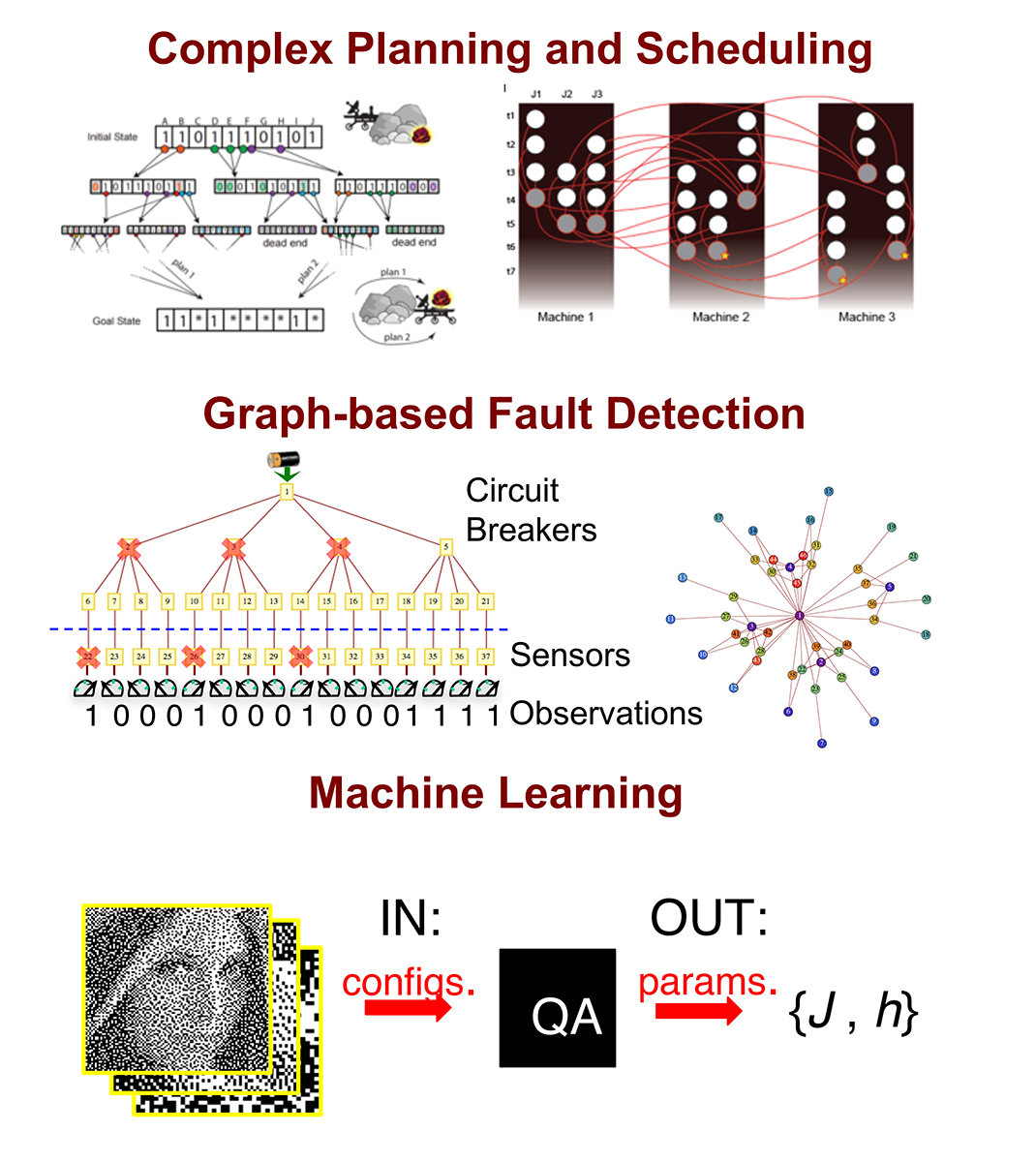
We make extensive use of NASA’s conventional supercomputers for simulations of quantum algorithms and systems, and for comparison of quantum and classical approaches to challenging computational problems. We also utilize the D-Wave quantum annealer housed in the NASA Advanced Supercomputing facility at Ames Research Center, in collaboration with Google and USRA.
Related Links
- A NASA Perspective on Quantum Computing: Opportunities and Challenges
- Compiling Quantum Circuits to Realistic Hardware Architectures using Temporal Planners
- From the Quantum Approximate Optimization Algorithm to a Quantum Alternating Operator Ansatz
- On the Readiness of Quantum Optimization Machines for Industrial Applications
- See the poster for this demonstration (PDF, 3.5MB), as shown in the NASA booth at SC17.
eleanor.rieffel@nasa.gov Rupak Biswas, NASA Ames Research Center
rupak.biswas@nasa.gov