
Interactive Exploration of Solar Magnetic Field Lines
Overview
Earth is vulnerable to bursts of X-rays and high-energy protons and electrons produced by energetic eruptions—flares and coronal mass ejections—from the solar surface. These space weather events can harm astronauts, disable satellites, disrupt radio communication and global positioning systems, and interfere with electricity distribution. Earth's space weather is driven by the evolution of the Sun's magnetic field, especially the emergence of new magnetic flux and active regions, commonly known as sunspots.
Researchers in the Physics and Astronomy Department at Michigan State University are using magnetohydrodynamics (MHD) simulations to model solar magneto-convection. The results of these simulations, coupled with advanced visualization techniques that support interactive exploration of magnetic field data, are helping to clarify the evolution of solar magnetic fields and to detect emerging magnetic features that drive the production of sunspots and solar eruptions.
This research furthers NASA’s scientific goals to understand the Sun, its variations, and its interactions with Earth and the solar system.
Project Details
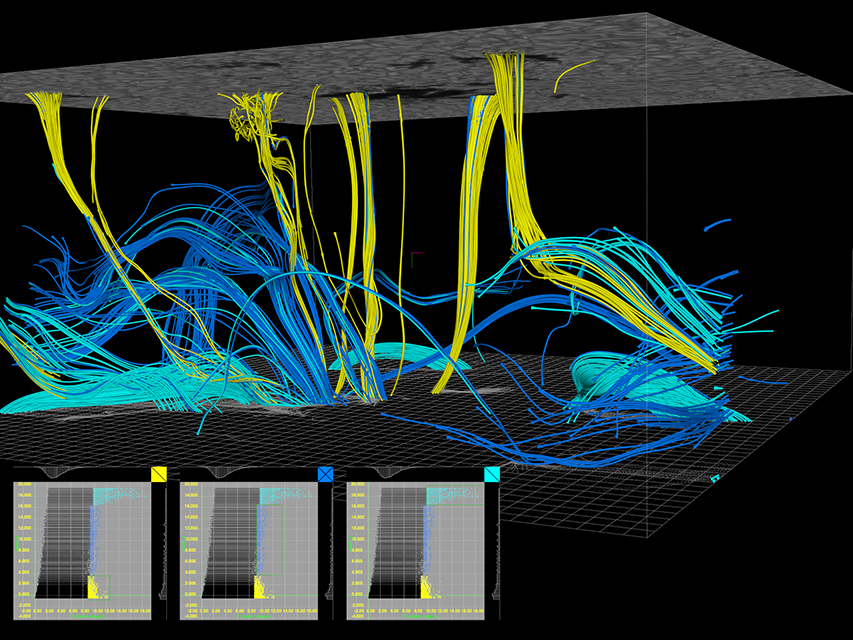
This project aims to model solar magneto-convection, and to understand its role in both the emergence of magnetic fields through the solar surface and in the formation of active regions. The outer 10% (two-thirds of the density scale heights) of the solar convection zone is modeled by numerically solving the conservation equations for mass, momentum, and energy plus the induction equation for the magnetic field using a three-dimensional, finite difference, MHD simulation code.
In the current approach to interpreting the simulation results, magnetic field lines are computed throughout the volume at different time steps, and an array of data attributes are sampled along each field line. These data attributes form the basis for a series of scatterplots, which, using a technique called "Linked Derived Spaces," are linked to a 3D rendering of the simulation volume. Selections within the scatterplots reveal 3D renderings of the associated magnetic field lines. This technique offers a new, highly exploratory approach to analyzing the simulation data.
Results and Impact
The solar magneto-convection models have helped researchers identify key processes involved in the production of sunspots, flares, and coronal mass ejections. Our advanced visualization techniques are enabling researchers to further investigate these complex processes by identifying new features and phenomena embedded within their models.
Why HPC Matters
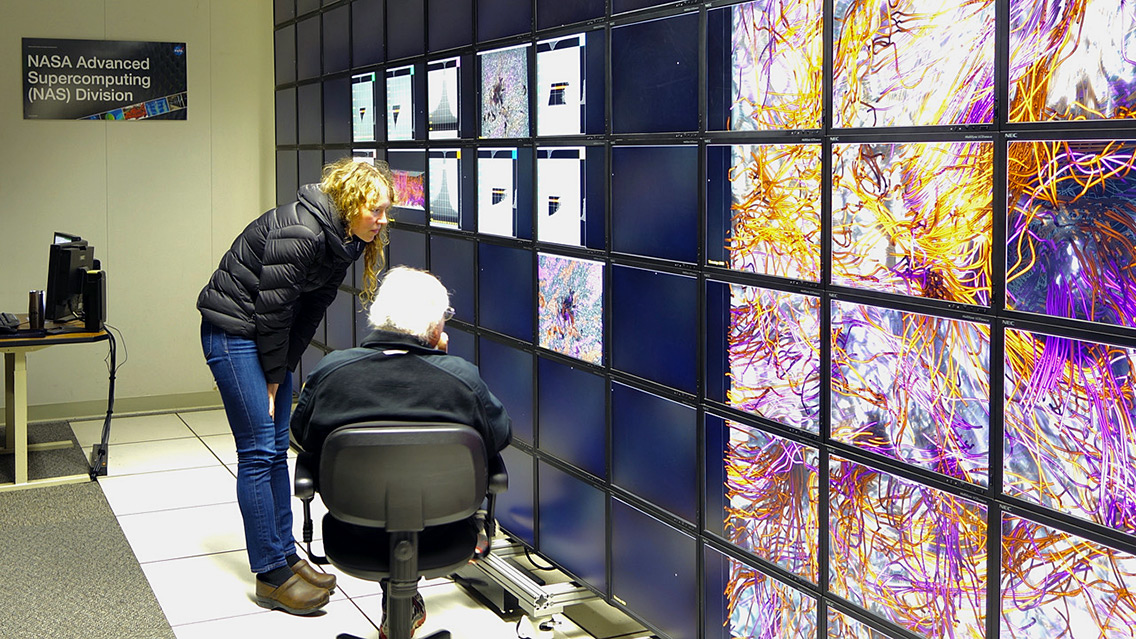
The MHD simulations are being run on 4,032 cores of the Pleiades supercomputer at the NASA Advanced Supercomputing (NAS) facility, at NASA’s Ames Research Center. Multi-processor computers such as Pleiades are necessary to simulate magneto-convection with large enough dimensions to capture the key features and processes under study.
Our visualization software was developed by the NAS visualization group, in collaboration with Physics and Astronomy researcher Dr. Robert Stein (MSU). The software takes advantage of the NAS facility’s 128-tile hyperwall system for both the display and real-time analysis of data.
More Information
- NASA hyperwall Visualization System
- Data Analysis and Visualization Services
- MSU Department of Physics and Astronomy
- See the poster for this demonstration (PDF, 3.6MB), as shown in the NASA booth at SC17.
nina@cs.utah.edu Patrick Moran, NASA Ames Research Center
patrick.moran@nasa.gov