
Supercomputing Stars
Overview
Understanding how stars work is one of the greatest achievements of the human intellect, but not all of the science is known in detail. Like Earth’s climate, the physics of stars is too complex to be fully described by a simple theory. Instead, supercomputers are used to solve equations representing the events inside the stars and their atmospheres. While very powerful, today’s supercomputers can only begin to characterize the rich detail of stellar phenomena, but we can compute results that are both scientifically relevant and beautiful.
Project Details
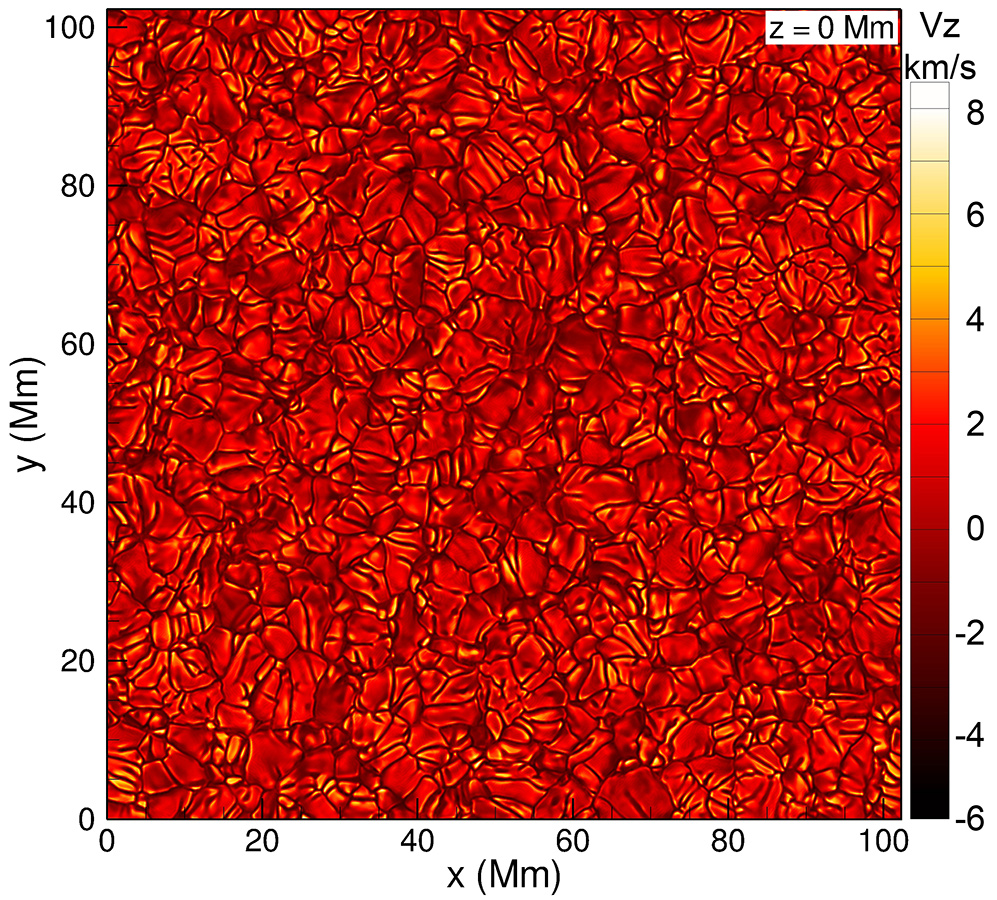
We used the Stellarbox radiative magnetohydrodynamics (MHD) code, developed in the NASA Advanced Supercomputing (NAS) Division at Ames Research Center, to run large simulations of stars more massive than the Sun on the Pleiades supercomputer. Because of their greater masses, the convective zones of these stars are thinner than the Sun’s, so the zones can be simulated in their entirety—from the surface down to the boundary of the stellar core—on current computers. Such deep simulations are not yet feasible for the Sun at the level of detail needed for complete confidence and understanding, but the simulation of more massive stars provides a valuable window into solar phenomena, as well as important astrophysical insights into these fascinating heavy stars.
Stellarbox solves the radiative MHD equations for stars of many sizes, masses, and rotation rates. A rectangular computational domain is used to simultaneously simulate different parts of the star, from the atmosphere, to the surface, and into the deep interior.
Results and Impact
Magnetic fields play a pivotal role in both the structure and evolution of stars, including, of course, the Sun. Stellar magnetic fields are known to result from moving conductive plasma—called the dynamo—but the details of how these dynamos work are not known. The Sun’s interior, where its dynamo operates, has been studied extensively for many years via helioseismological observations. And while much has been learned, some critical information is not available through helioseismology alone. Simulations are now filling these gaps in our knowledge and will ultimately help explain how stellar magnetism is created and maintained, leading to a better understanding of stellar winds and the interplanetary medium. Such improved understanding will affect many areas of space science, in particular predicting the occurrence of strong solar outbursts that can adversely affect both deep-space missions and near- and on-Earth technological assets..
Why HPC Matters
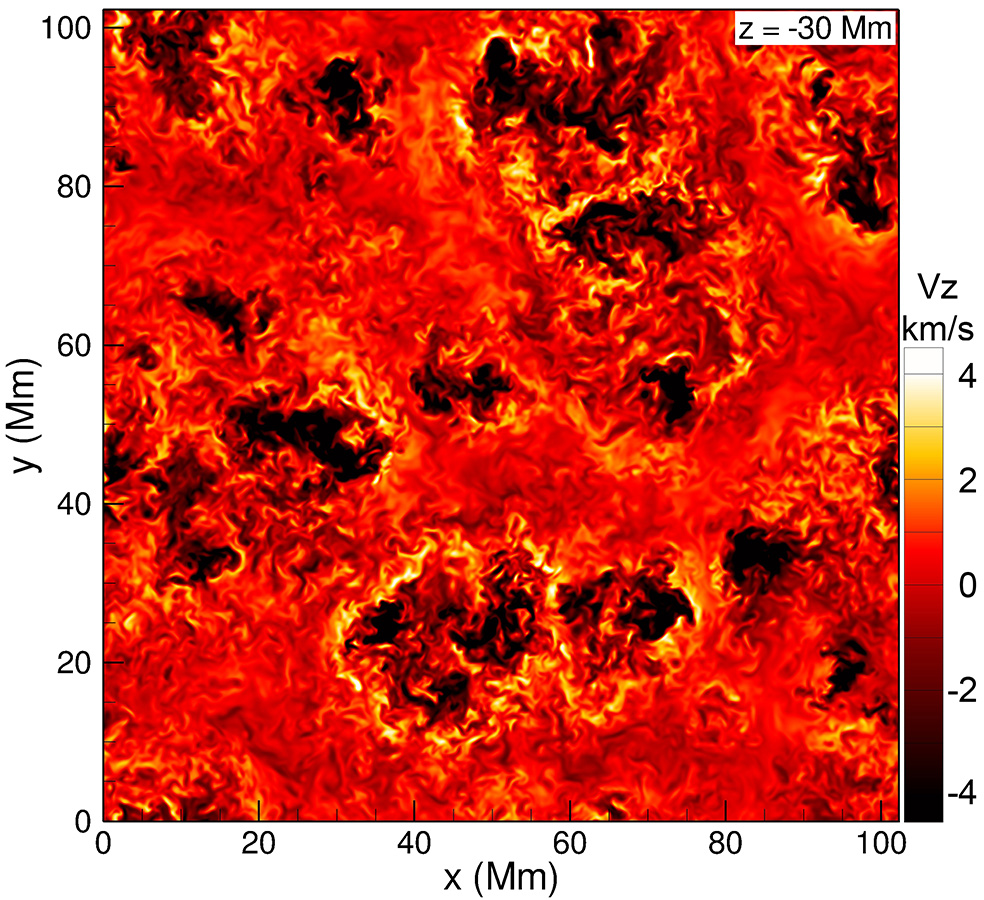
HPC is crucial to our understanding of solar and stellar physics: there is simply no other means for gaining the detailed knowledge required to achieve the results just described. We often use thousands of processors at a time on Pleiades, and many hundreds of runtime hours per case. Equally important to computing power and capability are other HPC components provided by the NAS Division: system availability for frequent testing; storage for the very large datasets resulting from our most detailed runs; and services, especially data visualization, which is so critical for analyzing the massive 4D datasets and discerning the scientific knowledge they contain.
More Information
- Heliophysics Modeling and Simulation Project
- See additional images/videos related to this demo in our media gallery.
- See the poster for this demonstration (PDF, 3.6MB), as shown in the NASA booth at SC17.
alan.a.wray@nasa.gov