
Lattice Boltzmann Simulations for Analyzing UAM Vehicle Propeller Noise
Overview
As urban air mobility (UAM) technology continues to develop, the market for novel vertical take-off and landing vehicles—including autonomous urban air taxis, and drones for applications such as package delivery, imaging, and surveillance—is growing rapidly. According to McKinsey & Company, commercial drones are projected to have an economic impact of $31–46 billion on the United States gross domestic product by 2026. While electrification of the propulsion system and complete autonomy for operational efficiency are key pacing items, noise continues to be the biggest roadblock to community acceptance and widespread adoption.
Computational prediction of aerodynamic noise for vertical lift vehicles has largely been based on lower-fidelity approaches, to date. While this approach has been extremely successful for predicting the tonal component of noise, the accuracy of existing semi-empirical approaches for predicting the broadband component of propeller noise is far from satisfactory. The Lattice Boltzmann solver within NASA’s Launch Ascent and Vehicle Aerodynamics (LAVA) framework is now being used to predict the aerodynamic noise generated by a small isolated drone propeller in hover derived from first principles. The computational efficiency of the solver is a key enabler for making it possible to routinely conduct first-principles aeroacoustic analysis of urban air taxis and drones.
Project Details

The project is part of an ongoing effort to significantly reduce the turnaround times for high-fidelity computational fluid dynamics simulations aimed at predicting aerodynamic noise from first principles—without compromising accuracy—using the Lattice Boltzmann method. The benefits of Lattice Boltzmann include ultra-high performance, minimal numerical dissipation, and the ability to simulate arbitrarily complex geometry in a relatively straightforward manner. High performance is due to significantly lower floating point operations relative to high-order Navier-Stokes algorithms, excellent data locality, and parallel scalability that is very nearly platform agnostic. The Lattice Boltzmann approach minimizes numerical dissipation while simultaneously retaining the robustness necessary for under-resolved engineering simulations at full-scale Reynolds numbers.
Results and Impact
Reducing time-to-solution without compromising accuracy within the context of propeller noise prediction from first principles is a key enabling technology for several emerging applications, including urban air mobility, that currently rely on semi-empirical approaches. The project also represents a further step towards advancing NASA’s Ames Research Center’s expertise in the Lattice Boltzmann approach and improving the NASA Advanced Supercomputing (NAS) Division’s in-house Lattice Boltzmann solver.
Why HPC Matters
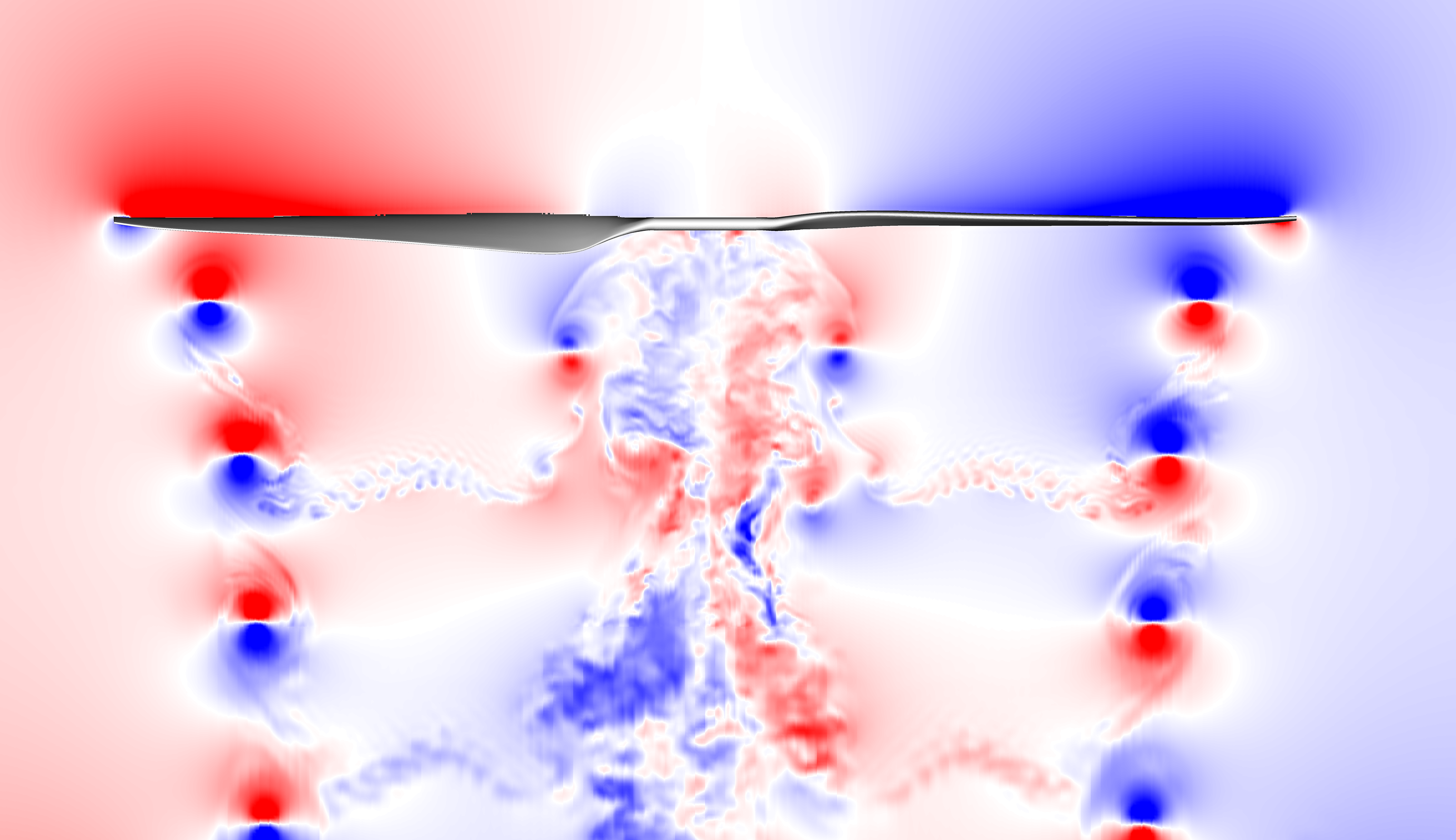
The simulations are run on hundreds of Intel Xeon Skylake cores on the Electra supercomputer at the NAS facility, and several terabytes of data are generated for each calculation. Data analysis and visualization are conducted using the facility’s high-performance systems and custom in-house software. High-performance computing is the key enabler that makes performing high-fidelity propeller noise simulations possible in useful turnaround times.
More Information
- See the poster for this demonstration (PDF, 2.0MB). As shown in the NASA booth at SC18.
michael.g.piotrowski@nasa.gov Cetin Kiris, NASA Ames Research Center
cetin.c.kiris@nasa.gov