
Using Retrorockets for Human Exploration of Mars
Overview
One long-term goal of human space exploration is to send astronauts to the Martian surface and return them safely back to Earth. Entry, descent, and landing technologies used in previous Mars missions are not scalable for delivering the massive payloads necessary for human Mars missions. One technology capable of sending heavy payloads directly to the surface of Mars is retropropulsion. The idea of using rockets to decelerate and land a spacecraft dates back to NASA experiments in the 1960s and 1970s. While the recent success of fly-back boosters by SpaceX and Blue Origins suggests the use of retrorockets is routine and well-understood, more research is needed to develop safe and reliable systems for potential crewed vehicles to Mars.
Project Details
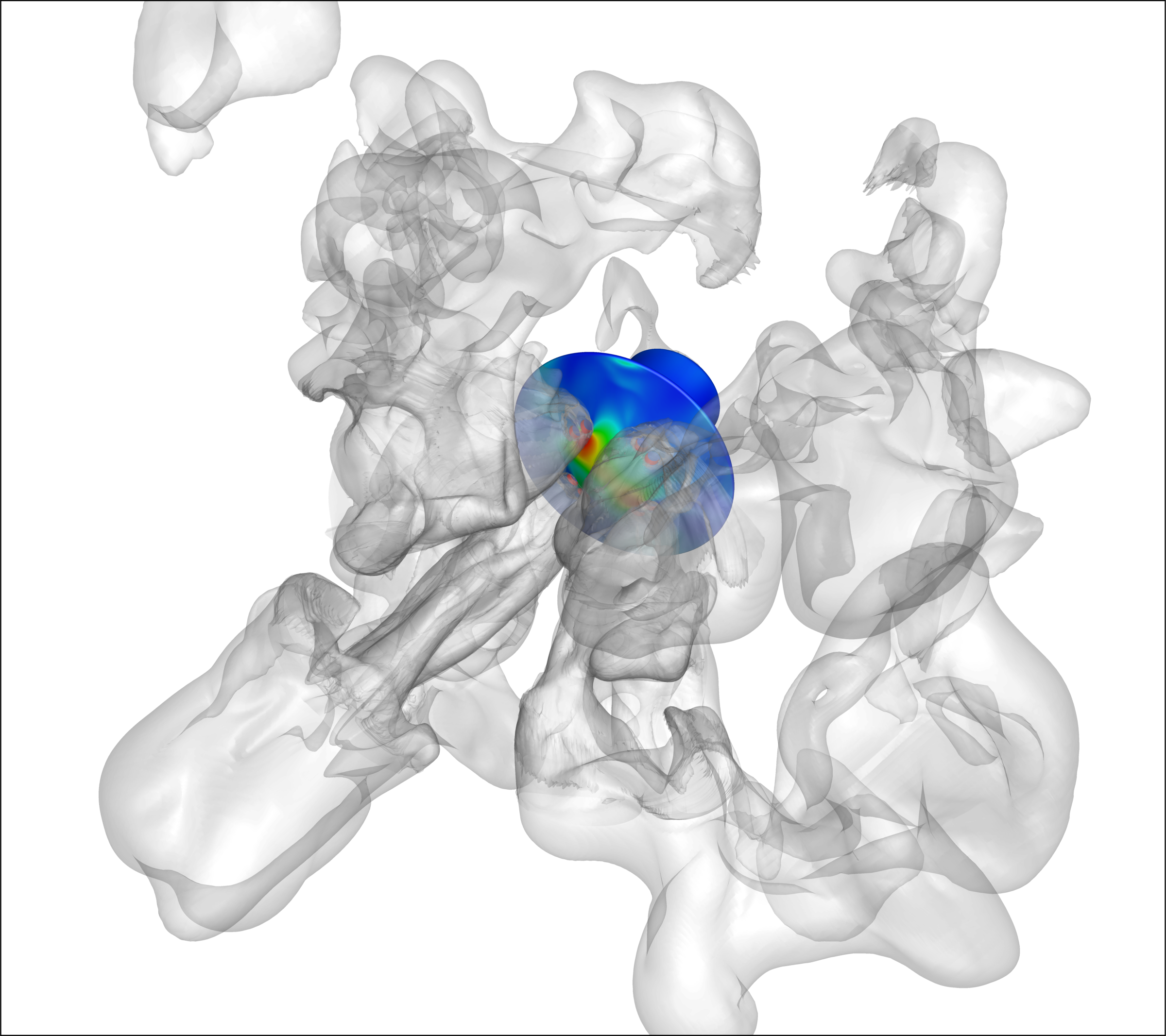
The Descent System Studies team at NASA’s Ames Research Center used the Data Parallel Line Relaxation (DPLR) Navier-Stokes code to model two baseline configurations with retropropulsion. These simulations were part of a larger group effort to characterize the aerodynamics and aerothermal performance of concept vehicles at various freestream conditions and rocket throttle settings during the descent phase of a Mars entry. The first set of simulations compared computational fluid dynamics (CFD) results from the DPLR, Loci-CHEM, FUN3D, and OVERFLOW codes. These comparisons showed differences in the predicted aerodynamics, and current computations are underway to understand the discrepancies among the different codes and the uncertainties associated with the estimated values.
Results and Impact
CFD provides a valuable tool for designers to analyze different concept vehicles quickly and at relatively low costs. Aerospace engineers can change various design parameters—such as the number and placement of rocket engines, throttle settings, and engine cant angles—to study the controllability and stability of a spacecraft using retropropulsion for powered descent and landing. The knowledge and insights gained from these simulations are being applied to refine the design and architecture of future human exploration missions to Mars.
Why HPC Matters
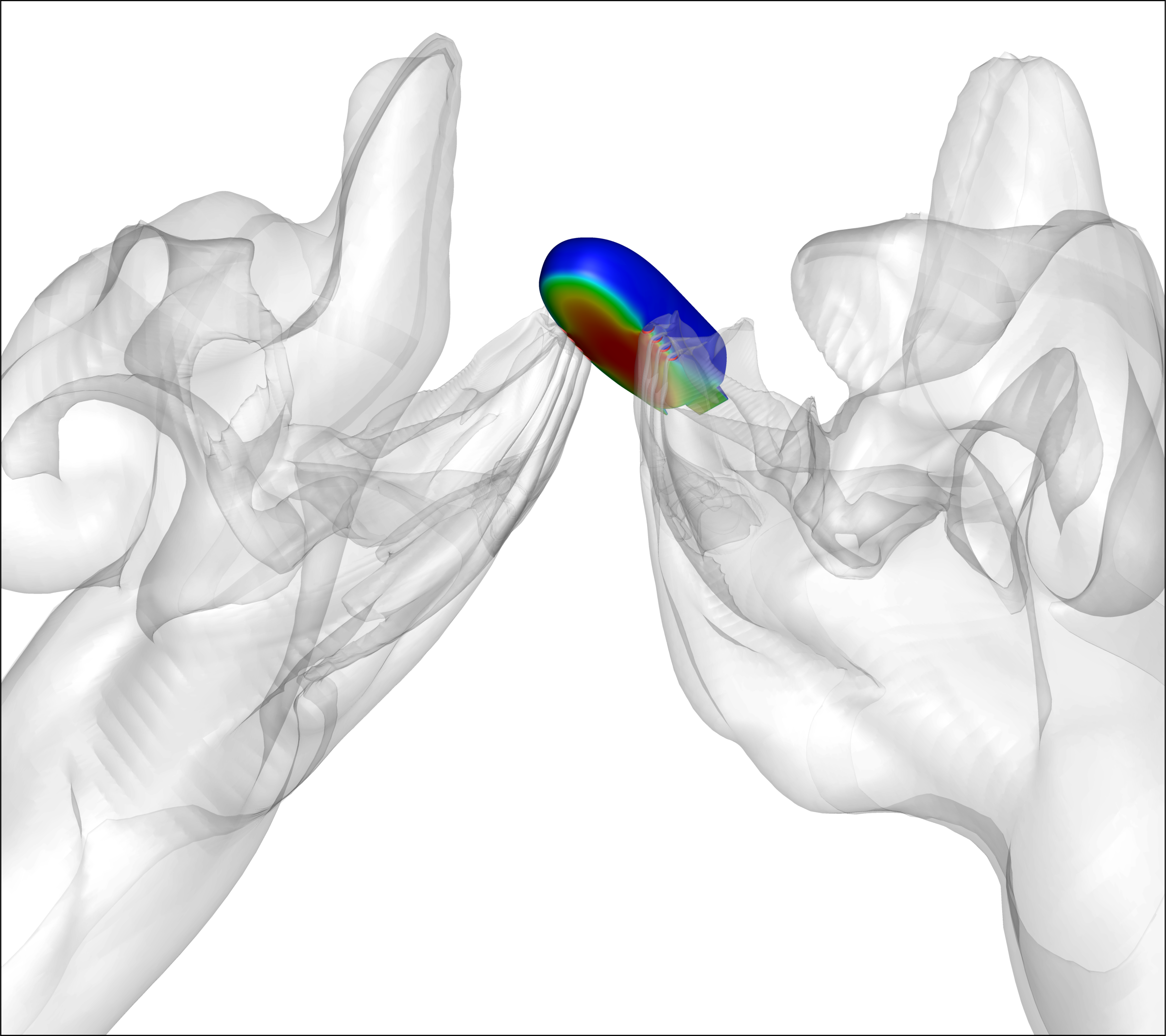
Simulations of various concept vehicles using retropropulsion were run on the Pleiades supercomputer at the NASA Advanced Supercomputing (NAS) facility. Due to the large computational meshes (over 100 million points) and time-averaging of the unsteady flowfield, a typical simulation required approximately 2,500 cores running for 100 wall-clock hours. Dozens of computations were run at different freestream conditions and rocket throttle settings to study the complex physics between the rocket plumes and the supersonic freestream. These high-fidelity simulations are only feasible on a massively parallel supercomputer system like Pleiades, and they are essential in the design process of any space exploration mission.
More Information
- See the poster for this demonstration (PDF, 1.8MB). As shown in the NASA booth at SC18.
chun.y.tang@nasa.gov