
Understanding the Amazon Rainforests Using Machine Learning
Overview
The Amazon rainforest represents the largest tropical ecosystem on the planet, storing about 100 billion tons of carbon in woody biomass, and accounting for approximately 15% of the global net primary production. There is a growing concern among the scientific community that in a progressively warming and drying climate, the Amazon rainforests may exhibit reduced photosynthetic activity and suffer from higher rates of tree mortality, which can lead to catastrophic consequences—including extensive grass invasion and increased likelihood of future fires—due to the extensive release of carbon into the atmosphere. In order to predict the effect of climate change on the health of these forests, it is essential to quantify how various climatic factors, such as rainfall and temperature, affect the vegetation in these regions.
In this work, we have adopted a machine learning and optimization-based approach for quantifying the governing equation of climate-vegetation dynamics in the Amazon, without any significant assumptions on the structure of the equation discovered. We show how our discovered equations help explain the various, often divergent, theories about the future of the rainforests, as well as explain the observations made by NASA satellites in different regions.
Project Details
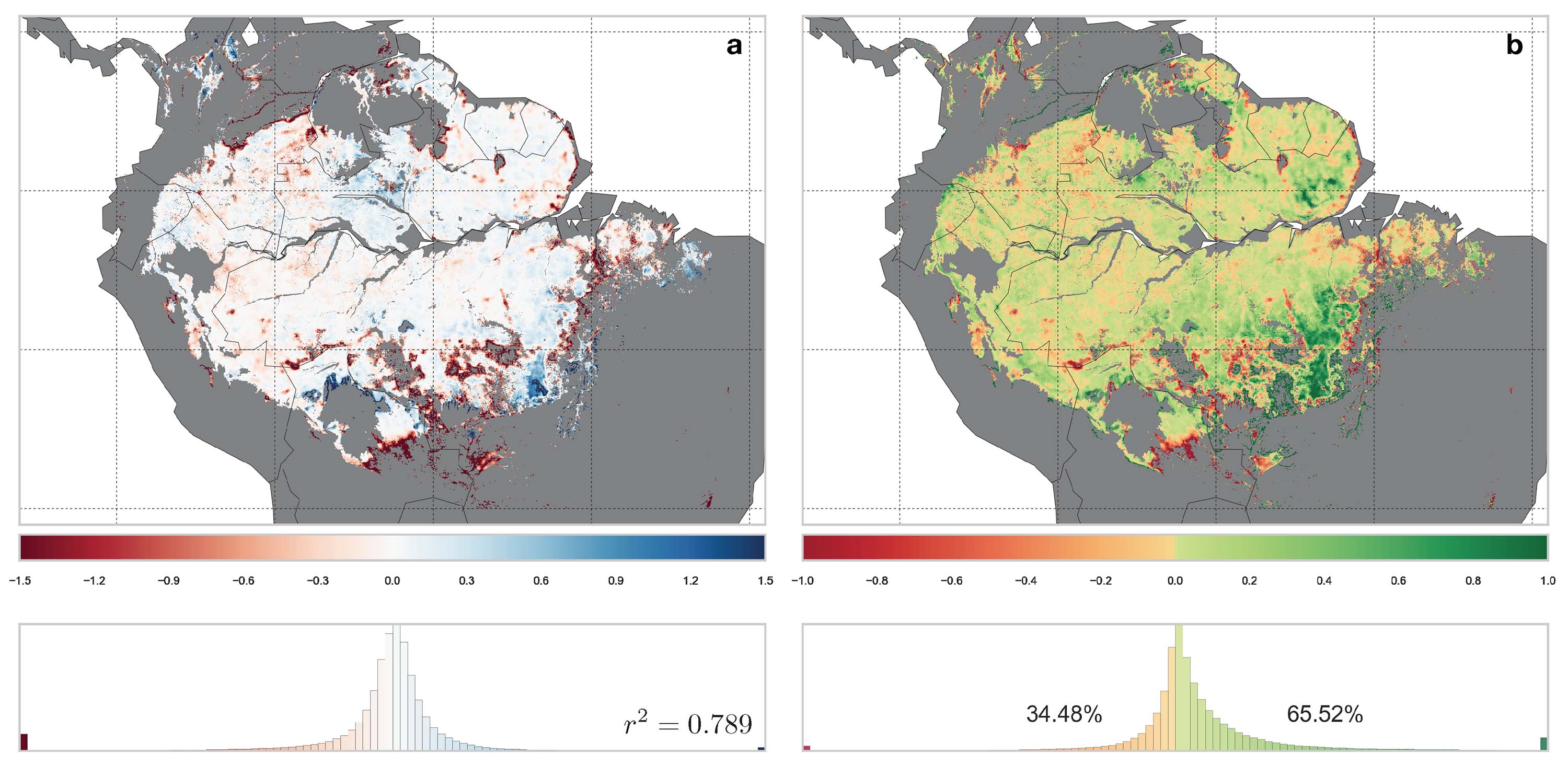
We use satellite-derived observations of precipitation, land surface temperature (LST), and Normalized Difference Vegetation Index (NDVI) to quantify the dependency of vegetation greenness in the Amazon on precipitation and temperature. The LST and vegetation values are derived from Collection 6 of the Moderate Resolution Imaging Spectroradiometer (MODIS), which is the primary source of data for vegetation-related studies. Precipitation values are taken from NASA’s Tropical Rainfall Measurement Mission (TRMM).
Simple regression techniques may not be able to accurately explain climate-vegetation interactions in the entire Amazon region because of the standard linearity assumption among the climate variables and vegetation and the uniform distribution assumption over a large geographic region. We use genetic-programming-based symbolic regression to verify our hypothesis. This data-driven approach learns nonlinear relationships while making minimal assumptions about the structural form of the underlying system, and the constructed models are optimized not only to accurately explain the data but also to be easily interpreted.
Results and Impact
These models allow us to discover, for the first time, unknown but ecologically meaningful interactions between remotely sensed climatic factors and vegetation productivity in the Amazon. They also help us correctly infer the state of vegetation in the Amazon, given climate projections that accurately mimic real-world observations. Our analysis shows that increased temperature is a more important factor than reduced precipitation in causing loss of photosynthetic capacity. Our analysis also reveals regionally specific vegetation dynamics, demonstrating that the mean temperature of the season, which tends to be the warmest in a given region, is a limiting factor for canopy greenness.
Why HPC Matters
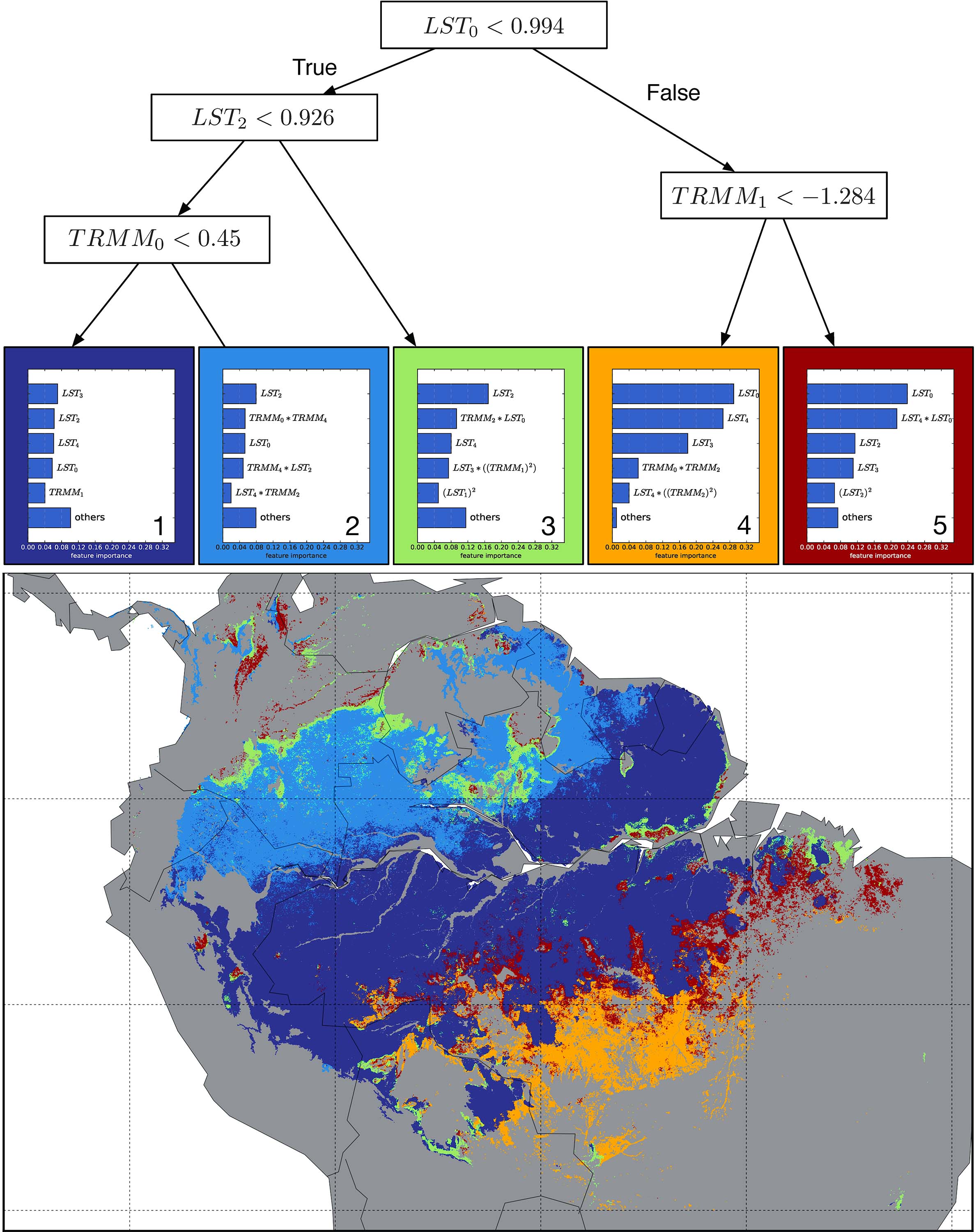
Genetic programming requires a heuristic search in the space of all candidate solutions for a given optimization problem, and is inherently as powerful as the amount of computing resources available for running parallel searches. This project benefitted from the use of the NASA Advanced Supercomputing (NAS) facility infrastructure in two ways: we could directly access NASA Earth Exchange (NEX) data pools for all our data needs; and we used Pleiades nodes for our high-memory data preprocessing needs and for running our genetic programming search algorithm.
More Information
- See the poster for this demonstration (PDF, 1.8MB). As shown in the NASA booth at SC18.
kamalika.das@nasa.gov