
Simulations Provide Insight into Shock Wave/Boundary-Layer Interactions
Overview
Shock wave/boundary-layer interactions (SBLIs) occur in aircraft and space vehicles that travel at transonic, supersonic, and hypersonic speeds. SBLIs happen when strong pressure waves disrupt near-wall flow, creating excessive unsteady aerothermal loads that can compromise structural integrity, cause component failure, and result in loss of vehicle control surfaces. In propulsion systems, SBLIs can cause reversed flow and distortion, reducing engine efficiency. Due to their unsteady nature, it is extremely difficult to obtain accurate predictions of SBLIs, which remains an outstanding challenge in the field of computational fluid dynamics. In this work, we address this gap by performing wall-resolved large-eddy simulation of an SBLI and comparing the results with experimental data to validate the simulation approach.
Project Details
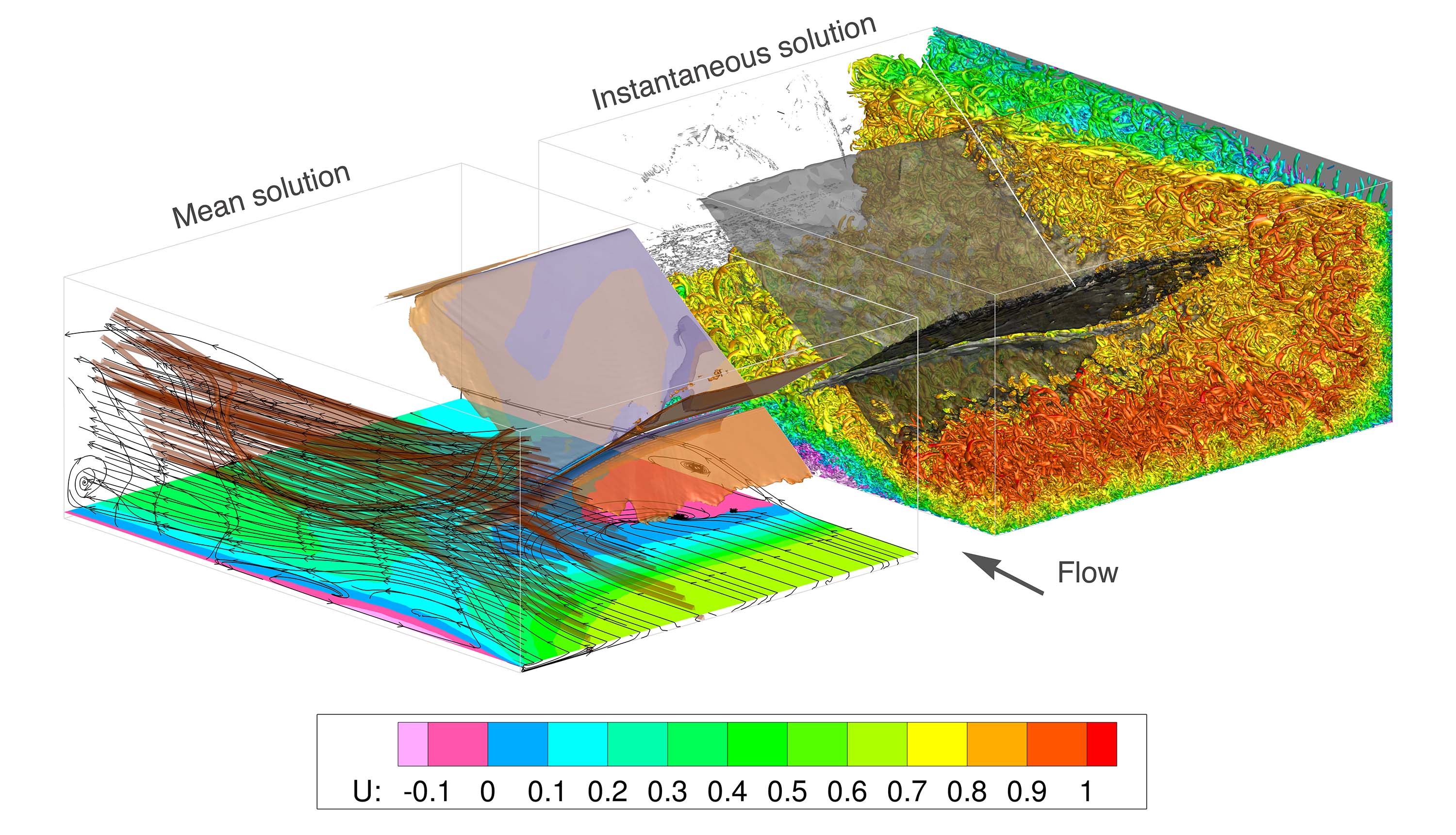
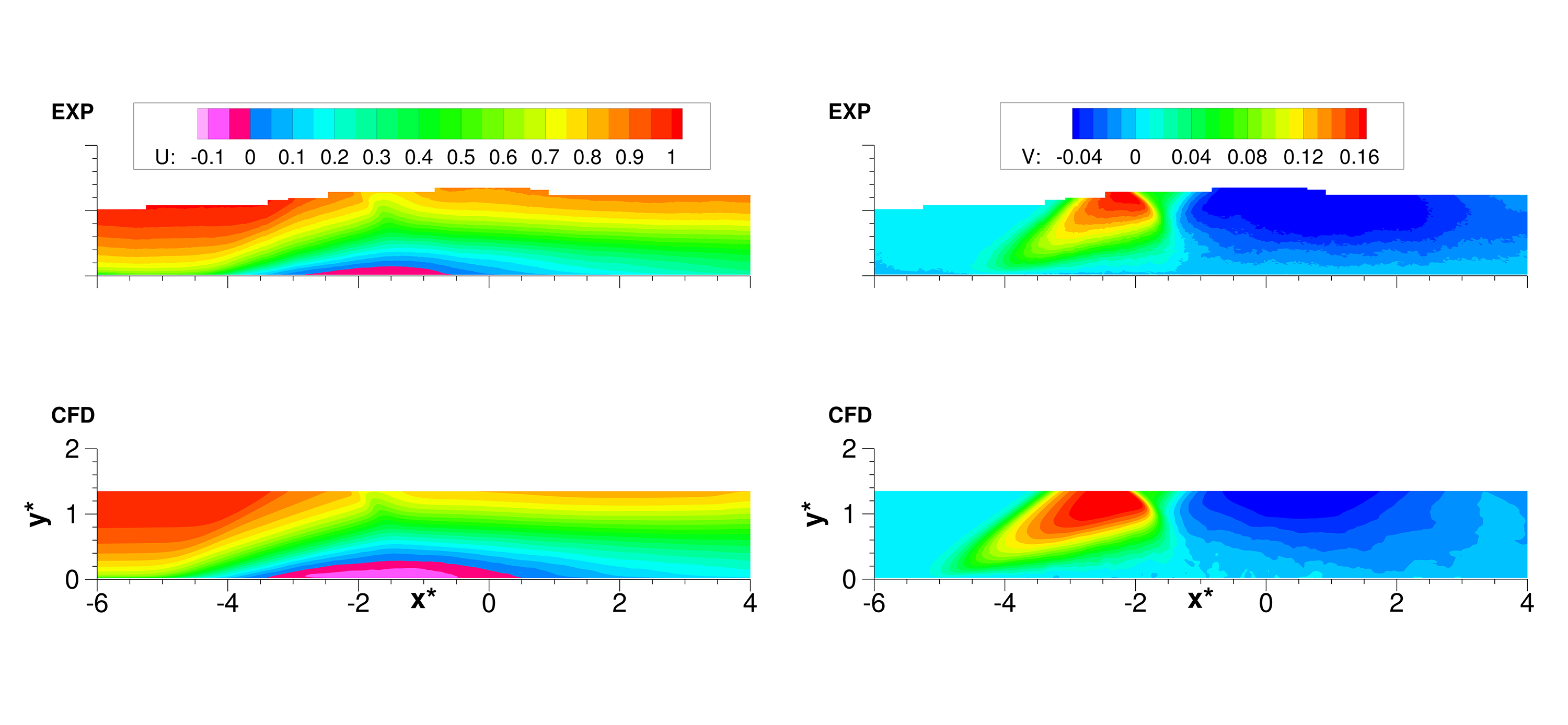
Funded by NASA’s Transformational Tools and Technologies Project, part of the Aeronautics Research Mission Directorate’s Transformative Aeronautics Concepts Program, this work addresses the need to develop and advance physics-based tools and methods to reduce the predictive error in simulations of phenomena like SBLIs. Our wall-resolved large-eddy simulation (LES) forgoes the simplifications common in turbulence modeling and directly solves Navier-Stokes equations to provide insight into the governing physics of SBLIs. The results are validated against experimental data to assess the mean velocity and turbulent stress predictions. The simulation also provides a rich database to study characteristic frequencies and length scales associated with SBLIs. Calculated values of the Reynolds stress transport terms will aid future turbulence model development.
Results and Impact
While others have applied wall-resolved large-eddy simulation to a variety of SBLI configurations, ours is the first application of this method to an impinging SBLI with two sidewalls. Such SBLIs are common among components of propulsion flow paths like inlets and isolators where corner separation has a dominant role, so including the sidewalls is critically important for capturing the key physics and reducing the predictive error in the simulation. When compared with experimental data, the simulation shows improvement over previous simulations, some of which ignore the sidewalls for simplicity. Moreover, a comparison of the Reynolds stress shows remarkable quantitative agreement with the experiment. Insight gained from this work will enable wall-resolved large-eddy simulations of complex SBLI configurations and aid development of next-generation turbulence models for faster and more reliable prediction of SBLIs.
Why HPC Matters
High-fidelity calculations such as wall-resolved large-eddy simulations require significant computational and storage resources for validation-quality predictions. In this case, the simulation domain was decomposed into 600 million elements and used 5,600 processors of NASA’s Electra supercomputer. Five million processor-hours were used to obtain a solution corresponding to a few shock cycles, which gives a good representative mean solution database. However, up to 10 times as many processor-hours will be needed to obtain a representative temporal database. Approximately 200 terabytes of mean and temporal data will be collected for analysis and visualization, which is possible only with the NASA Advanced Supercomputing facility’s high-performance computing (HPC) resources and services.
What's Next
Numerical data generated from this simulation will be used by researchers to identify shortcomings in existing turbulence model assumptions and approximations. The completeness of the numerical database will also enable testing of new theories of turbulence and the application of machine learning to uncover unforeseen relationships between flow parameters.
More Information
- Transformational Tools and Technologies Project
- See the poster for this demonstration (PDF, 1.8MB). As shown in the NASA booth at SC18.
manan.vyas@nasa.gov Datta Gaitonde, The Ohio State University
gaitonde.3@osu.edu