
Simulation of Shuttle SRB Ignition Transient with Sound Suppression Water
Overview
Starting with space shuttle mission STS-2 on November 12, 1981 until the end of the Space Shuttle Program with STS-135, on July 8, 2011, NASA employed the use of water to quiet the acoustic energy loading that occurs from the liquid main engines (RS-25s) and the solid rocket boosters (SRB) ignition. The Ignition Overpressure and Sound Suppression (IOP/SS) water system consisted of six “rain birds” to protect the top of the mobile launcher, approximately 60 water nozzles surrounding the liquid engines’ hole, three levels of water in each SRB hole, and “water bags” surrounding the SRB and covering the SRB drift hole. The IOP/SS water system used 350,000 gallons of water in 41 seconds and started flowing 7 seconds before ignition of the SRBs. The system was designed and implemented entirely through empirical analysis and scale-model testing, as simulating this environment with computational fluid dynamics (CFD) was impossible—until recent innovations in CFD became available.
Project Details

Over the past few years, CFD researchers at NASA’s Marshall Space Flight Center (MSFC) have demonstrated the ability to model the complex interaction of water and supersonic plumes with MSFC’s workhorse CFD flow solver Loci/CHEM, using its “real fluids” module; and applied it to the ignition transient of a single SRB with the IOP/SS water system. The validation of this new tool set required running many simulations where the sensitivity of certain numerical parameters (for example, physical time step, number of Newton sub-iterations, and mesh density) affected the predicted flow field. Validation of these numerous simulations was performed both qualitatively, looking at the water that splashes above the deck and comparing that with high-speed video, and quantitatively, comparing the CFD predicted pressures along the mobile launcher hole with data that was measured during a launch.
Results and Impact
Loci/CHEM‘s new tool set was able to predict the correct timings of the plumes of water mist that exit the top of the SRB holes and the peak pressures inside those holes. By closely analyzing the results of the CFD simulations, the NASA Marshall researchers determined that the exact cause of the high wall pressures is caused by lower IOP/SS temporarily stopping, and then pushing the SRB plume towards the wall. With 3.1 million pounds of thrust pushing on the water, this only lasts a fraction of a second—but still long enough to cause pressure spikes on the wall.
Why HPC Matters
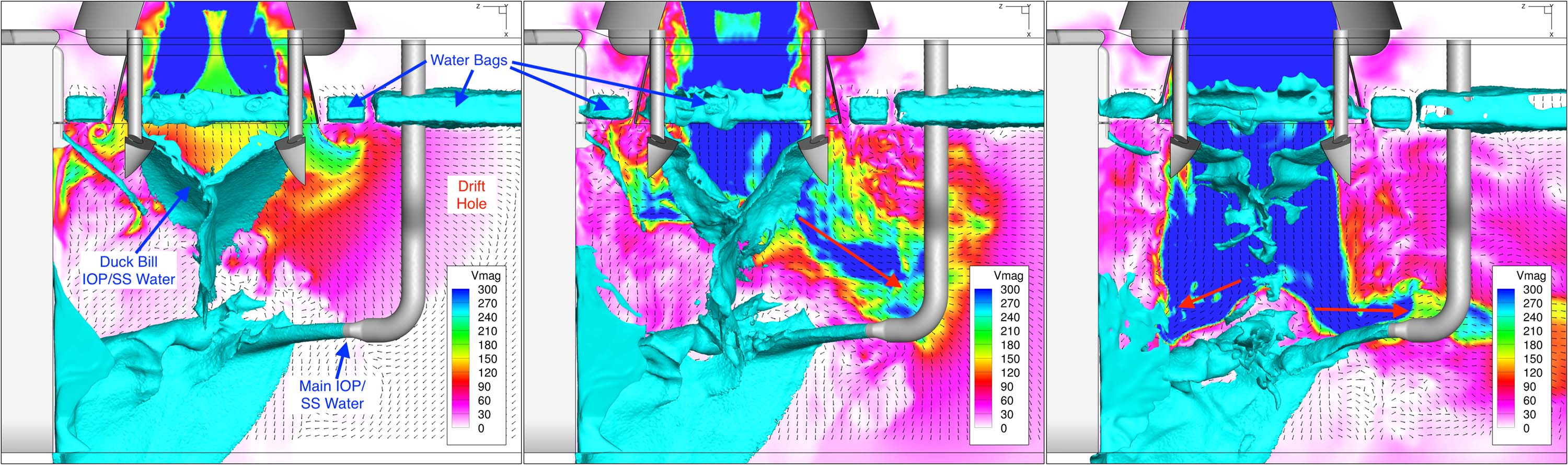
Using a large supercomputer, such as the Pleiades system at NASA’s Ames Research Center, is essential for these simulations. Because of the complex multi-phase flow, a half-vehicle mesh containing 114 million cells was used. A standard simulation using 200 Intel Xeon Broadwell nodes, with 28 cores per node, took approximately two months to complete—using over 5 million processor-hours. A total of five different simulations were performed using a total of about 27 million processor-hours; without Pleiades, these simulations might have taken a year to perform. During the project, a total of 40 terabytes of data was generated.
What's Next
This new Loci/CHEM tool set is now being applied for NASA’s newest and biggest rocket, the Space Launch System. Simulations that include the redesigned mobile launcher and IOP/SS system are currently running on Pleiades, and engineers at MSFC have used over 69 million processor-hours to date to complete work, as the first launch approaches.
More Information
- See the poster for this demonstration (PDF, 2.0MB). As shown in the NASA booth at SC18.
andrew.b.weaver@nasa.gov Jeff West, NASA Marshall Space Flight Center
jeffrey.s.west@nasa.gov Jared Gudekauf, NASA Marshall Space Flight Center